
How to type faster: home row, no looking, accuracy first
The answer to how to type faster is touch typing. Rest your fingers on the home row, find it by the bumps on F and J, give each finger its own column of keys and stop looking down. Keep accuracy high before pushing speed, practise in short daily sessions, and check your speed once a week with a one-minute test.
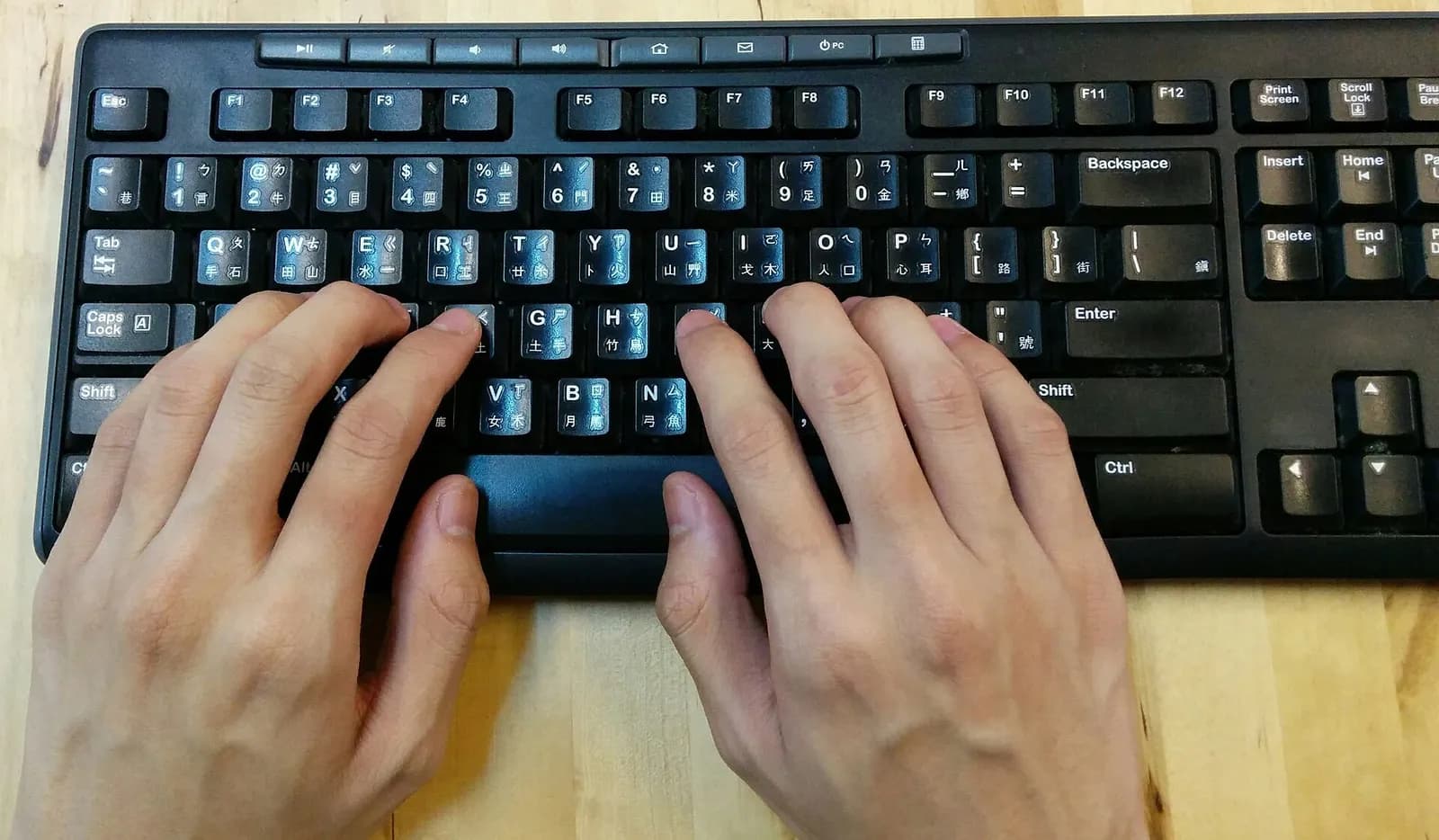
Most slow typists are short of a system, not of effort. The eyes travel between keyboard and screen, one or two fingers reach for half the keys, and every error costs a backspace. The method below removes those losses one at a time.
Key ideas
- Home position is A, S, D, F for the left hand and J, K, L and the semicolon for the right; the bumps on F and J let you find it by touch.
- One finger per column turns every key into a fixed, repeatable movement.
- Accuracy comes first: in a large study, faster typists also made fewer errors.
- Short sessions spread over many days teach more than one long session.
Start from the home row
Place the left fingers on A, S, D and F and the right fingers on J, K, L and the semicolon, with the thumbs over the space bar. Most keyboards have a small raised bump or bar on F and J, so the index fingers can find home without a glance.
Every reach starts from this position and returns to it. That return is what makes touch typing possible: the hands always know where they are.
One finger per column, eyes on the screen
Each finger owns a slanted column of keys above and below its home key. The left index finger covers F and G and the keys above and below them; the right little finger reaches up to P. When a key always belongs to the same finger, the movement becomes muscle memory instead of a search.
Then stop looking at the keyboard. Expect speed to fall at first: the encyclopedia entry on touch typing notes that early performance is far lower than with hunt-and-peck and that a sharp drop at the beginning is common. Speed returns gradually with routine practice, and 60 words per minute or more is achievable.
Accuracy before speed, in short daily sessions
Type slowly enough to make almost no mistakes. A 2018 study of 168,000 typists by Aalto University and the University of Cambridge found that faster typists made fewer errors, and the fastest pressed the next key before releasing the previous one in 40 to 70% of keystrokes. That flow grows out of clean, confident movements, not out of rushing.
Practise little and often. In a 1978 experiment by Baddeley and Longman, postmen who learned to type in shorter sessions spread over several days learned better than those trained in longer blocks. A short session every day fits that finding; keep at it until no key feels weak.
Once a week, take a one-minute speed test under the same conditions and note words per minute and accuracy. Weekly numbers show the trend; daily ones mostly show the mood of the day.
Practise the method step by step
The free touch typing trainer at VITON13 SCHOOL follows this order in eight short lessons: anchor keys, home row centre, whole home row, top row centre, whole top row, bottom row, words, sentences. A lesson passes at 94% accuracy or more, so speed never runs ahead of precision.
A Fingers switch colours each finger's keys, which makes the one-finger-per-column rule visible while you learn. The trainer is free and needs no account.
In everyday language
Learning to touch type is like learning to drive without staring at the pedals. At first it feels slower than looking; then your feet know where to go and your eyes stay on the road.
Try it yourself
Open the touch typing trainer, turn on the Fingers switch, and complete the first lesson on the anchor keys without looking at your hands.
Expected result
The lesson passes when accuracy reaches 94% or higher; if it does not, repeat it at a slower, even pace.
Check your answer: You finished a lesson quickly but at 90% accuracy. What should change in the next attempt?
Slow down until errors almost disappear. The lesson needs at least 94% accuracy, and clean, repeatable movements are what later turn into speed.
Questions
How long does it take to type faster?
It depends on how regularly you practise more than on talent. Expect a slower phase while the new finger positions settle, then steady gains from short daily sessions; a weekly one-minute test shows the trend.
Do I have to use all ten fingers?
Not strictly. The 2018 Aalto and Cambridge study found that some self-taught typists using fewer fingers were as fast as touch typists. Ten fingers on the home row remain the most systematic way to learn typing without looking.
Start the first VITON13 SCHOOL typing lesson today, keep accuracy at 94% or above, and take the one-minute speed test once a week.
Sources and further reading
- Wikipedia: Touch typing ↗Sources checked:
- Wikipedia: Distributed practice (Baddeley and Longman, 1978) ↗Sources checked:
- University of Cambridge: What makes a faster typist? (2018 study of 136 million keystrokes) ↗Sources checked: