
Flags of Europe: all 44 country flags, the patterns behind them and the look-alikes
Europe has 44 sovereign countries in the UN’s M49 list (43 UN members plus the Holy See), and most of their flags follow three patterns: tricolours of three equal stripes (France, Italy, Germany), Nordic crosses shifted towards the pole (Denmark, Sweden, Norway, Finland, Iceland) and the white, blue and red often called the pan-Slavic colours (Russia, Slovakia, Slovenia).
European flags look simple, yet they are some of the easiest in the world to mix up: three countries fly blue, yellow and red stripes, and three more run white, blue and red from top to bottom. This guide follows the UN statistical list of countries (M49), shows the three patterns behind most of Europe’s flags, describes every country’s flag in one line, takes the look-alikes apart one detail at a time and states carefully what is known about the oldest national flag. At the end you can test yourself in the free flags quiz at VITON13 SCHOOL.
Key ideas
- The UN’s M49 standard places 44 sovereign countries in Europe: 43 UN members and the Holy See. Cyprus, Turkey, Georgia, Armenia and Azerbaijan are counted in Western Asia.
- Three patterns cover most of them: tricolours, Nordic crosses (Denmark, Finland, Iceland, Norway, Sweden) and the white, blue and red often called the pan-Slavic colours.
- The groups people confuse most are Romania, Andorra and Moldova; Ireland and Italy; the Netherlands and Luxembourg; and Russia, Slovakia and Slovenia.
- Guinness World Records lists Denmark’s Dannebrog as the oldest continuously used national flag; a white cross on red is attested for Danish kings from the 14th century.
How are the flags of Europe built?
Most flags of Europe follow one of three patterns, and once you see the pattern the colours are easy to remember. The commonest is the tricolour, three stripes of equal width. Vertical tricolours hang in columns from the pole: France (blue, white, red), Italy (green, white, red), Ireland (green, white, orange), Belgium (black, yellow, red) and Romania (blue, yellow, red). Horizontal ones lie in rows: Germany (black, red, gold), the Netherlands (red, white, blue), Hungary (red, white, green), Bulgaria (white, green, red), Lithuania (yellow, green, red) and Estonia (blue, black, white). Austria’s red, white and red uses only two colours, and Poland, Monaco and Ukraine get by with two stripes.
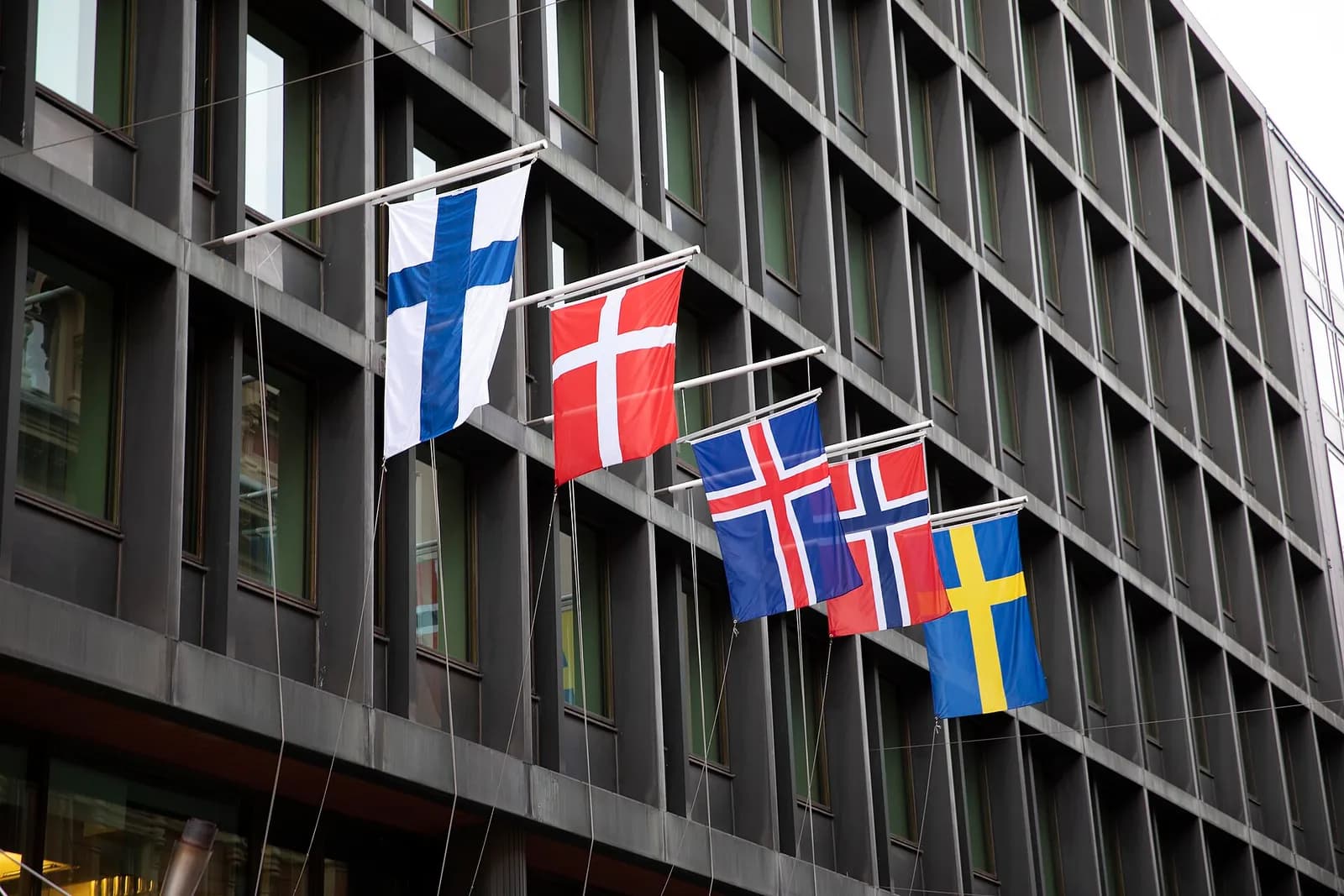
The second pattern is the Nordic cross: a cross that runs to the edges of the flag, with its upright bar shifted towards the pole. All five independent Nordic countries use it: Denmark (a white cross on red), Sweden (yellow on blue), Finland (blue on white), Norway (a blue cross edged in white on red) and Iceland (a red cross edged in white on blue). The design began with Denmark’s flag, the Dannebrog. A white cross on red is attested as the banner of the Danish kings from the 14th century, and its earliest undisputed colour picture is in the Gelre Armorial of about 1340–1370; the story that it fell from the sky at the Battle of Lindanise in 1219 is a legend first written down in the 16th century. Guinness World Records lists the Dannebrog as the oldest continuously used national flag, which is the fairest way to state the claim. Norway adopted its flag in 1821, Iceland in 1915 and Finland in 1918, and Norway’s was the first Nordic cross with three colours.
The third pattern is a set of colours rather than a layout: white, blue and red, often called the pan-Slavic colours. Russia (white, blue and red stripes), Slovakia and Slovenia (the same order with a coat of arms), Serbia (red, blue, white), Croatia (red, white, blue with a chequered shield) and Czechia (white over red with a blue triangle at the pole) all use them. Not every Slavic country does: Poland is white and red, Ukraine blue and yellow, Bulgaria white, green and red, and Belarus red and green.
What does each country’s flag in Europe look like?
Here is every European flag in one line, grouped by the four sub-regions of the UN’s M49 standard. Western Europe: Austria, red, white, red horizontal stripes; Belgium, black, yellow, red vertical stripes; France, blue, white, red vertical; Germany, black, red, gold horizontal; Liechtenstein, blue over red with a gold crown near the pole; Luxembourg, red, white, light blue horizontal; Monaco, red over white; the Netherlands, red, white, blue horizontal; Switzerland, a square red flag with a white cross in the centre.
Northern Europe: Denmark, a white Nordic cross on red; Estonia, blue, black, white horizontal; Finland, a blue Nordic cross on white; Iceland, a red Nordic cross edged in white on blue; Ireland, green, white, orange vertical; Latvia, dark red with a narrow white horizontal band; Lithuania, yellow, green, red horizontal; Norway, a blue Nordic cross edged in white on red; Sweden, a yellow Nordic cross on blue; the United Kingdom, the Union Jack, with the red cross of St George over the white saltire of St Andrew and the red saltire of St Patrick on blue.
Eastern Europe: Belarus, red over green with a red and white ornament at the pole; Bulgaria, white, green, red horizontal; Czechia, white over red with a blue triangle at the pole; Hungary, red, white, green horizontal; Moldova, blue, yellow, red vertical with an eagle coat of arms; Poland, white over red; Romania, blue, yellow, red vertical; Russia, white, blue, red horizontal; Slovakia, white, blue, red horizontal with a shield bearing a white double cross on three blue hills; Ukraine, blue over yellow.
Southern Europe: Albania, a black double-headed eagle on red; Andorra, blue, yellow, red vertical with a coat of arms; Bosnia and Herzegovina, a yellow triangle and a line of white stars on blue; Croatia, red, white, blue horizontal with a chequered red and white shield; Greece, nine blue and white stripes with a white cross in the blue corner; the Holy See, a square flag of yellow and white with crossed keys and a papal tiara; Italy, green, white, red vertical; Malta, white and red halves with the George Cross in the corner; Montenegro, a gold eagle on red inside a gold border; North Macedonia, a yellow sun with eight rays on red; Portugal, green and red with an armillary sphere and a shield; San Marino, white over light blue with a coat of arms; Serbia, red, blue, white horizontal with a coat of arms; Slovenia, white, blue, red horizontal with a small shield in the upper corner; Spain, red, yellow, red, the yellow twice as wide, with a coat of arms.
Which flags of Europe are easy to confuse?
The hardest trio is Romania, Andorra and Moldova, all with vertical blue, yellow and red stripes. Romania’s flag is plain, with three equal stripes. Andorra’s has a coat of arms in the centre and a yellow stripe slightly wider than the other two. Moldova’s carries an eagle holding a shield with an aurochs head, and the flag is longer, twice as wide as it is high. Outside Europe, Chad’s flag is almost identical to Romania’s, which is why the two appear side by side in the similar-flags comparison.
Ireland and Italy both start with green at the pole and white in the middle, but Ireland ends in orange and Italy in red; Ireland’s flag is also longer, 1:2 against Italy’s 2:3. Côte d’Ivoire, in Africa, reverses the Irish colours: orange at the pole, then white, then green. The Netherlands and Luxembourg are both red, white and blue from top to bottom: the Dutch flag has a darker red and blue, while Luxembourg’s is longer and its blue is a clear light blue.
Russia, Slovakia and Slovenia share the order white, blue, red, so look for a shield. Russia’s flag has none. Slovakia’s shield is large, sits towards the pole across all three stripes and shows a white double cross on three blue hills. Slovenia’s is smaller, in the upper corner, and shows the white peak of Mount Triglav under three yellow stars. Serbia reverses the order to red, blue, white. Poland and Monaco are another mirror pair: Poland is white over red, Monaco red over white.
How to learn the flags of Europe with a quiz
The fastest way to learn the flags of Europe is to sort them by pattern first and then drill the look-alikes side by side. Open the free flags tool at VITON13 SCHOOL and filter the gallery to Europe so that its flags appear together, then narrow them with the colour filter, for example to the flags with yellow, where the blue, yellow and red tricolours appear side by side. Click a flag to open its card with the country, the capital and the continent.
Next, open the similar-flags comparison, which puts close pairs such as Chad and Romania, Indonesia and Monaco or Ireland and Côte d’Ivoire next to each other, and look for the one detail that separates them. When the patterns feel familiar, start the quiz: choose Europe, guess the country from its flag with multiple choice or by typing the name, and keep an eye on your score. A round on the world map then shows where each country lies next to its neighbours.
In everyday language
Think of European flags as three families. The stripe family has three bands, the cross family has a cross pushed towards the pole, and the white-blue-red family shares the same three colours. Once you know the family, you only need one more detail, such as a stripe colour, a shield or the length of the flag, to name the country.
Try it yourself
Open the flags tool, filter the gallery to Europe and then by yellow, and open the cards of the flags that remain. Then play one quiz round on Europe with typed answers.
Expected result
Romania, Andorra and Moldova among the filtered flags, each card showing its capital (Bucharest, Andorra la Vella, Chișinău) and continent, and a quiz score you can try to beat in a second round.
Check your answer: A flag has three horizontal stripes, white, blue and red, and a shield with a white double cross on three blue hills. Which country is it?
Slovakia. Russia has the same stripes without a shield, and Slovenia’s smaller shield shows Mount Triglav under three yellow stars.
Questions
Is the blue flag with twelve gold stars a country flag?
No. The blue flag with a circle of twelve gold stars is the flag of Europe used by the Council of Europe and the European Union. It does not belong to any country, so it is not one of Europe’s 44 national flags.
Why are Cyprus, Turkey and Georgia not in this list?
The UN M49 standard places Cyprus, Turkey, Georgia, Armenia and Azerbaijan in Western Asia and Kazakhstan in Central Asia, so their flags are listed under Asia. Kosovo is neither a UN member nor an observer state, so it is not among the 195 countries used here.
Learn the flags of Europe by family, tricolours, Nordic crosses and white-blue-red, then drill the look-alikes in the free VITON13 SCHOOL flags tool until Romania, Andorra and Moldova or Russia, Slovakia and Slovenia no longer trip you up in the quiz.