
Piano notes: how to find and name every key on the keyboard
Piano notes repeat in a pattern of 12 keys, seven white and five black. The white keys are named C, D, E, F, G, A and B, each C sits just left of a group of two black keys, and the black keys are sharps or flats. A standard piano has 88 keys, from A0 to C8, and middle C is C4.
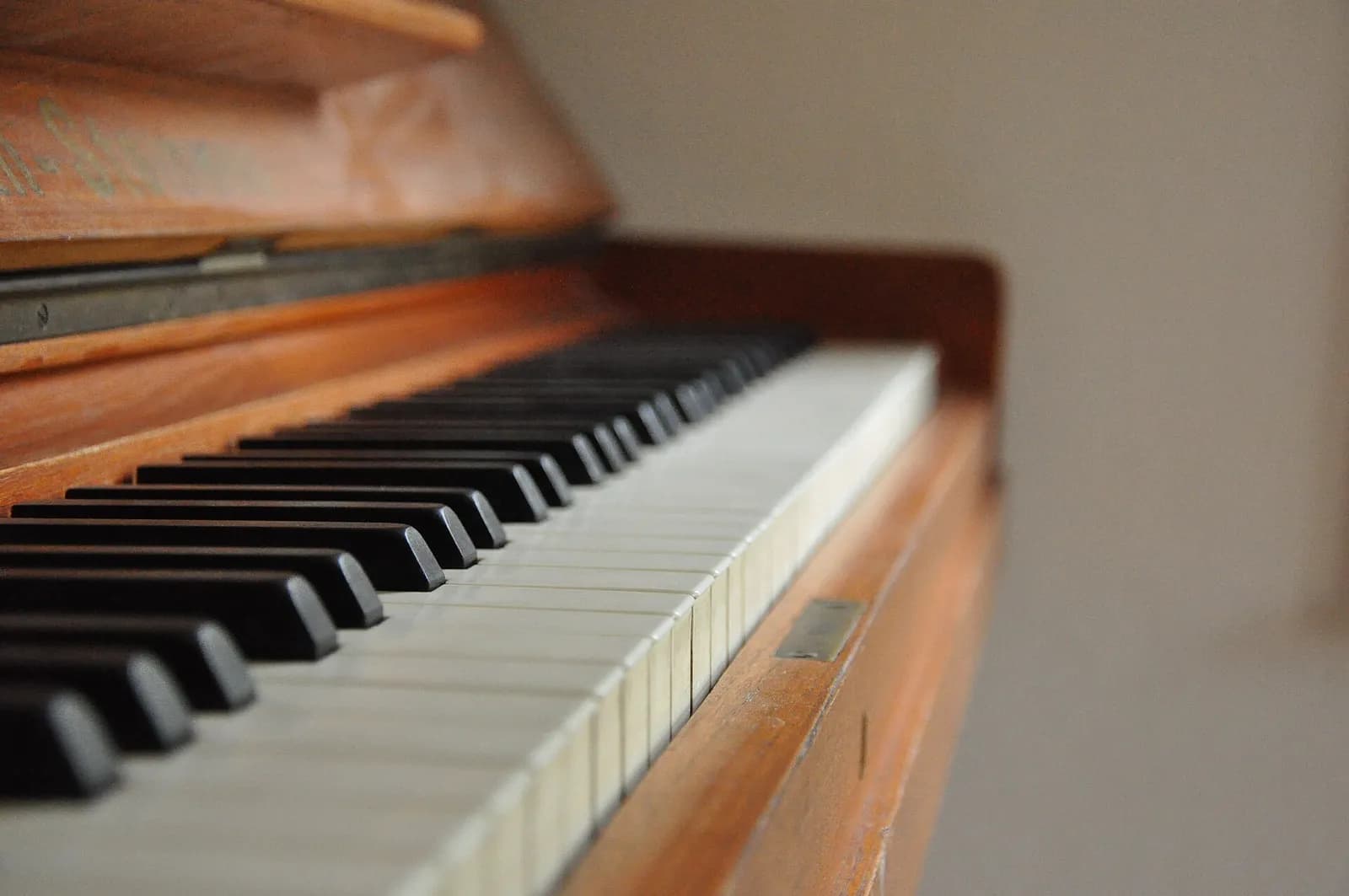
Once you see the pattern, a keyboard of 88 keys turns into the same 12 keys repeated. This guide shows how to find any note, how letter names line up with do re mi, what sharps, flats and octave numbers mean, and where the same notes sit on the treble and bass staff. Every step can be checked on the free online piano of VITON13 SCHOOL.
Key ideas
- An octave has 12 keys: seven white ones named C D E F G A B and five black ones in groups of two and three.
- C is the white key just left of each pair of black keys; F is the white key just left of each group of three.
- A sharp (♯) is the next key up and a flat (♭) the next key down, so the black key between C and D is both C♯ and D♭.
- In scientific pitch notation middle C is C4, A4 is tuned to 440 Hz, and an 88-key piano runs from A0 to C8.
How are the notes laid out on a piano?
Piano notes follow one pattern of 12 keys that repeats from left to right, from low to high. Seven of those keys are white and carry the letter names C, D, E, F, G, A and B; the other five are black and come in a group of two followed by a group of three. After B the letters start again at C, one octave higher.
The black keys are your map. Find any pair of black keys: the white key just to its left is C, the white key between the two black keys is D, and the one just to the right is E. Then find a group of three black keys: the white key to its left is F, and the white keys between and after them are G, A and B. With these two landmarks you can name any white key without counting from the end of the keyboard.
Moving from one key to the very next one, white or black, is a step of one semitone, so the 12 keys of an octave are 12 semitones. The two pairs of white keys with no black key between them, E–F and B–C, are also one semitone apart; every other pair of neighbouring white keys is two semitones, a whole tone, apart.
What are piano notes called: letters or do re mi?
The same keys have two sets of names: letters, used in English-speaking countries, and the solfège syllables do, re, mi, fa, sol, la, si. Where fixed do is taught, do always means C. That is the case in France, Spain, Italy, Portugal and Latin America, and also in Russia, so a Russian pupil learns до, ре, ми, a French pupil do, ré, mi and a Spanish pupil do, re, mi.
The full match is C = do, D = re, E = mi, F = fa, G = sol, A = la and B = si. English singing classes often say ti instead of si for the seventh note, so that every syllable starts with a different letter. Chord charts and music software often use letters, so it pays to know both systems.
What do sharps, flats and octave numbers mean?
A sharp raises a note by one semitone and a flat lowers it by one semitone. On the keyboard that means the next key to the right for a sharp and the next key to the left for a flat. The black key between C and D is therefore C♯ (C sharp) and also D♭ (D flat), and the five black keys are C♯/D♭, D♯/E♭, F♯/G♭, G♯/A♭ and A♯/B♭. One key with two names is an enharmonic pair; which name is written depends on the key of the piece.
Octave numbers tell the many Cs apart. In scientific pitch notation the number changes on every C, so all the notes from C4 up to B4 carry a 4. Middle C, the fourth C from the left on an 88-key piano, is C4; the A above it is A4, the 49th key, tuned to 440 Hz. The keyboard runs from A0, the lowest key, to C8, the highest: 52 white keys and 36 black keys, a little over seven octaves.
On the staff the same notes have fixed places. The treble clef, or G clef, marks G4 on the second line from the bottom; its five lines read E, G, B, D, F and its four spaces F, A, C, E. The bass clef, or F clef, marks F3 on the fourth line; its lines read G, B, D, F, A and its spaces A, C, E, G. Middle C is written on a short ledger line between the two staves, below the treble staff or above the bass staff.
How to practise piano notes on the online piano
The quickest way to learn the notes is to hear them while you name them. Open the free online piano of VITON13 SCHOOL: it shows two octaves on a phone, three on a small tablet and four or five on a computer, and you can play it with the mouse, your fingers or the computer keyboard, where the bottom letter row from Z plays one octave and the top row from Q the next.
First set the note names to letters. Every C then shows its octave number and middle C is marked, so C4 is easy to find. Play every C on the screen, then every F, finding them only by the groups of black keys. Next switch the names to do re mi, or turn them off and test yourself. The ← and → arrows move the computer keys by one octave, and Space or Shift holds the sustain pedal.
When the names come quickly, open the Chords or Scales mode: choose a root and a type, and the keys light up with their note names, which is good practice for reading sharps and flats in context.
In everyday language
The keyboard is like a street where the houses repeat every 12 doors. Once you know that the white house just left of the two black ones is always C, you can find any address, and the octave number tells you which block you are in.
Try it yourself
Open the online piano, set the note names to letters and play every C you can see, from left to right.
Expected result
Each C is the white key just left of a pair of black keys, and its label shows its octave number, such as C3, C4 and C5.
Check your answer: You start on middle C (C4) and move up 12 keys, counting white and black. Which note do you reach? And if you move up only 9 keys?
Twelve semitones up is C5, the next C, one octave higher. Nine semitones up is A4, the A tuned to 440 Hz.
Questions
How many octaves does a piano have?
A standard 88-key piano runs from A0 to C8: seven full octaves from A0 to A7 plus three more keys up to C8. Counted from C to C, it holds seven octaves, from C1 to C8.
Are C sharp and D flat the same note?
On a piano they are the same black key, so they sound the same. The written name depends on the music: a piece in D major writes C♯, while a piece in A♭ major writes D♭.
Learn the two landmarks, C to the left of two black keys and F to the left of three, then open the VITON13 SCHOOL online piano and name every key in letters and in do re mi until you no longer need to count.