
Big Bang theory explained: how the universe began and how we know
The Big Bang theory says the Universe expanded from an extremely hot, dense state about 13.8 billion years ago and has been expanding and cooling ever since. It was not an explosion in empty space: space itself stretched and carried matter and energy with it. Three independent observations support it: galaxies receding in proportion to their distance, the cosmic microwave background at 2.7 kelvins, and the measured share of hydrogen and helium.
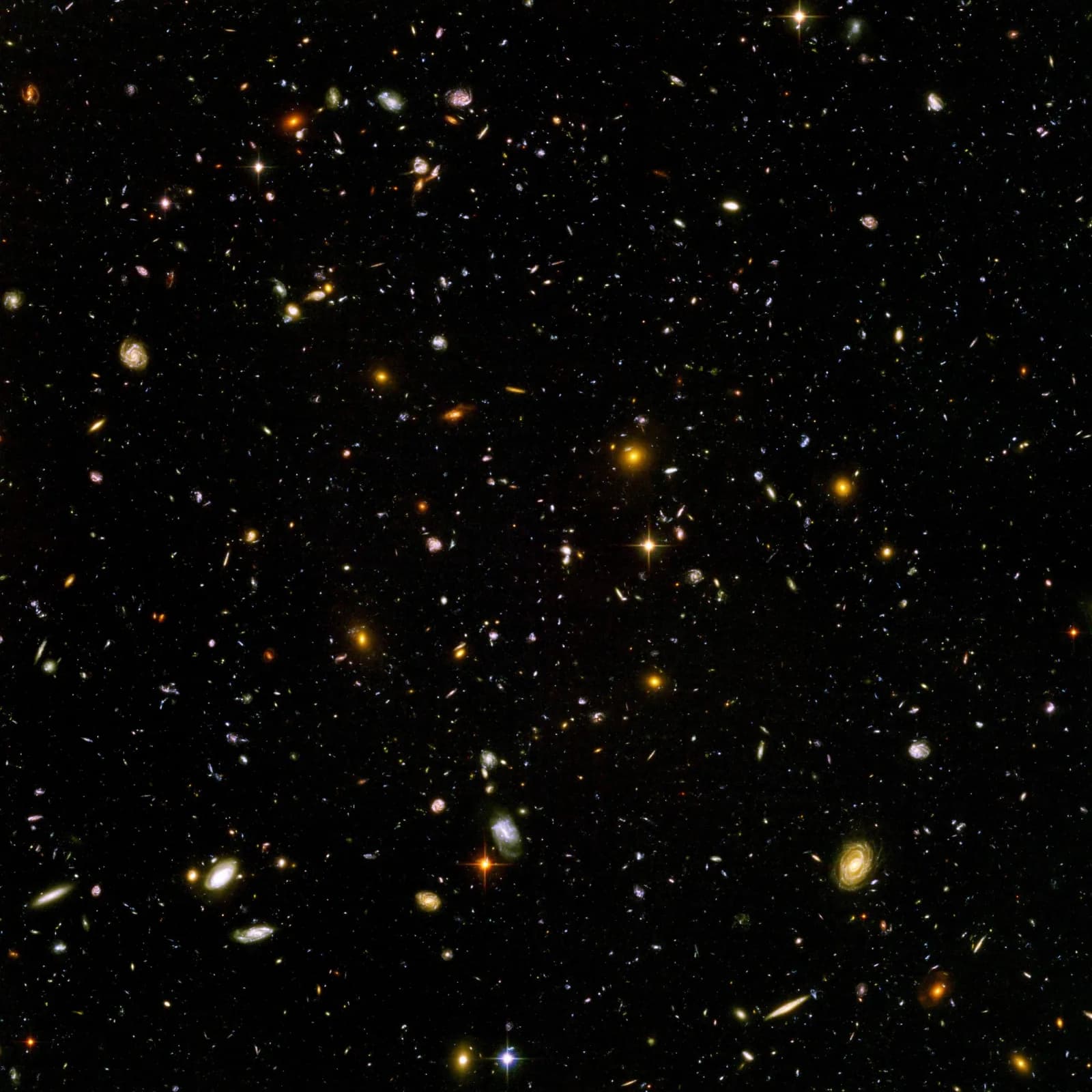
People who ask how did the universe begin usually expect one event with one cause. The theory is narrower and better tested than that: it describes what the Universe did from a very early hot state onward. This guide separates what has been measured from what is still open, in about five minutes.
Key ideas
- The Universe is about 13.8 billion years old, and its space has been expanding and cooling since an extremely hot, dense beginning.
- The Big Bang was not an explosion in space and has no centre: every galaxy sees the others moving away, because the space between them stretches.
- Three observations back the theory: the redshift of galaxies (1920s), the cosmic microwave background (detected 1964) and the amounts of hydrogen and helium.
- The theory does not say what came before or why the expansion began, and dark matter and dark energy, about 95% of the content, are still unexplained.
What the Big Bang theory actually says
The theory describes the history of the Universe from a hot, dense early state, about 13.8 billion years ago, up to today. The key idea is that space itself expands. Galaxies are not flying outward through an empty room: the distances between them grow, like raisins in a loaf that rises in the oven. Every raisin sees all the others moving away, and none of them is the centre.
In the beginning the Universe was a hot, dense mix of particles and light. As space expanded it cooled. Within the first few minutes, protons and neutrons fused into the nuclei of hydrogen, helium and traces of lithium. After roughly 380,000 years it had cooled to about 3,000 kelvins, atoms could form, and light was free to travel across space.
The name came from a rival. Fred Hoyle, who preferred a Steady State universe that never changes in the large, used the phrase “Big Bang” in a BBC radio talk in 1949. Scientists then did what they do with competing ideas: they looked for observations on which the two disagreed.
Proof one: galaxies move away, and the farther the faster
In 1927 the Belgian physicist Georges Lemaître found that Einstein’s equations allow an expanding Universe. In 1929 Edwin Hubble measured the redshift of galaxies, the stretching of their light toward red, and showed that the farther a galaxy is, the faster it recedes. Redshift is the same effect that makes a siren sound lower as it drives away, except that here the space itself stretches the light waves.
The relation is Hubble’s law, v = H₀ × d. The Planck satellite measured the present expansion rate as H₀ ≈ 67.4 kilometres per second per megaparsec, while measurements using nearby stars give about 73. That disagreement, called the Hubble tension, is a real open problem. With H₀ = 70, a galaxy 100 megaparsecs away (about 326 million light-years) recedes at about 7,000 km/s.
Run the film backwards and the galaxies meet. The quick estimate 1 / H₀ gives about 14 billion years, close to the 13.8 billion years that detailed models give. It is only a rough match, because the expansion rate has not been constant.
Proof two and three: the oldest light and the first elements
For about its first 380,000 years the Universe was opaque, like fog, because light kept colliding with free electrons. When atoms formed, the light was released, and it has travelled ever since. Stretched by expansion, it now arrives as microwaves from every direction, at a temperature of 2.725 kelvins. This is the cosmic microwave background, with about 400 of its photons in every cubic centimetre of space.
Gamow, Alpher and Herman predicted such a glow in the late 1940s. Arno Penzias and Robert Wilson detected it by accident in 1964 with a radio antenna in New Jersey and shared the 1978 Nobel Prize in Physics. A Steady State universe has no reason to glow like this, so the discovery tipped the debate. Later satellites (COBE, WMAP, Planck) found tiny temperature differences of about one part in 100,000, the seeds from which galaxies grew.
The third support comes from nuclear physics. In the first minutes the hot Universe could make only the lightest nuclei, so it should contain about three quarters hydrogen and one quarter helium by mass. The oldest gas clouds we can measure match that mix.
What the Big Bang theory does not explain
The theory does not say what, if anything, came before, or why the expansion began. In the very first instants the density was so extreme that known physics stops working, so any claim about “before” is speculation, not a measurement.
Cosmologists add a short phase of rapid growth right after the start, called inflation, to explain why the Universe is so smooth and where the tiny seeds of galaxies came from. It fits the data well, but it is not directly confirmed.
The standard model also needs two ingredients nobody has identified. By the Planck results, ordinary matter is only about 5% of the Universe’s content, dark matter about 27% and dark energy about 68%. Headlines that say the James Webb Space Telescope broke the Big Bang misread the findings: Webb sees bright galaxies less than 400 million years after the start, which refines how galaxies formed, not whether space expanded from a hot early state.
How the VJOURNAL SMART BOOK shows it
The chapter “The Beginning of Everything” opens Volume I of the VJOURNAL SMART BOOK History, “From the Big Bang to Rome”. The full text sits on the left and a drawing plays what the text describes on the right: a point of light that starts to grow, galaxies flying apart faster the farther they are, the first light cooling into a speckled glow, the first stars switching on, then the Sun’s family and the Moon.
The chapter has six animated moments. You can play them in order, drag the timeline, or tap a paragraph to replay its moment. There is a short version in simple words, a facts strip, a three-question quiz with explanations, and a list of sources. Where scientists disagree, the text says so.
In everyday language
Draw dots on a balloon and blow it up. Every dot moves away from every other dot, the far ones fastest, and no dot is the centre. The dots are galaxies and the rubber is space, which is what stretches.
Try it yourself
Draw five dots on a balloon, measure three distances between pairs of dots with a thread, blow the balloon up a little more and measure the same three pairs again.
Expected result
Every distance grows, and the pairs that started farther apart grew by more. That is the pattern Hubble found in the galaxies: speed of recession increases with distance.
Check your answer: A galaxy recedes at 14,000 km/s. With H₀ = 70 km/s per megaparsec, how far away is it?
14,000 ÷ 70 = 200 megaparsecs, which is about 650 million light-years.
Questions
Was the Big Bang an explosion?
No. It is a name for the expansion of space from a hot, dense state, not for a blast inside a pre-existing space. Matter did not fly out from a point: space itself grew everywhere at once.
Where did the Big Bang happen?
Everywhere. The Universe has no centre and no edge that galaxies are expanding into. Every observer sees the other galaxies receding, like every raisin in the rising loaf.
How do we know the Universe is 13.8 billion years old?
The pattern of the cosmic microwave background, fitted to the standard model, gives 13.8 billion years: 13.82 in the 2013 Planck release and 13.787 plus or minus 0.020 in the 2018 results. The expansion rate gives a similar rough value.
What was there before the Big Bang?
Nobody knows. The theory describes the Universe from a very early hot state, and the first instants are beyond tested physics. Be sceptical of any confident answer.
Is the Big Bang just a theory?
In science, a theory is a tested explanation, not a guess. This one made predictions that came true, such as the microwave glow and the hydrogen-helium mix, while its rival, the Steady State universe, failed them.
Does the James Webb telescope disprove the Big Bang?
No. Webb’s early galaxies challenge details of how fast galaxies formed. They do not change the evidence that space has expanded from a hot, dense state about 13.8 billion years ago.
Remember the three proofs: galaxies receding, a 2.7-kelvin afterglow and a three-to-one hydrogen-helium mix. Then open the chapter, play its six moments and take the quiz to test yourself.
Sources and further reading
- ESA: Planck and the cosmic microwave background ↗Sources checked:
- NASA Science: The Big Bang ↗Sources checked:
- ESA: Planck reveals an almost perfect Universe (age, composition, Hubble constant) ↗Sources checked:
- Nobel Prize in Physics 1978: Arno Penzias, facts ↗Sources checked:
- Planck Collaboration: Planck 2018 results. VI. Cosmological parameters ↗Sources checked: