
Human evolution: a short timeline from the first upright apes to Homo sapiens
Human evolution is the long process by which our species, Homo sapiens, descended from earlier apelike ancestors in Africa. Humans and chimpanzees share a common ancestor that lived between 8 and 6 million years ago, and our own species appeared about 300,000 years ago. We did not descend from chimpanzees, and the human family tree is a bush with many branches, not a ladder.
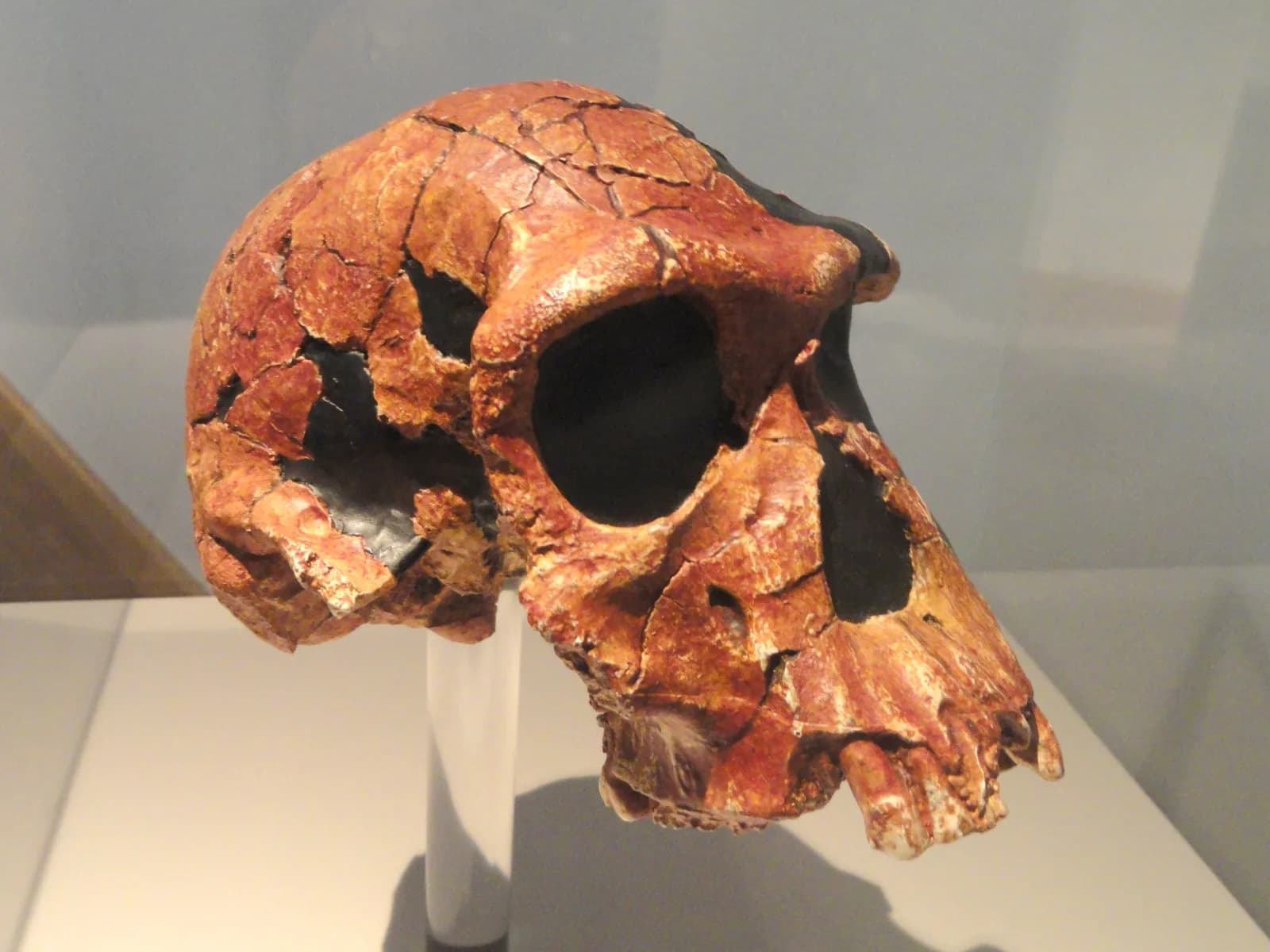
Searching for human evolution returns dozens of species names and dates. This guide gives the order, the numbers and the evidence in about five minutes, and says plainly where scientists still disagree.
Key ideas
- The human and chimpanzee lines split from a common ancestor 8 to 6 million years ago in Africa; people did not evolve from chimpanzees, which kept evolving too.
- Walking upright came first (Sahelanthropus, Lucy at 3.2 million years), and big brains came much later.
- Homo erectus left Africa about 1.9 to 1.8 million years ago, and Homo sapiens appeared in Africa about 300,000 years ago.
- The Smithsonian recognises 15 to 20 early human species, and most left no descendants; Neanderthals live on as about 1 to 2% of the DNA of people outside Africa.
The short answer: a bush, not a ladder
The famous picture of an ape slowly straightening into a man is wrong. Humans and the African great apes share a common ancestor that lived between 8 and 6 million years ago. From it, one line led to chimpanzees and bonobos, and another led to us. Neither is the ancestor of the other, any more than your cousin is your parent.
The Smithsonian’s Human Origins Program says that scientists recognise some 15 to 20 different species of early humans and do not all agree on how they are related. Several lived at the same time, and many left no living descendants. Evolution here means change in the inherited traits of populations over many generations, not a march toward us.
Timeline: from walking upright to Homo erectus
Between 7 and 6 million years ago in Chad lived Sahelanthropus tchadensis, known only from skull material. The opening where the spinal cord leaves its skull sits further forward than in apes, which suggests an upright head and possibly walking on two legs. That is an inference from a skull, and it is still debated.
Australopithecus afarensis lived between 3.85 and 2.95 million years ago in eastern Africa. The best-known individual is Lucy, a 3.2-million-year-old skeleton found in 1974 at Hadar, Ethiopia. She walked upright but still had long arms and curved fingers for climbing trees, and a brain smaller than 500 cubic centimetres, about a third the size of ours. Walking on two legs clearly came long before big brains.
By about 1.9 million years ago Homo erectus had a tall body with long legs, like ours, and the first major advance in stone tools followed by about 1.76 million years ago: handaxes and cleavers. Groups of Homo erectus left Africa 1.9 to 1.8 million years ago, which skulls of about 1.8 million years found with stone tools at Dmanisi in Georgia show.
Homo sapiens, the Neanderthals and the journey across the world
Our species, Homo sapiens, evolved in Africa about 300,000 years ago. The oldest fossils come from Jebel Irhoud in Morocco, dated in 2017 to about 315,000 years with an uncertainty of 34,000 years. The average modern brain is about 1,300 cubic centimetres. For roughly the first four million years, the Smithsonian says, human evolution took place only in Africa.
Genetic studies suggest that a group of modern humans left Africa for good about 70,000 to 60,000 years ago and spread along the coasts. Dates for Australia (at least 50,000 years, perhaps 65,000) and for the first people in the Americas (at least 16,000 years, with older claims debated) keep changing as new sites are found.
Out there, they met cousins. Neanderthals shared an ancestor with us 700,000 to 300,000 years ago, had brains as large as ours and vanished about 40,000 years ago. The complete Neanderthal genome showed that people outside Africa carry about 1 to 2% Neanderthal DNA, so the two groups had children together. DNA from a Siberian cave also revealed another group, the Denisovans.
How scientists know: fossils, DNA and stone tools
Three independent kinds of evidence point the same way. Fossils show bodies changing through time, and radioactive dating gives their ages. Stone tools and other artefacts show what the makers did. DNA shows how closely living and some extinct species are related.
The Smithsonian puts the genetic difference between human beings and chimpanzees at about 1.2% when only single-letter substitutions in shared genes are counted, and at 4 to 5% more when inserted and deleted stretches are counted too. Both numbers show that humans, chimpanzees and bonobos are each other’s closest relatives. Charles Darwin predicted in 1871 that the African apes were our closest kin, and the DNA agrees.
A scientific theory is an explanation supported by many independent lines of evidence, not a guess. The broad picture of human evolution is supported this way. The open questions are details: the exact family tree, which species were direct ancestors, and exact dates of migrations.
How the VJOURNAL SMART BOOK shows it
The History book of the VJOURNAL SMART BOOK has two chapters for this story. “Earth’s Day in 24 Hours” squeezes 4.5 billion years into one clock face and puts Homo sapiens six seconds before midnight. “Out of Africa” follows the species from the split with chimpanzees to the Americas in six animated moments on a map.
In both chapters the text sits beside a drawing that plays the moment you are reading. You can tap a paragraph to replay it, drag the timeline, switch to a short version in simple words and check yourself with a quiz that explains each answer. Notes can be sent to VITON13 LAB, where the chapter opens on a map or a timeline.
In everyday language
Think of a big family: a chimpanzee is a distant cousin, not a grandparent. We and chimpanzees share a very old great-great-great-and-so-on grandparent. Their branch and ours grew apart, and our branch had many side shoots, most of which are gone.
Try it yourself
Cut a paper strip 80 cm long. Let 1 cm stand for 100,000 years and make the right-hand end today. Mark the split from chimpanzees (8 million years), Lucy (3.2 million), Homo erectus leaving Africa (1.9 million), Homo sapiens (300,000) and the last Neanderthals (40,000).
Expected result
Our species fits in the last 3 cm of the 80 cm strip, and the disappearance of the Neanderthals sits only 4 mm from the end.
Check your answer: On this strip, how far from the right-hand end is Lucy?
32 cm, because 1 cm stands for 100,000 years and 3,200,000 divided by 100,000 is 32.
Questions
Did humans evolve from chimpanzees?
No. Humans and chimpanzees descend from a shared ancestor that lived 8 to 6 million years ago. Chimpanzees have been evolving along their own branch ever since, so living chimpanzees are cousins, not ancestors.
When did Homo sapiens appear?
About 300,000 years ago in Africa, according to the oldest fossils from Jebel Irhoud in Morocco. The date moves as fossils are found and dated, so treat it as an estimate.
Where did human evolution happen?
Mostly in Africa. The Smithsonian says the first four million years or so of human evolutionary history took place only there. Homo erectus was the first to spread beyond, about 1.9 to 1.8 million years ago.
Are Neanderthals our ancestors?
No, they are a closely related extinct group. We share an ancestor with them from 700,000 to 300,000 years ago, and our two groups interbred, so people outside Africa carry about 1 to 2% Neanderthal DNA.
Is human evolution still happening?
Yes. Evolution continues whenever inherited traits differ in how often they are passed on. A much-studied example is the ability to digest milk sugar as an adult, which became common in some populations after dairying began.
Is human evolution just a theory?
In science a theory is an explanation that many independent observations support. For human evolution those are fossils, DNA and tools. Scientists argue about details such as the exact tree, not about the main outline.
Remember the order: common ancestor with chimpanzees 8 to 6 million years ago, upright walking, Homo erectus out of Africa, Homo sapiens 300,000 years ago. Then follow it on the map in the “Out of Africa” chapter.
Sources and further reading
- Smithsonian Human Origins Program: Introduction to Human Evolution ↗Sources checked:
- Smithsonian Human Origins Program: Genetics ↗Sources checked:
- Smithsonian Human Origins Program: Homo sapiens ↗Sources checked:
- Nature (2017): New fossils from Jebel Irhoud, Morocco, and the pan-African origin of Homo sapiens ↗Sources checked:
- Nature (2014): The complete genome sequence of a Neanderthal from the Altai Mountains ↗Sources checked: