
Claude, ChatGPT, Gemini or open models: how to choose in November 2026
Choosing between Claude, ChatGPT, Gemini and open models means testing them on your own tasks, not trusting a headline or a leaderboard. Write the job in one sentence, give the same prompt to two or three models in fresh chats, hide which answer came from which, and pick the one you would actually send to a client.
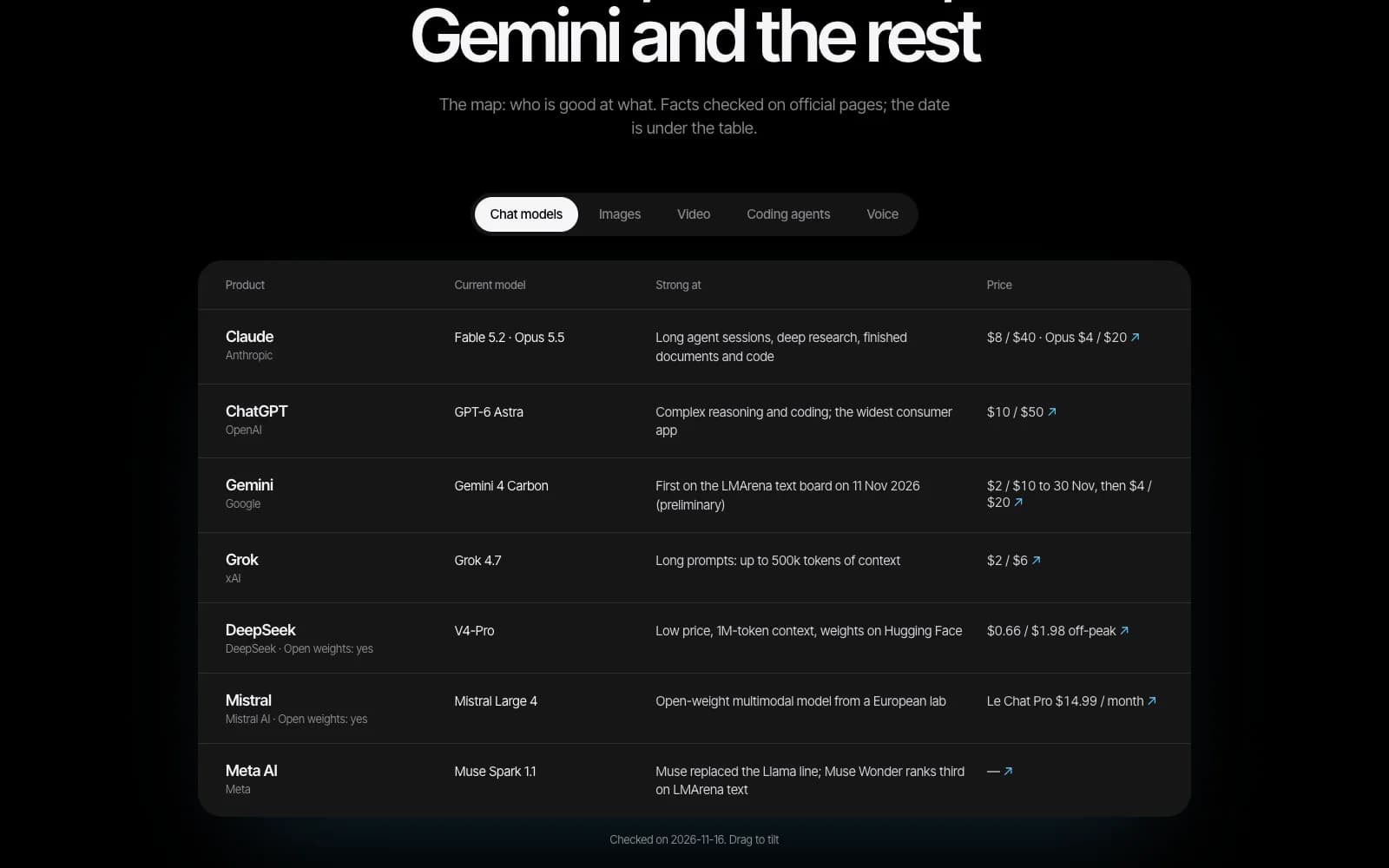
New models appear every month, and every one is called the best by someone. A comparison table helps you know what exists, but it cannot know your work. This guide gives you a short map as of 16 November 2026 and a method that does the real choosing for you.
Key ideas
- A map shows what exists; only your own test shows what fits.
- Facts here were checked on 16 November 2026 and the market moves monthly.
- Use the same prompt, fresh chats and a blind judge, with criteria written first.
- Keep a stack with one slot per job, including an open or local one.
What the map says as of 16 November 2026
The course keeps a comparison table checked against the vendors’ own pages on 16 November 2026. For chat models it lists Claude from Anthropic (Fable 5.2 and Opus 5.5, noted for long agent sessions, deep research, finished documents and code), ChatGPT from OpenAI (GPT-6 Astra, noted for complex reasoning and coding and the widest consumer app) and Gemini from Google (Gemini 4 Carbon, first on the LMArena text board on 11 November 2026, a preliminary result).
It also lists Grok 4.7 with up to 500k tokens of context, DeepSeek V4-Pro with a 1M-token context and weights on Hugging Face, Mistral Large 4 as an open-weight multimodal model from a European lab, and Meta’s Muse Spark 1.1, which replaced the Llama line. Any value that could not be confirmed is shown as a dash rather than guessed.
Why a leaderboard is not your answer
A leaderboard tells you what voters preferred in general. Your tasks may be different: a short rewrite, a strict table format, a long document, a bit of code. Prices differ too, and some are time-limited. Gemini, for example, was listed at $2 / $10 per million tokens until 30 November and $4 / $20 after that, which is the kind of detail that changes a decision.
So treat the table as a starting list of candidates. Before you commit money to a plan, open the vendor link in the row and check again, because this market changes monthly.
The method: a blind test on three tasks
Pick three tasks from your last two weeks that differ in shape: one writing task, one reasoning task, one with a strict format. For each, write three pass-or-fail criteria before you see any answers. Run the identical prompt in two or three models, each in a fresh chat with your passport pasted first, and tell them not to name themselves.
Paste the answers into a separate judge chat labelled A, B and C in random order, with your criteria, and ask for pass or fail on each plus any invented fact. Reveal the names only afterwards. Use public or invented sample input, never client data or keys, because the same text goes to several vendors.
Turn the result into a stack
A stack is one slot per job: a main chat model, a cheap and fast one, an open or local one, an image tool, a video tool and a coding agent. Fill each slot from your own result and mark guesses as untested, with a review date in the file.
Open models matter here because they can run on your own machine. That is mission 7 of the course. Mission 2, “The AI map: your personal model stack”, is free and builds the whole stack file with the test above.
In everyday language
Imagine buying a pair of running shoes. The shop’s list of best-selling models is useful, but you still run a few steps in each pair before you decide. A blind test is those few steps, with the labels covered so the brand cannot talk to you.
Try it yourself
Choose one real task from your week, write three pass or fail criteria, and run the same prompt in two or three models.
Expected result
Three answers judged blind, with a pass or fail on each criterion and the winner written into your stack file.
Check your answer: Why should you write the criteria before you read the answers?
Because criteria written first stop you from rewarding whichever answer simply sounds the most confident.
Questions
Is there a single best model right now?
The course does not claim one. Each model in the table has different strengths and prices, and the right answer depends on your tasks, so you test instead of trusting a ranking.
Can I include open models in the test?
Yes. Open-weight models such as DeepSeek or Mistral can be part of the comparison, and mission 7 shows how to run an open model locally.
Do not look for a winner; build a stack from your own blind tests. Mission 2 of the AI course is free on VITON13 SCHOOL and gives you the prompts and the stack file to start today.
Sources and further reading
- VITON13 SCHOOL — Course 01: Artificial Intelligence ↗Sources checked:
- Anthropic — Models overview ↗Sources checked:
- OpenAI — Models ↗Sources checked: