
The Pomodoro technique: how 25-minute sessions work and how to use them for school
The Pomodoro technique is a time-management method developed by Francesco Cirillo in the late 1980s: you work on one task for 25 minutes, take a short break of about 5 minutes, and after four such sessions, called pomodoros, take a longer break, typically 20 to 30 minutes. Pomodoro is Italian for tomato, after his tomato-shaped kitchen timer.
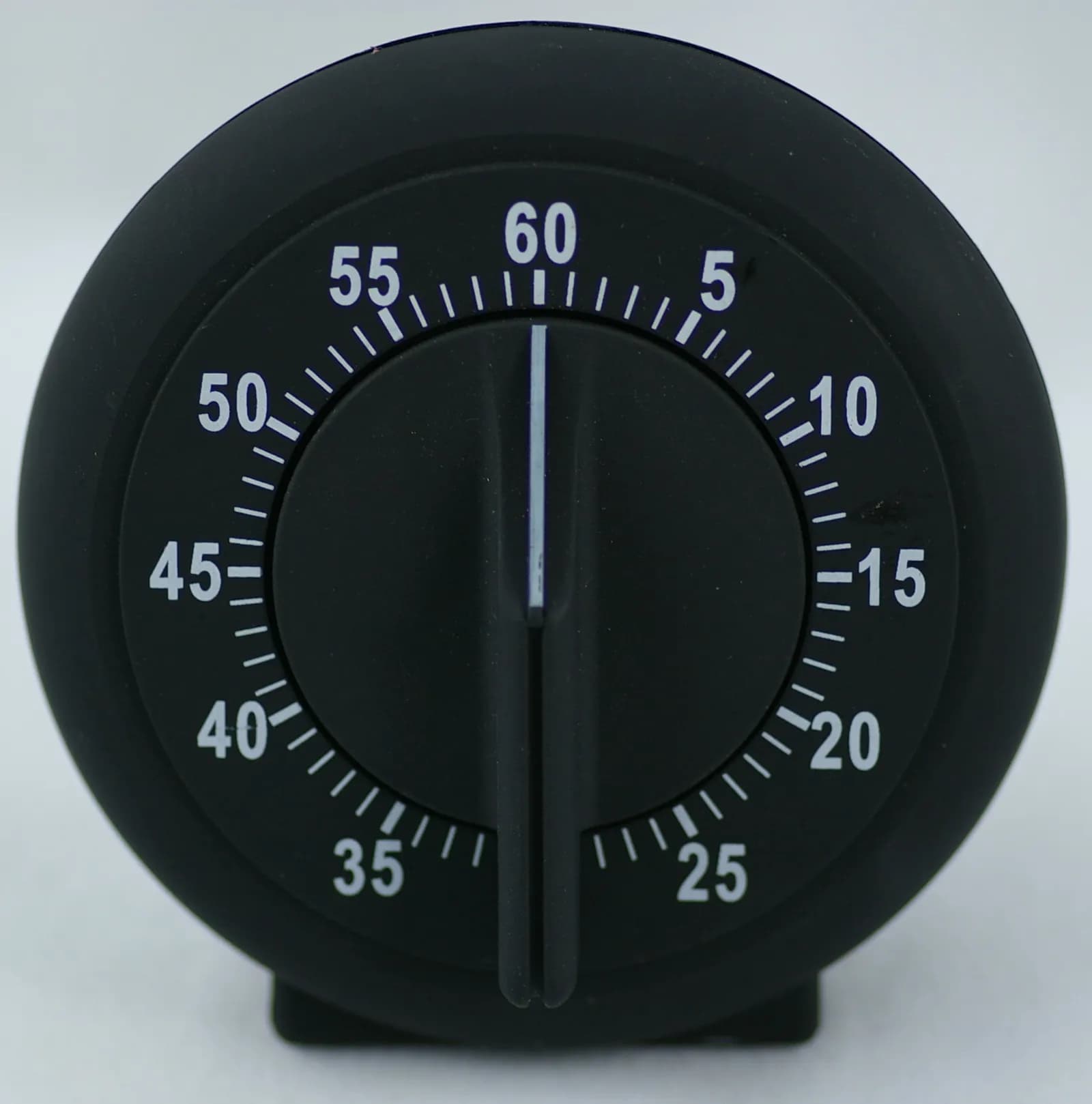
The method needs nothing more than a timer and a task. This guide explains where it comes from, the steps and the one rule about interruptions, how to adapt the lengths for a lesson, homework and exam revision, and what research does and does not show. At the end, a free timer with a Pomodoro mode runs the cycles for you.
Key ideas
- A pomodoro is 25 minutes on one task, followed by a short break of about 5 minutes; after four pomodoros comes a longer break, usually 20 to 30 minutes.
- Francesco Cirillo developed the method in the late 1980s as a university student, timing himself with a tomato-shaped kitchen timer.
- A pomodoro is not split: if something interrupts, postpone it and carry on, or abandon that pomodoro and start a fresh one later.
- The lengths can be adapted for class, homework or revision. One 2023 study of 87 students found mood benefits from fixed breaks, but no difference in task completion.
What is the Pomodoro technique and where does it come from?
It is a way of dividing work into short, timed blocks of focus separated by breaks. Francesco Cirillo developed it in the late 1980s while he was a university student, challenging himself to concentrate for a short period with a kitchen timer shaped like a tomato, in Italian a pomodoro. Each block of work took the timer's name.
The classic block is 25 minutes, followed by a short break, and after four blocks a longer break. The breaks are part of the method rather than a reward you may skip: the idea is to work on one activity at a time and to use regular pauses to protect your attention.
Cirillo's own description has three parts. Plan: choose the work for the day and estimate the effort it will take. Focus: work on one activity at a time, handle interruptions and take the breaks. Reflect: record the effort you actually spent, compare it with your estimate and make small improvements to the way you work.
How do you do the Pomodoro technique, step by step?
There are six steps. First, choose a task. Second, set the timer, usually for 25 minutes. Third, work on that task until the timer rings. Fourth, take a short break, typically 5 minutes and up to 10. Fifth, repeat the cycle of work and break until four pomodoros are done. Sixth, take a longer break of about 20 to 30 minutes, then start again.
One rule makes the method work: a pomodoro is indivisible. If a message, a question or a new idea interrupts, you either postpone the other thing and finish the pomodoro, or you abandon it and start a new pomodoro later. Half a pomodoro does not count.
A worked example shows how the time adds up. Four pomodoros are 4 × 25 = 100 minutes of work. Between them come three short breaks of 5 minutes, which is 15 minutes more, so the first round takes 115 minutes, almost two hours, before the long break begins.
How can you adapt the Pomodoro technique for school?
Keep the structure of focus, short break and long break, and change the lengths to suit the task and the learner. Twenty-five minutes is the classic block, not a law: a younger pupil may manage a shorter one, while a long written answer may need more. Whatever you choose, keep it the same for a whole round so the rhythm becomes familiar.
For homework, give each pomodoro a single subject or a single set of exercises and write the list before you start. For exam revision, use the plan and reflect steps: list the topics, estimate how many pomodoros each will take, tick them off, and compare the estimate with reality at the end of the day. In class, a teacher can show a large timer for a work block and the break, so everyone can see how much time is left.
Be honest about what the evidence shows. In a 2023 study, 87 Dutch university students did one day of self-study. Those who took a 6-minute break after every 24 minutes of study, the Pomodoro-style group, reported less fatigue and distraction and more concentration and motivation than those who chose their own breaks, but the groups did not differ in mental effort or in how much work they completed. One day of study says nothing about grades, so treat the method as a tool to try, not a guarantee.
How to run the Pomodoro technique with the free timer and stopwatch
Open the free online timer at VITON13 SCHOOL and choose the Pomodoro mode. It starts with 25 minutes of focus, a 5-minute short break, a 15-minute long break and a long break after every 4 sessions; all four numbers can be changed before you start. Press Start or the Space bar. The phases follow one another by themselves, each with its own short signal, a counter shows the sessions done, and the cycles repeat until you pause or reset.
For a lesson, press F for full screen on the projector and choose a white or dark screen. While the timer runs, the time left shows in the tab title, it stays right in a background tab, and the page asks the browser to keep the screen on where that is supported. Your settings are kept in this browser only.
The free online stopwatch helps with the reflect step. Start it when you begin a task and press Lap or L each time you finish an exercise or a topic: every row shows the lap time and the total, and the fastest and slowest laps are marked. Afterwards, copy the laps or download them as a CSV file and compare them with the pomodoros you planned.
In everyday language
A pomodoro is a sprint with a finish line you can see: 25 minutes on one task, then a real rest. After four sprints, a longer rest.
Try it yourself
Choose one piece of homework, open the timer in Pomodoro mode and complete two pomodoros with the short break in between.
Expected result
Two 25-minute focus phases with a 5-minute break between them, the session counter showing 2, and a short list of what you finished in each.
Check your answer: You plan six pomodoros of 25 minutes, with 5-minute short breaks and a 15-minute long break after the fourth. How long is it from the first start to the end of the sixth pomodoro?
185 minutes, or 3 hours 5 minutes. The work is 6 × 25 = 150 minutes. The breaks come after pomodoros 1, 2, 3 and 5 (4 × 5 = 20 minutes) and after the fourth (15 minutes), which makes 35 minutes of breaks.
Questions
Does a pomodoro have to be exactly 25 minutes?
No. Twenty-five minutes is the classic length, but you can shorten or lengthen it; the 2023 study used 24 minutes of work and 6 of rest. What matters is a fixed block, one task and a real break.
Does the Pomodoro technique actually work?
The evidence is limited. A 2023 study of 87 students found that fixed breaks brought better mood and concentration than self-chosen ones and appeared to reach similar task completion in less time, but it covered a single day and did not measure grades.
Pick one task, set 25 minutes, work until the signal, rest for 5, and take a long break after four. Adjust the lengths to your class or homework, and let the free VITON13 SCHOOL timer run the cycles while the stopwatch shows where the time really went.
Sources and further reading
- Wikipedia: Pomodoro Technique ↗Sources checked:
- Francesco Cirillo: The Pomodoro Technique (official site) ↗Sources checked:
- Biwer et al. (2023): Understanding effort regulation: Comparing ‘Pomodoro’ breaks and self-regulated breaks ↗Sources checked: