
What is BPM in music? Beats per minute, tempo markings and how to find a song’s tempo
BPM, or beats per minute, is the number of beats in one minute of music, the standard measure of tempo. At 60 BPM each beat lasts exactly one second; at 120 BPM, half a second. The time signature tells you which note value counts as the beat, usually the quarter note in 4/4.
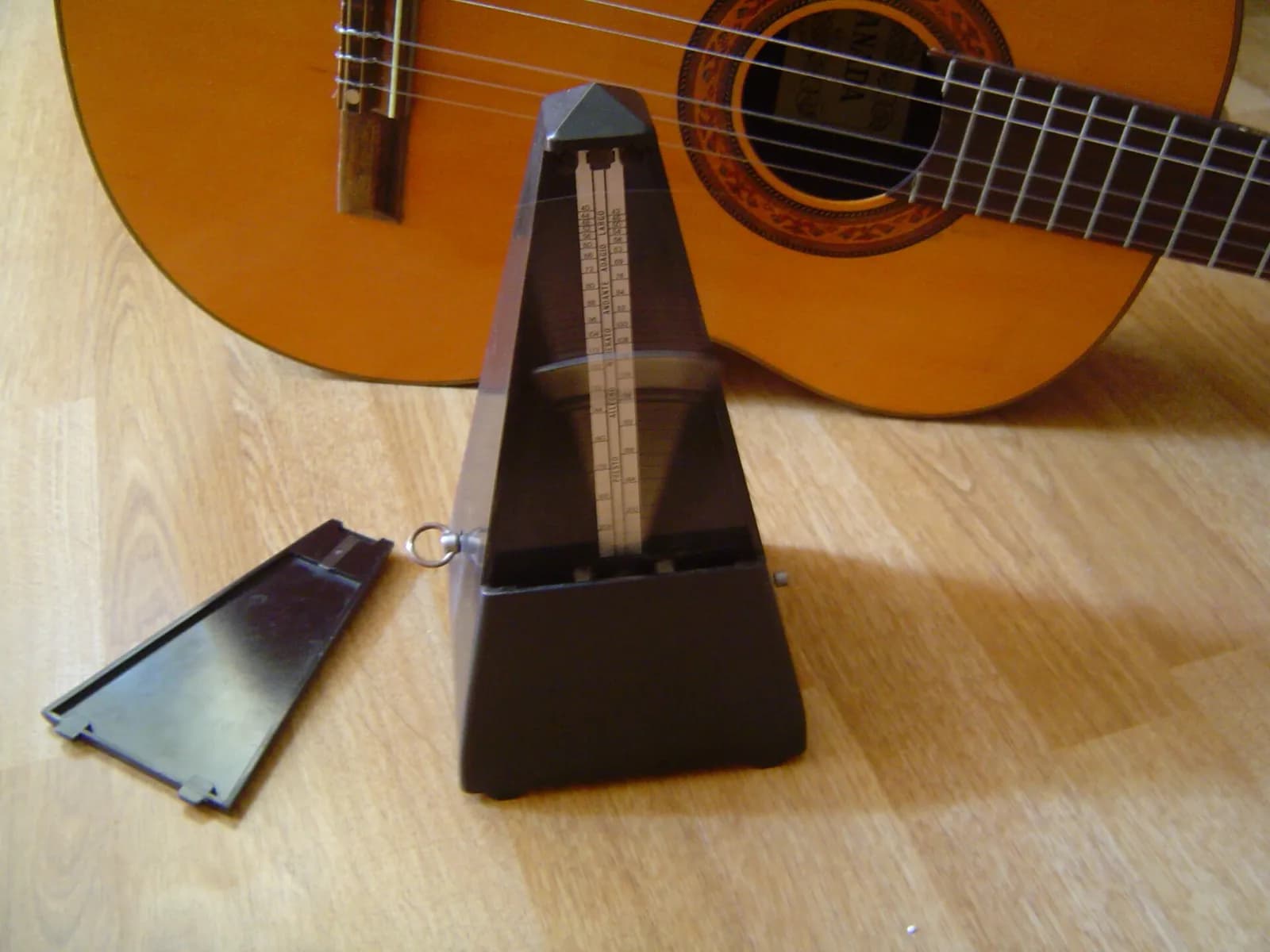
Tempo is the speed of a piece of music, and BPM turns that speed into a number you can set on a metronome. This guide explains what a beat is, how BPM connects to the time signature, what the Italian tempo words such as Adagio and Allegro mean in beats per minute, where the “M.M.” on sheet music comes from, and how to measure the BPM of any song by tapping along. At the end you can try it all on a free online metronome.
Key ideas
- BPM counts beats, not notes: at 100 BPM there are 100 beats a minute, so eighth notes at that tempo go by at 200 a minute.
- One beat lasts 60 divided by the BPM in seconds: 1 second at 60 BPM, 0.75 seconds at 80 BPM, 0.5 seconds at 120 BPM.
- Tempo words give rough spans, not exact numbers: Andante is about 56–108 BPM and Allegro about 120–156 in a common chart, and sources differ.
- To find a song’s BPM, count the beats for 15 seconds and multiply by 4, or tap along on a metronome with tap tempo.
What does BPM mean in music?
BPM means beats per minute: it measures tempo by counting how many beats pass in sixty seconds. The beat is the basic pulse of the music, the regular unit you count or tap your foot to, and the first beat of each bar is called the downbeat.
The arithmetic is simple. One beat lasts 60 divided by the BPM, in seconds. At 60 BPM a beat lasts one second, the same as a clock’s second hand. At 90 BPM it lasts about 0.67 seconds, at 120 BPM exactly half a second, and at 150 BPM 0.4 seconds. Double the BPM and every beat becomes half as long.
BPM counts the beat, not every note you play. A melody at 100 BPM can contain quick runs of sixteenth notes, which at that tempo arrive at 400 per minute, and long held notes that last several beats. The tempo stays 100 because the pulse underneath stays 100.
How does BPM relate to the time signature?
The time signature decides which note value counts as one beat; the BPM then says how many of those beats go by in a minute. The beat is typically the note value named by the bottom number of the time signature, so in 2/4, 3/4 and 4/4 the beat is the quarter note, and in 2/2 it is the half note.
So “♩ = 120” in 4/4 means 120 quarter notes a minute: 30 bars a minute, or one bar every two seconds. The same 120 BPM in 3/4 gives 40 bars a minute, because each bar holds only three beats. The tempo of the beat is identical; only the grouping into bars changes.
Compound metres need one extra step. In 6/8 a bar holds six eighth notes, but it is felt as two beats of three eighths each, so the beat is a dotted quarter note. If a metronome clicks eighth notes at 180 per minute, the music moves at 60 dotted-quarter beats per minute. That is why tempo marks in 6/8 are often given for the dotted quarter.
Tempo markings: Largo, Adagio, Andante, Moderato, Allegro, Presto
Tempo markings are Italian words that describe the speed and character of a piece, and each one corresponds only roughly to a span of BPM. A widely used chart gives: Largo, slow and broad, about 40–66 BPM; Adagio, slow and expressive, about 44–66; Andante, at a walking pace, about 56–108; Moderato, moderate, about 108–120; Allegro, fast and bright, about 120–156; Presto, very fast, about 168–200. Beyond these sit Grave, about 24–40, and Prestissimo, 200 and over.
Treat these numbers as guidance. The spans overlap, and they vary widely between composers, works and reference books, so an Andante by one composer can be slower than an Adagio by another. The character of the music matters more than any exact figure. The school’s metronome shows one span per name, for example Andante 76–107 and Allegro 120–155, which sit inside the ranges above.
Exact numbers arrived with the mechanical metronome. Dietrich Nikolaus Winkel built a spring-driven design in Amsterdam in 1814, and in 1815 Johann Nepomuk Maelzel patented a wind-up metronome with a numbered scale. That is why tempo marks are often written “M.M. ♩ = 96”: M.M. stands for Maelzel’s Metronome. Beethoven was the first notable composer to write metronome markings into his music, starting with a copy of his Cantata op. 112 in December 1815. A mechanical metronome usually covers about 40 to 208 BPM.
How to find the BPM of a song and practise with a metronome
To find the BPM of a song, count the beats for 15 seconds and multiply by 4. First, find the pulse by tapping your foot until it feels natural. Then start a stopwatch, count every tap for 15 seconds and multiply: 23 beats in 15 seconds gives 92 BPM. Counting for 30 seconds and multiplying by 2 is more accurate, because one missed beat costs you only 2 BPM instead of 4.
Two listeners can tap the same song at, say, 70 and 140 BPM, and both are counting a real pulse: one taps every other beat. Choose the level that matches how the music moves, and check it against the time signature. A metronome with tap tempo is quicker than counting: tap along for a few beats and it calculates the BPM for you.
The free online metronome at VITON13 SCHOOL does exactly that. Press Tap, or the T key, in time with the music at least twice: it averages the gaps between your last taps, up to eight, and sets the tempo, and after a pause of more than three seconds it starts counting afresh. The Italian tempo name for that speed appears above the number. You can also drag the slider, press −1/+1 or −5/+5, or type any tempo from 20 to 300 BPM, pick a time signature, then press Start or Space. For practice, the tempo trainer raises the tempo by a step every few bars up to your target, and muted bars leave some bars silent so you can check whether you kept the time yourself.
In everyday language
BPM is like counting steps on a walk. Walk at 60 steps a minute and each step takes a second; speed up to 120 and each takes half a second. The tempo word, such as Andante, describes the kind of walk, and the BPM is the exact step count.
Try it yourself
Open the online metronome, play a song you know on another device and press Tap in time with its beat eight times. Then compare the result with a 15-second count of the same song.
Expected result
Two close numbers for the song’s BPM, and the Italian tempo name the metronome shows for that speed.
Check your answer: A metronome is set to 80 BPM. How long does one beat last, and how many beats will you hear in 30 seconds?
One beat lasts 60 ÷ 80 = 0.75 seconds. In 30 seconds you hear half of 80, so 40 beats. In 4/4 that is exactly 10 bars.
Questions
Is BPM the same as tempo?
BPM is the number that measures tempo. Tempo can also be given in words such as Allegro, which describe a rough speed and a character, while a BPM figure or an “M.M. ♩ = 120” marking fixes the exact speed of the beat.
What does M.M. mean in sheet music?
M.M. stands for Maelzel’s Metronome, after Johann Nepomuk Maelzel, who patented his metronome in 1815. “M.M. ♩ = 96” means 96 quarter-note beats per minute.
Open the free VITON13 SCHOOL metronome, tap along to a song you like to find its BPM, then practise a passage a few BPM slower than that and let the tempo trainer bring you up to full speed.
Sources and further reading
- Wikipedia: Tempo (beats per minute and Italian tempo markings) ↗Sources checked:
- Wikipedia: Metronome (Winkel, Maelzel’s 1815 patent, M.M.) ↗Sources checked:
- Wikipedia: Beat (music) ↗Sources checked: