
UX research for beginners: turn assumptions into questions
UX research investigates how people understand and use a product in relation to their goals. Start with a question you need evidence to answer, select an appropriate activity and record observations separately from interpretations. A participant’s preference or a small convenience sample should not automatically become a claim about every user.
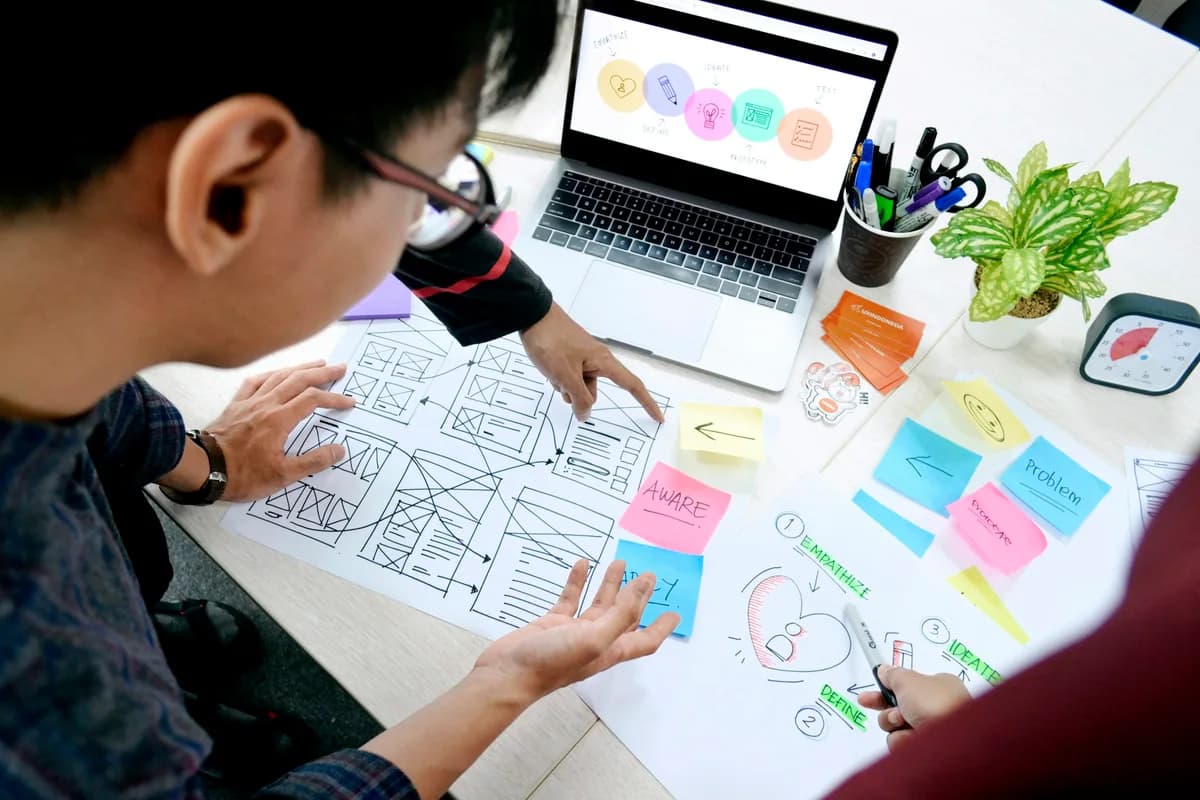
The fictional workshop page looks clear to its creator, but visitors may misunderstand who it is for. We use an interview and a simple task to investigate that uncertainty. The example teaches a method without claiming a measured usability improvement.
Key ideas
- Name the uncertainty before selecting a method.
- Ask about experience rather than inviting praise.
- Record what happened separately from your explanation.
- State the limits of a small research exercise.
Turn a design opinion into a research question
Replace 'the page needs a better button' with 'can a visitor understand how to ask about a session?' The first already assumes a solution. The second lets you observe where the problem begins. Write what you know, what you assume and which decision the research should inform. If you only need to check whether a control can be operated, a practical task may be more relevant than a long interview about general preferences.
Ask for concrete experience
In an interview, ask how the person last found a similar activity and what they needed to know. Avoid a leading question such as 'would our simple page help you?' Invite them to explain a specific action, difficulty or choice. GOV.UK’s research guidance offers a primary reference for planning in-depth interviews. Obtain appropriate consent, avoid unnecessary personal questions and write a short discussion guide so you can compare the evidence across sessions.
Watch the task without supplying the answer
Ask a participant to find the information needed to enquire about the workshop. Observe the first destination, the information they use and where they stop. Do not point to the button while claiming to test its discoverability. Record the action and the wording of the uncertainty. 'Paused at the schedule and asked whether beginners can attend' is an observation; 'all visitors hate the schedule' is an unsupported interpretation. Preserve that distinction in your notes.
Make a bounded design decision
Group observations around the research question, identify contradictions and propose a change with a reason. You might clarify the prerequisites before redesigning the enquiry button. Label the sample and circumstances: a small exercise with acquaintances cannot establish a population-wide success rate. After revising the page, repeat an appropriate task and inspect what changed. Keep unresolved questions for the next session rather than turning every note into a feature request.
In everyday language
Research is like watching someone follow a set of directions you wrote. You learn where the instructions stop helping by observing the attempt. Asking whether the directions look attractive gives a different answer. Choose the activity that exposes the uncertainty you actually need to resolve.
Try it yourself
Write one research question for the workshop page, three neutral interview prompts and a task instruction. Create a note template with separate fields for observation, interpretation and next question.
Expected result
A short plan that could produce evidence for one design decision. The notes preserve what a participant did without inventing general statistics or claiming the exercise represents everyone.
Check your answer: A participant likes the page. Does that verify the enquiry process?
Positive feedback describes an opinion. Test whether the person can identify the required information and complete the relevant task. Record the observed action and any uncertainty; liking the appearance and using the interface are different evidence.
Questions
How many participants are enough?
There is no universal number that establishes every kind of claim. The purpose, method, audience diversity and decision determine the evidence needed. A small teaching exercise can reveal questions to investigate, but it cannot justify a population-wide success percentage. State the scope and limits, and seek methodological advice when the research will support a consequential business or public-service decision.
Can AI replace interviews?
AI can help draft a discussion guide or organise non-sensitive notes, but a simulated answer is not an observation of a real person using your product. Check generated prompts for assumptions and preserve original evidence. If the question concerns actual user behaviour, collect suitable evidence from that behaviour and apply the consent and privacy practices appropriate to the study.
Keep observations, interpretations and decisions separate. Improve the interface around an evidenced problem.
Sources and further reading
- GOV.UK — Using in-depth interviews ↗Sources checked:
- W3C WAI — Accessibility curricula ↗Sources checked:
- MDN — Thinking before coding ↗Sources checked: