
The deepest part of the ocean: Challenger Deep and what a descent would feel like
The deepest part of the ocean is the Challenger Deep, at the southern end of the Mariana Trench in the western Pacific, about 10,935 metres (35,876 feet) down according to NOAA. That is roughly 2 kilometres deeper than Mount Everest is tall (8,849 m), and the water pressure at the bottom is about 1,100 times the pressure at the surface. The average depth of the whole ocean is only about 3,682 metres.
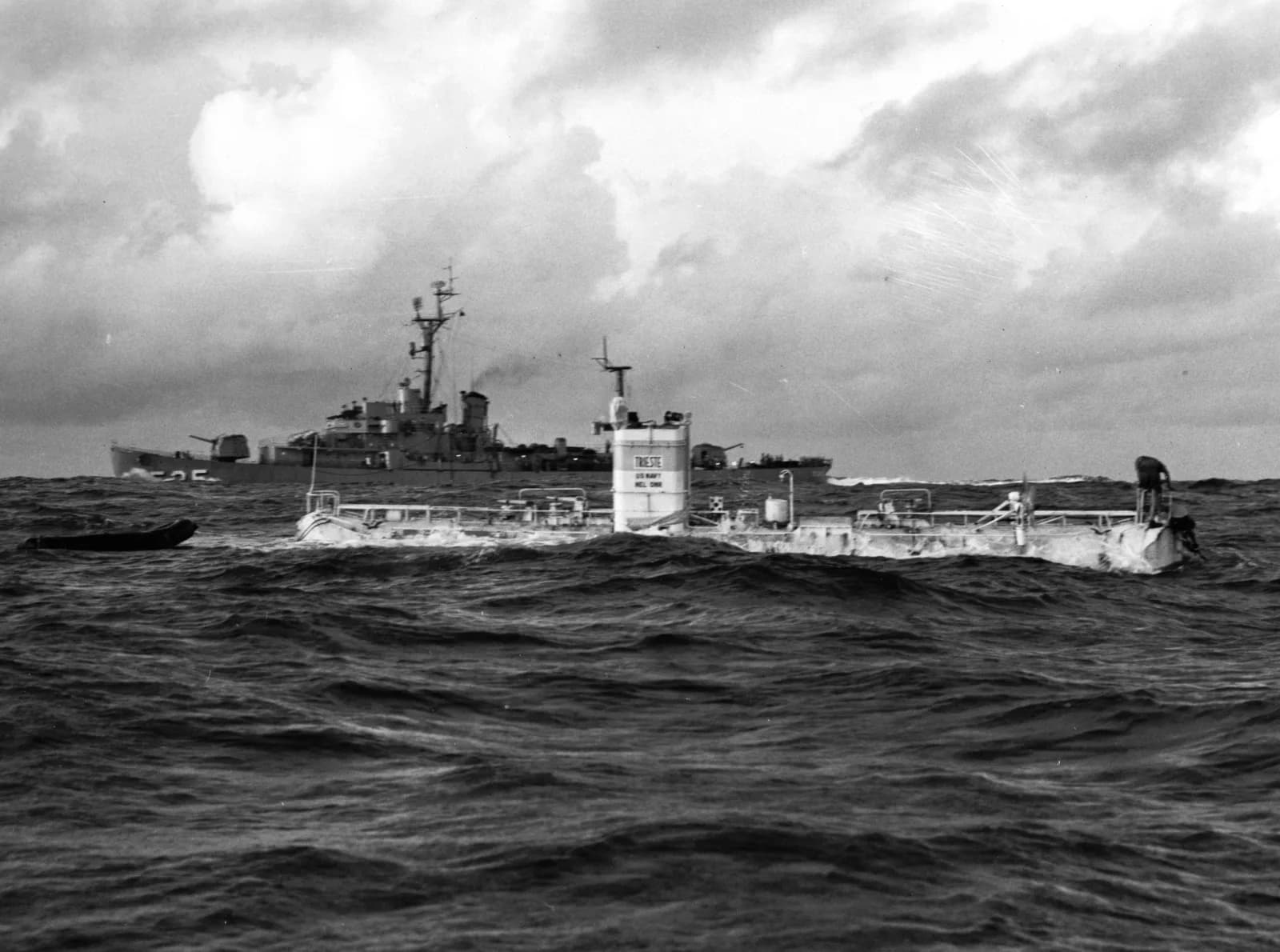
Numbers like 10,935 metres are hard to feel, so this guide goes down the way a diver or a submersible would: first the depth itself and how it was measured, then what the water does to pressure, light and temperature every few hundred metres, and finally who has actually reached the bottom. It is a calm tour of the facts, not a diving manual; deep diving is learned only with a qualified instructor and the right equipment.
Key ideas
- The Challenger Deep is about 10,935 m deep (a 2021 estimate, ±6 m), against an ocean average of 3,682 m.
- Pressure rises by about 1 atmosphere for every 10 m: 4 atm at 30 m, and roughly 1,100 atm at the bottom, about a tonne on every square centimetre.
- Red light fades within the first 10 metres, there is rarely any significant sunlight below 200 m and none below 1,000 m, and the deep water is only a few degrees above freezing.
- Two men reached the bottom in the bathyscaphe Trieste on 23 January 1960; James Cameron went alone in 2012; only a few dozen people in all have been there.
- No one goes to the bottom unprotected: people travel inside sealed vehicles with thick pressure hulls, and the free-diving record on a single breath is 214 m.
How deep is the deepest part of the ocean?
The deepest known point of the ocean floor is the Challenger Deep, in the southern end of the Mariana Trench, several hundred kilometres south-west of the island of Guam. NOAA gives its depth as approximately 10,935 metres (35,876 feet). The place is named after HMS Challenger, whose crew first sounded the depths of the trench in 1875. The Mariana Trench is a long crescent-shaped cut in the seabed; the Challenger Deep is its deepest slot.
Why do books quote slightly different numbers? Measuring a depth of 11 kilometres is hard, because sonar travels through water whose temperature and salinity change on the way down. A 2011 study put the depth at 10,920 ± 9 m, and a 2021 study based on submersible dives in 2020 revised it to 10,935 ± 6 m at a 95 per cent confidence level, which is the figure NOAA uses. Older sources give 10,911 m, 10,916 m or 10,994 m, all within the same range of about 10.9 to 11 kilometres.
For scale, the average depth of the ocean is about 3,682 metres. Mount Everest is 8,849 metres high, so if it stood at the bottom of the Challenger Deep its summit would still lie about 2 kilometres under the surface.
What does pressure do on the way down?
At the surface the air above you presses with about 1 atmosphere (1 atm). Water is heavy: every 10 metres of sea water adds roughly one more atmosphere, so pressure in atmospheres is about 1 + depth in metres ÷ 10. At 10 m that is 2 atm, at 30 m it is 4 atm, and at 100 m it is 11 atm. At the bottom of the Challenger Deep the same rule gives about 1,100 atm; a 1996 survey measured 1,113 bar at 10,897 m. That is about a tonne pressing on every square centimetre.
Gas can be squeezed, and the rule is Boyle’s law: when the pressure doubles, the volume halves. A balloon that holds one litre at the surface holds half a litre at 10 m and a quarter of a litre at 30 m. This is why the air spaces in the body, such as the ears, sinuses and lungs, are what matter on a dive. The rest of the body is mostly water, which hardly compresses at all, so tissue is not simply flattened.
That is the reason nobody goes to the very bottom in the open water. At such a pressure a person needs a sealed vehicle with a thick-walled pressure hull that keeps the inside at normal air pressure. Recreational scuba diving stays far shallower, usually within about 40 metres, and is learned with a qualified instructor.
How do light and temperature change with depth?
NOAA divides the ocean into three zones by light. The upper 200 metres is the sunlight (euphotic) zone. Between 200 and 1,000 metres lies the twilight zone, where light fades rapidly and photosynthesis is no longer possible. Below 1,000 metres the water is dark, because sunlight does not reach it. This dark region is divided further: the midnight zone from 1,000 to 4,000 m, the abyss from 4,000 to 6,000 m, and the hadal zone from 6,000 m down, where the Challenger Deep lies.
Colours disappear before the light does. Water absorbs red light first, within roughly the first 10 metres, then orange and yellow, and blue light travels deepest, which is why the sea looks blue and a red fish looks grey at depth. In the deep sea the water is cold, only a few degrees above freezing; the 1996 survey measured 2.6 °C at 10,897 m.
Life reaches even these depths. In 2017 researchers recovered samples and photographs of a new species of snailfish, Pseudoliparis swirei, from 7,581 metres on the northern slope of the Challenger Deep, where there is no sunlight and the pressure is about 760 atmospheres.
Who has been to the bottom, and what are the records?
The first crewed descent was on 23 January 1960, when Jacques Piccard and US Navy Lieutenant Don Walsh reached the bottom in the bathyscaphe Trieste. The descent took 4 hours 47 minutes; after passing about 9,000 metres a window pane cracked, shaking the vessel, and the two men spent about twenty minutes at the bottom, where the temperature in the cabin was 7 °C. The depth they recorded was about 10,911 to 10,916 m, slightly different from today’s figure.
On 26 March 2012 the film director James Cameron made the first solo descent in the submersible Deepsea Challenger. His descent lasted 2 hours 36 minutes and the recorded depth was 10,908 m. In 2019 explorer Victor Vescovo made four dives to the Challenger Deep in the submersible Limiting Factor, and by mid-2022 a total of 27 people had been to the bottom.
A person on a single breath goes far less deep. The free-diving record in the no-limits discipline, where a weighted sled takes the diver down, is 214 metres, set by Herbert Nitsch in June 2007; there the pressure is more than 20 atm. Such dives are extremely dangerous even for champions, and the same diver was seriously injured in a deeper attempt in 2012.
How the VJOURNAL SMART BOOK shows the descent
The chapter “Deep under the water” in the free SMART BOOK “Everything about everything” on VITON13 SCHOOL follows this same route in five short moments. Beside the text there is a living 3D picture of a diver that you can turn with your finger or mouse, and under it a depth slider from the surface to the bottom of the Challenger Deep.
As you drag the slider the numbers change on the spot: the pressure in atmospheres (1 + depth ÷ 10), how much a balloon of air shrinks, and the colour of the water as the light fades. The chapter ends with three facts and a three-question quiz, and every number comes from the sources listed below. It is a way to try the rule yourself instead of only reading it.
In everyday language
Imagine the ocean as a tall stack of ten-metre blocks of water. Each block sitting on you adds one more “atmosphere” of push. Ten blocks is 100 metres, a thousand blocks is the bottom of the Challenger Deep, and the push there is so big that only a strong steel or glass ball can keep people safe inside.
Try it yourself
Open the chapter “Deep under the water” in the SMART BOOK “Everything about everything”, drag the depth slider to 30 m and write down the pressure, then drag it to the very end.
Expected result
4 atm at 30 m (1 + 30 ÷ 10), and at the end of the slider about 1,100 atm, with the water dark and cold.
Check your answer: A balloon holds 1 litre of air at the surface. About how much does it hold at 30 m, where the pressure is 4 atm?
About a quarter of a litre. By Boyle’s law four times the pressure means a quarter of the volume.
Questions
How deep is the Mariana Trench?
Its deepest point, the Challenger Deep, is about 10,935 metres (35,876 feet) below sea level according to NOAA. Sources give 10.9 to 11 kilometres because the depth is hard to measure.
Is the Mariana Trench deeper than Mount Everest is tall?
Yes. Everest is 8,849 metres high, and the Challenger Deep is about 2,000 metres deeper than that, so Everest would still be covered by roughly 2 kilometres of water.
Could a person survive the pressure at the bottom of the ocean?
Not in the open water. People have reached the bottom only inside sealed vehicles with thick pressure hulls that keep the inside at normal air pressure: the Trieste in 1960 and several submersibles since.
How long does it take to reach the bottom of the Challenger Deep?
The Trieste took 4 hours 47 minutes in 1960; James Cameron’s Deepsea Challenger took 2 hours 36 minutes in 2012. Modern submersibles take a few hours.
How cold is the deep sea?
Only a few degrees above freezing. A 1996 survey measured 2.6 °C at 10,897 m in the Challenger Deep.
The deepest part of the ocean, the Challenger Deep, is about 10,935 metres down; each 10 metres adds one atmosphere, the light is gone below 1,000 metres and the bottom is reached only in sealed vehicles. To see the pressure rise as you drag a slider, open the free “Deep under the water” chapter of the VJOURNAL SMART BOOK.
Sources and further reading
- NOAA Ocean Service: How deep is the ocean? ↗Sources checked:
- NOAA Ocean Service: How far does light travel in the ocean? ↗Sources checked:
- Wikipedia: Challenger Deep (depth surveys, 1996 pressure and temperature, 2012 descent) ↗Sources checked:
- Wikipedia: Bathyscaphe Trieste (the dive of 23 January 1960) ↗Sources checked:
- Wikipedia: Herbert Nitsch (free-diving no-limits record of 214 m) ↗Sources checked: