
The death zone on Everest: what happens to the body above 8,000 metres
The death zone is the altitude above about 8,000 metres (26,247 feet), where the air pressure falls below about 35 per cent of its sea-level value and the body can no longer acclimatise: it uses oxygen faster than it can take it in. On Everest, whose summit is 8,849 m, the air pressure is about one third of that at sea level, although the air is still about 21 per cent oxygen. Most climbers who go that high breathe bottled oxygen.
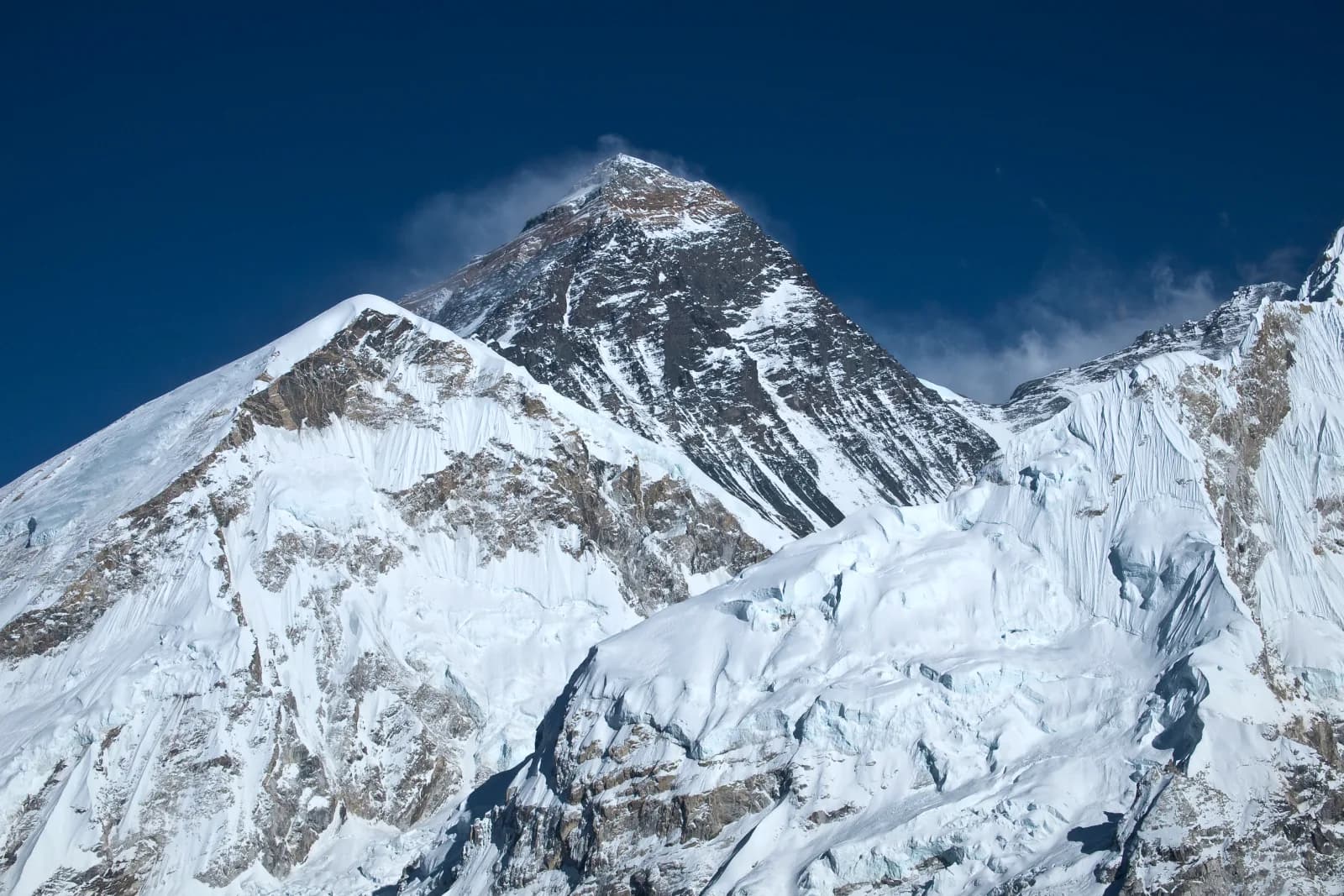
“Death zone” sounds like a wall in the sky, but it is a convention: a round number where the body’s defences stop working. This guide explains where the number comes from, how thin the air on top of Everest really is, what doctors measured in the blood of climbers there, and how a few people have reached the summit without bottled oxygen. It is a description of the physics and physiology, not climbing advice.
Key ideas
- The death zone starts at about 8,000 m; all 14 mountains higher than that, the “eight-thousanders”, are in the Himalaya and Karakoram, and Everest is 8,849 m.
- The air is still about 21 per cent oxygen at every height; what falls is the pressure: half at about 5,500 m and about one third (253 Torr) on the summit of Everest.
- That equals breathing air with only about 7 per cent oxygen at sea level; in blood samples taken at 8,400 m the oxygen pressure was only about 25 mmHg.
- Acclimatisation takes days to weeks and has limits: above 8,000 m the body deteriorates even at rest, so most climbers use bottled oxygen and spend little time there.
- Reinhold Messner and Peter Habeler reached the summit without bottled oxygen in 1978, which many had thought physiologically impossible.
What is the death zone on Everest?
In mountaineering the death zone means the altitudes above which the pressure of oxygen is not enough to sustain human life for an extended time. The line is generally drawn at 8,000 metres (26,247 feet), where the air pressure is below about 356 millibars, against 1,013 at sea level. The idea goes back to the Swiss doctor Edouard Wyss-Dunant, who in the early 1950s wrote about a “lethal zone”. The 14 mountains that rise above 8,000 metres, all in the Himalaya and Karakoram of Asia, have their summits inside it.
Everest is the highest of them. Its height was set at 8,848.86 metres by a joint survey of China and Nepal announced in December 2020, and it is usually rounded to 8,849 m. So the summit lies about 850 metres above the start of the death zone.
Because pressure falls smoothly with height, there is no sharp edge: the body does not change at 7,999 metres. Some researchers, for example at a high-altitude institute in Bolivia, dispute the idea of a strict “zone” and point out that people can tolerate very low oxygen in some medical and natural conditions. The number is useful because it marks roughly where, for a healthy visitor, oxygen runs out faster than any rest can repair.
How thin is the air on top of Everest?
Air at the summit is not poorer in oxygen by share: it is about 20.9 per cent oxygen at every height we climb. What falls is the total pressure. Air pressure halves at about 5,500 metres, the height of Everest Base Camp. On the summit the pressure was measured directly at 253 Torr in October 1981, and again within about 1 Torr in May 1997. On the days when the mountain is normally climbed it is 251–253 Torr, against 760 Torr at sea level, or about 33 per cent.
Oxygen pressure falls in the same proportion. A simple calculation shows the effect: at sea level oxygen contributes 0.21 × 760 ≈ 160 Torr, on the summit only 0.21 × 253 ≈ 53 Torr. In other words each breath on the summit contains about a third of the oxygen molecules of a breath at the sea, which is like breathing air that has only about 7 per cent oxygen (0.21 × 0.33).
The pressure also changes a little with the weather and the season. The physician and mountaineer Tom Hornbein wrote that physiologists once thought that on the very top an acclimatised person could do no work at all. The first ascent in 1953 by Edmund Hillary and Tenzing Norgay showed that this was not so.
What does the body do, and why can it not keep up?
When the oxygen pressure drops, the body responds. You breathe deeper and faster, the heart beats faster, and over days and weeks the blood makes more red cells, which is called acclimatisation. A 2009 study in the New England Journal of Medicine took arterial blood from 10 climbers on the way up and down Everest. Their haemoglobin rose so much that the oxygen content of their arterial blood stayed at or above sea-level values until they reached 7,100 metres.
Above that the compensation is not enough. At 8,400 metres, where the barometric pressure was 272 mmHg, the mean oxygen pressure in the climbers’ arterial blood was only 24.6 mmHg, against roughly 80 to 100 mmHg in a healthy person at sea level, and the oxygen content of their blood was 26 per cent lower than at 7,100 metres. The climbers were breathing so hard that carbon dioxide in their blood fell to about a third of the normal level. This is why climbers in the death zone are slow, tired and cannot recover by resting: the body uses up its oxygen stores faster than it can replace them, and digestion and sleep suffer.
How fast the change comes matters. Hornbein notes that an unacclimatised person taken suddenly to the height of Everest, as the balloonists of the 19th century were, would lose consciousness within a couple of minutes. Climbers survive only because they spend weeks going up gradually, and then they limit their time on the highest ground.
How do people survive in the death zone, and what is altitude sickness?
Most climbers above 8,000 metres breathe bottled oxygen from a mask, which raises the oxygen in each breath. The first people to stand on the summit, Hillary and Tenzing in 1953, used it. On 8 May 1978 the Austrian Peter Habeler and the Italian Reinhold Messner made the first ascent without it. Many people had believed that to be physiologically impossible, and the feat is still counted among the extreme achievements of human physiology.
Altitude illness begins much lower than the death zone. The NHS describes altitude sickness as something that can happen above about 2,500 metres, usually 6 to 10 hours after arrival, with headache, loss of appetite, nausea, tiredness, dizziness and poor sleep. It is more likely when people go up quickly, and it usually gets better in one to three days with rest.
The serious forms are fluid on the lungs or brain. Confusion, loss of balance, breathlessness at rest, a wet cough or blue lips are signs that the NHS says need urgent medical help and a move to a lower altitude. The rule of mountain medicine is therefore simple: ascend slowly, rest when unwell, and go down if symptoms worsen.
How the VJOURNAL SMART BOOK shows the thin air
The chapter “High on a mountain” in the free SMART BOOK “Everything about everything” on VITON13 SCHOOL shows these numbers in five short moments. Beside the text there is a living 3D picture of a mountain that you can turn with your finger or mouse, and under it an altitude slider from sea level to the summit of Everest.
Drag the slider upwards and the sandbox recalculates on the spot: the air pressure, the oxygen bar that shrinks to a third, and the boiling point of water, which falls to about 70 °C at the top. The chapter ends with three facts and a three-question quiz, and the numbers come from the sources listed below.
In everyday language
Imagine a room where every breath you take hands you 100 tiny oxygen beads. At the sea you get all 100. Half-way up Everest you get 50, and on the very top only about 33. You are still breathing the same kind of air; there is just much less of it in every breath.
Try it yourself
Open the chapter “High on a mountain” in the SMART BOOK “Everything about everything”, drag the altitude slider to about 5,500 m and then to the top of Everest, and note the pressure and the boiling point of water.
Expected result
About half of the sea-level pressure at 5,500 m, about one third (0.33 atm) on the summit, an oxygen pressure of about 0.07 atm, and water boiling at about 70 °C.
Check your answer: The air on top of Everest is still about 21 per cent oxygen. Why is breathing there so much harder?
Because the total air pressure is about one third of that at sea level, so each breath holds only about a third as many oxygen molecules, even though the share stays the same.
Questions
At what height does the death zone start?
At about 8,000 metres (26,247 feet), where the air pressure is below about 356 millibars. It is a convention, not a sharp line, because pressure falls gradually with height.
Can you climb Everest without bottled oxygen?
A few people have: Reinhold Messner and Peter Habeler were the first, on 8 May 1978. Most climbers use bottled oxygen, and the few who do not still need weeks of acclimatisation.
Why is it called the death zone?
Because above about 8,000 metres the body cannot acclimatise: it uses its oxygen stores faster than it can replace them, so a long stay without extra oxygen leads to loss of function. Falls and poor decisions made under stress add to the danger.
How many mountains are in the death zone?
Fourteen, the “eight-thousanders”, all in the Himalaya and Karakoram. Everest, at 8,849 metres, is the highest.
Does altitude sickness happen below the death zone?
Yes. It can start above about 2,500 metres, usually with headache, nausea and poor sleep, and often improves with rest. Confusion, breathlessness at rest or loss of balance need urgent medical help and descent.
The death zone starts at about 8,000 metres, where air pressure is only about a third of the sea-level value and the body cannot adapt; on Everest each breath holds about a third of the oxygen. To see the pressure and the oxygen bar fall as you drag a slider, open the free “High on a mountain” chapter of the VJOURNAL SMART BOOK.
Sources and further reading
- PubMed: Grocott et al., Arterial blood gases and oxygen content in climbers on Mount Everest (NEJM, 2009) ↗Sources checked:
- PubMed: West, Barometric pressures on Mt. Everest: new data and physiological significance (J Appl Physiol, 1999) ↗Sources checked:
- PBS NOVA: Hornbein, Higher than Everest? (and West, Climbing without O’s) ↗Sources checked:
- NHS: Altitude sickness ↗Sources checked:
- Wikipedia: Death zone (mountaineering): the 8,000 m convention and Wyss-Dunant ↗Sources checked: