
How is lightning formed? Charge in the cloud, the leader and the flash
Lightning forms when collisions between ice crystals and small hail inside a thunderstorm cloud separate electric charge, so that positive charge gathers near the top of the cloud and negative charge in the middle. When the difference becomes too great, the air, normally an insulator, breaks down and a giant spark of electricity discharges it. The channel heats the air to about 50,000 °F (roughly 28,000 °C), and the air bursts outwards as thunder.
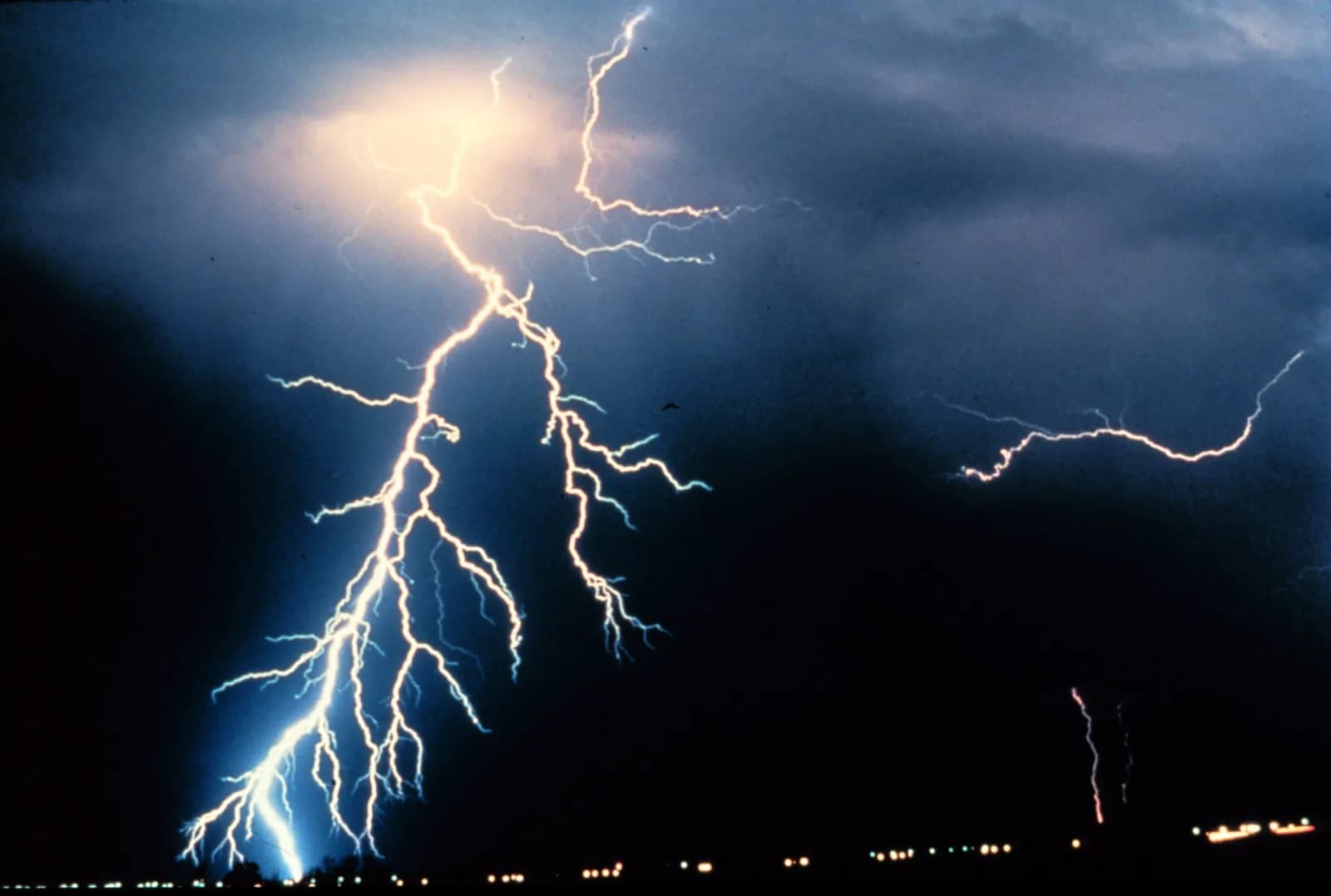
Lightning is one of the oldest natural phenomena people have watched, yet scientists still debate some of the details of how a cloud builds up its charge. This guide follows the best-supported account step by step: how the cloud becomes a battery, what happens in the few thousandths of a second of a flash, why the flash is followed by thunder, how to estimate the distance by counting, and what weather services say to do when you hear it.
Key ideas
- Collisions between small hail (graupel) and ice crystals in a tall storm cloud separate charge; the details are still debated, but the cloud ends up with positive charge on top and negative charge in the middle.
- A stepped leader runs down from the cloud in short steps, a spark rises to meet it, and the return stroke that runs back up the channel produces the bright flash.
- The channel heats the air to about 50,000 °F, five times hotter than the surface of the Sun; the air expands explosively and we hear thunder.
- Count the seconds from flash to thunder: divide by 3 for kilometres or by 5 for miles.
- If you can hear thunder you are close enough to be struck: the NWS says go into a substantial building or a closed metal-topped vehicle and stay there at least 30 minutes after the last thunder.
How does a storm cloud become electrically charged?
A thunderstorm begins when the Sun heats the ground and pockets of warm air rise. Towering cumulus clouds grow upwards until the top flattens into an anvil. Inside, a well-developed cloud contains small ice crystals in the upper levels, a mixture of crystals and small hail in the middle, and rain and melting hail below. Strong updrafts keep these particles moving and colliding.
Scientists think the first step involves small soft hail called graupel, a fraction of a millimetre to a few millimetres wide, growing as it collects supercooled water droplets. When graupel collides with and bounces off smaller ice particles, the graupel gains one sign of charge and the ice particle the other. The smaller ice particles are carried upward faster by the updraft, so the two kinds of charge are pulled apart.
The result, as the NWS describes it, is a cloud with the top positively charged and the middle and lower part negatively charged, plus a small positive pocket near the bottom. The negative charge in the middle makes the ground below positive by contrast. NOAA’s National Severe Storms Laboratory adds an honest note: we know what conditions are needed to produce lightning, but there is still debate about exactly how a cloud builds up its charges.
What happens in a flash: the leader and the return stroke
Air is an insulator, so it holds the opposite charges apart for a while. When the difference becomes too large, the insulation breaks down and there is a rapid discharge of electricity, which is lightning. Most flashes start inside the cloud, and most of them stay there: NSSL says there are roughly 5 to 10 times as many cloud flashes as flashes that reach the ground.
A flash that is going to strike the ground sends a channel downward, called a stepped leader because it advances in short steps as the air ahead becomes ionised. When the leader gets within roughly a hundred yards (about 90 metres) of the ground, objects such as trees, buildings and bushes send up sparks to meet it. When one spark connects, a huge current surges along the whole channel. That surge, the return stroke, is what produces the bright flash we see, and it all happens in a few thousandths of a second, too fast for the eye to follow the formation.
Tall objects are more likely to send up a connecting spark, so trees, skyscrapers and mountains are struck often, but lightning can also strike open ground even when trees are close by. NSSL gives the voltage of a typical flash as 100 million to 1 billion volts, with billions of watts of power.
Why does lightning make thunder, and how far away is it?
Thunder is the sound of the flash. The lightning channel heats the air around it to around 50,000 degrees Fahrenheit (about 28,000 °C), roughly five times hotter than the surface of the Sun, in a few millionths of a second. The air has no time to expand, so it is at a very high pressure and bursts outwards as a shock wave, which fades into the sound we hear. Straight after the flash the air cools and contracts again.
The sound rumbles because the flash is long. You first hear the thunder from the nearest part of the channel, then from parts farther and farther away, and high-pitched sounds fade faster in the air than low ones. A sharp crack means the channel passed nearby; a low rumble means it was several miles away. The NWS says thunder can normally be heard about 10 miles (16 km) from a strike.
Light reaches you almost instantly, but sound travels about one third of a kilometre (one fifth of a mile) each second. Count the seconds between the flash and the thunder and divide by 3 to get the distance in kilometres, or by 5 to get miles: 9 seconds is about 3 km, 15 seconds is about 3 miles. Do the counting from a safe place.
How common is lightning, and what should you do when you hear thunder?
Lightning is happening somewhere on Earth all the time. Counting from satellites, NASA scientists using the Optical Transient Detector found about 1.4 billion flashes a year, an average of 44 ± 5 every second, with a land-to-ocean ratio of about 10 to 1. An older estimate of 100 flashes a second, made in 1925, turned out to be too high. In the United States lightning strikes the ground about 25 million times a year, and it kills about 20 people a year, according to the NWS.
The NWS rule is “When thunder roars, go indoors”. If you hear thunder, lightning is close enough to strike you. Move to a substantial building with electricity or plumbing, or to an enclosed metal-topped vehicle with the windows up, and stay there at least 30 minutes after you hear the last thunder. Indoors, stay off corded phones and electrical equipment that connects you directly to the mains, and avoid plumbing such as sinks and baths.
Lightning can strike many kilometres from the storm, even from a blue sky at its edge. For people who are caught outside with no shelter, the NWS lists last-resort steps, among them getting off hills and ridges, never lying flat on the ground, never sheltering under an isolated tree and getting away from water. It is much safer to leave in good time than to rely on them.
How the VJOURNAL SMART BOOK shows a thunderstorm
The chapter “In a thunderstorm” in the free SMART BOOK “Everything about everything” on VITON13 SCHOOL goes through the same story in five short moments. Beside the text there is a living 3D picture of a storm cloud that you can turn with your finger or mouse, and under it a sandbox: set the seconds between the flash and the thunder, and the air temperature, and the page gives the distance and the speed of sound (about 343 m/s at 20 °C).
The chapter ends with three facts and a three-question quiz, including the “divide by three” rule from this guide, and every number comes from the sources listed below. It is a way to test the counting trick yourself before the next storm.
In everyday language
Rub a balloon on your hair and it makes a tiny spark when it touches something. A storm cloud does the same thing on a giant scale: ice and hail rub together inside the cloud until the cloud is full of electricity, and when the air can no longer hold it back, the electricity jumps as a huge spark. The air that the spark heats up goes bang, and that bang is thunder.
Try it yourself
Open the chapter “In a thunderstorm” in the SMART BOOK “Everything about everything”, set the seconds between flash and thunder to 9, and then change the air temperature between 0 °C and 30 °C.
Expected result
A distance of about 3 km, and a speed of sound of about 331 m/s at 0 °C and about 349 m/s at 30 °C, so thunder arrives a little sooner in hot air.
Check your answer: You see a flash and hear the thunder 15 seconds later. About how far away is the lightning, and what should you do?
About 5 km (15 ÷ 3) or 3 miles (15 ÷ 5). It is close enough to be dangerous, so go into a substantial building or a closed car and wait at least 30 minutes after the last thunder.
Questions
What causes lightning, in one sentence?
Collisions between hail and ice in a storm cloud separate electric charge until the air between the opposite charges can no longer insulate, and a giant spark discharges them.
Is lightning hotter than the Sun?
The air in a lightning channel can reach about 50,000 °F (roughly 28,000 °C), which is about five times hotter than the surface of the Sun, but only for a few millionths of a second.
How do you tell how far away lightning is?
Count the seconds between the flash and the thunder and divide by 3 for kilometres or by 5 for miles. Sound travels about a third of a kilometre per second.
How many times does lightning strike the Earth?
About 1.4 billion flashes a year, an average of 44 every second, counting flashes inside clouds as well as flashes to the ground, as measured from space by NASA’s Optical Transient Detector. Most are over land.
Is it safe to go outside again when the thunder stops?
Not at once. The NWS says to stay in safe shelter for at least 30 minutes after you hear the last thunder, because lightning can still strike from a storm that is moving away.
Lightning is a giant spark that discharges a storm cloud after ice and hail have separated its charge; the flash heats the air to about 50,000 °F and the bang is thunder. Count the seconds to find the distance, and go indoors when you hear it. To try the counting rule yourself, open the free “In a thunderstorm” chapter of the VJOURNAL SMART BOOK.
Sources and further reading
- NOAA National Severe Storms Laboratory: Severe Weather 101, Lightning basics ↗Sources checked:
- National Weather Service: Understanding Lightning, Thunder ↗Sources checked:
- National Weather Service: Overview of lightning science and safety ↗Sources checked:
- National Weather Service: Lightning safety tips ↗Sources checked:
- Christian et al.: Global frequency and distribution of lightning as observed from space by the Optical Transient Detector (J. Geophys. Res., 2003) ↗Sources checked: