
How do airplanes fly? Lift, the four forces and why the “equal transit” story is wrong
An airplane flies because its wings turn the passing air downwards and the air pushes the wings up with an equal and opposite force, called lift. In steady level flight lift equals weight and thrust equals drag. Lift follows L = ½·ρ·v²·S·C_L, so it grows with the square of speed: a light plane of 1,100 kg with 16 m² of wing needs about 47 m/s, roughly 169 km/h, at a lift coefficient of 0.5.
Many of us were taught that air has to travel farther over the top of a wing and “catch up” with the air below, and that this makes lift. NASA’s own education pages call that explanation incorrect. Below are the forces, the lift formula with worked numbers, what is wrong with the myth, and why a wing stalls.
Key ideas
- Four forces act on a plane: lift, weight, thrust and drag. In level flight lift balances weight and thrust balances drag.
- A wing makes lift by turning air downwards; the air pushes back up. Lower pressure above and higher pressure below describe the same push.
- Lift grows with the square of speed: doubling speed gives four times the lift, other things equal.
- The “equal transit time” story is wrong: air above and below do not have to meet at the back, and planes with flat or symmetric wings fly, even upside down.
- A stall happens when the wing is tilted too steeply, about 15 to 16 degrees for many wings, and air stops following the surface. The fix is to lower the nose.
The four forces in balance
Every aircraft has four forces acting on it. Lift pushes it up, weight pulls it down, thrust from the engine or propeller pulls it forward, and drag, the resistance of the air, holds it back. In steady level flight they balance in pairs: lift equals weight, and thrust equals drag.
For a small plane of 1,100 kg the weight is W = m·g = 1,100 × 9.81 ≈ 10,800 N, so the wings must give exactly that much lift. If lift is bigger, the plane climbs; if it is smaller, it sinks.
Lift is a mechanical force that needs air. NASA points out that the Space Shuttle did not stay in space because of its wings: with no air there is no lift, and orbital speed does the job. Lift also needs motion between the wing and the air: no motion, no lift.
How a wing makes lift: it turns the air
NASA Glenn describes lift in one sentence: it occurs when a moving flow of gas is turned by a solid object. The flow turns in one direction, and by Newton’s third law the lift acts in the opposite direction. Both the top and the bottom of the wing take part in turning the air, and leaving out the upper surface leads to a wrong theory.
The same push can be described by pressure. The pressure around the wing is lower on top and higher below, and adding up that pressure over the whole wing gives the lift. NASA notes that “Bernoulli” and “Newton” are just labels for two camps, because neither man tried to explain aerodynamic lift. The two views describe one flow, and a correct explanation must account for the whole flow around the wing.
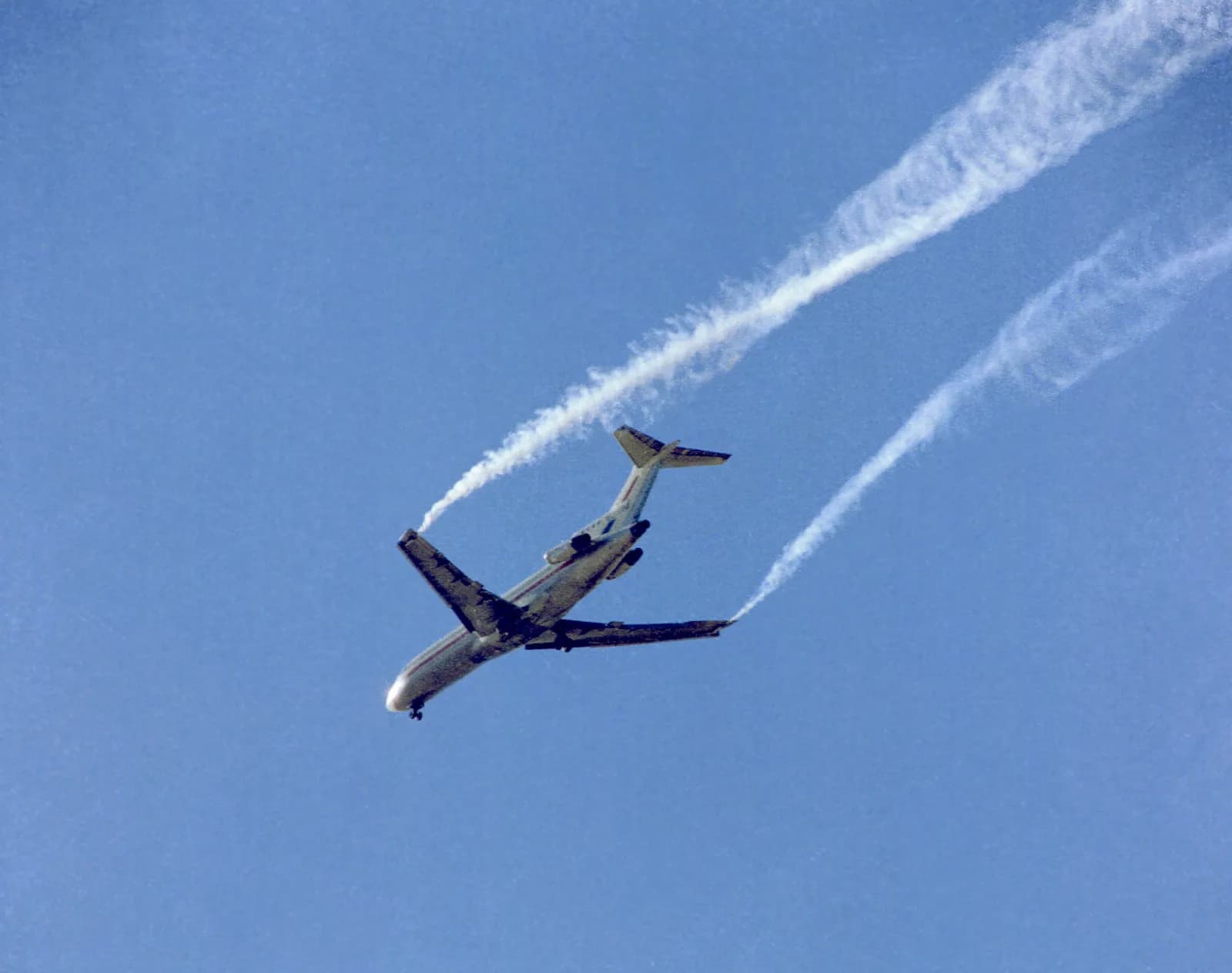
The photo of the Boeing 727 shows a by-product. White smoke released at each wingtip curls into swirling air, the wingtip vortices, which are left behind whenever a wing carries weight.
The lift formula, with numbers
Engineers write lift as L = ½·ρ·v²·S·C_L. Here ρ (rho) is air density, 1.225 kg/m³ at sea level, v is speed in metres per second, S is the wing area, and C_L is the lift coefficient, which collects the effects of wing shape and angle into one number. The quantity ½·ρ·v² is called dynamic pressure.
Take a light aircraft with S = 16 m² and C_L = 0.5. For level flight, L must equal 10,800 N, so v² = 2 × 10,800 / (1.225 × 16 × 0.5) ≈ 2,204 and v ≈ 47 m/s, about 169 km/h. Because v is squared, doubling the speed gives four times the lift.
Raise the angle a little, or lower flaps, and C_L grows. At C_L = 1.5 the same plane needs only v ≈ 27 m/s, about 98 km/h. This is why planes slow down for landing but extend flaps.
The myth: air must “catch up” over the wing
The equal transit theory says a wing has a longer upper surface, so air going over the top must move faster to meet the air below at the trailing edge, and that faster flow means lower pressure. It is one of the most widely repeated explanations, and NASA Glenn calls it one of the most widely circulated incorrect ones.
NASA goes through its claims. A wing does not need a longer top: a symmetric wing makes plenty of lift, a paper plane is a flat plate with top and bottom the same length, and some modern low-drag wings have a longer lower surface. The theory also fails to explain planes flying upside down, where the longer surface would be below.
The flow over the top really is faster than below. But it is much faster than the equal-transit story needs, and two neighbouring bits of air at the front do not end up together at the back. The pressure difference is real; the supposed reason for it is not.
Angle of attack, stall and glide
The angle between the wing and the oncoming air is the angle of attack. Raising it increases C_L almost in a straight line, up to about 15 to 16 degrees for many wings; the exact value depends on the wing. Beyond that critical angle the air separates from the top surface, turbulence takes over and lift collapses. That is a stall. Pilot training materials such as the FAA handbook stress that a stall is set by angle of attack, not by speed alone.
To recover, the angle must come down. Lower the nose first, even though the ground is below. Bring the wings level, add power so that speed builds, and raise the nose gently only when the wing is flying again. Pulling up too early brings the stall back. This is a physics explanation, not flying instruction.
A wing keeps working with the engines off. The glide ratio says how far you travel forward for each unit of height lost: sailplanes reach 40:1 to 60:1, and airliners about 15:1 to 20:1. From 10 km up, an airliner at 15:1 can glide about 150 km.
How the VJOURNAL SMART BOOK shows it
The chapter “How planes fly” in the VJOURNAL SMART BOOK Physics, Volume I, has five animated moments. Glowing force arrows are drawn to scale and grow and shrink as the plane climbs or dives, streamlines bend over the wing section, and the plane tips over and sinks when it stalls.
Under the picture is a sandbox. It starts with a plane in a stall and falling; you control pitch and throttle and try to recover it. It is a game of physics, not a flying lesson. The chapter has the full text with worked numbers, a short version in simple words, a quiz with explanations, sources, and the story of the Gimli Glider, a Boeing 767 that glided to a landing in 1983 after running out of fuel.
In everyday language
Imagine holding a flat hand out of a moving car, tilted slightly up: the air pushes your hand up. A wing is a carefully shaped hand. Tilt it too far and the smooth push suddenly breaks away.
Try it yourself
Use L = ½·ρ·v²·S·C_L for a light plane with mass 1,100 kg, wing area S = 16 m², C_L = 0.5 and air density 1.225 kg/m³. Find the speed for level flight, taking W = m·g with g = 9.81.
Expected result
About 47 m/s (169 km/h): the weight is about 10,800 N, so v² = 2 × 10,800 / (1.225 × 16 × 0.5) ≈ 2,204.
Check your answer: The same plane flies twice as fast, at 94 m/s. What happens to lift if the angle of attack does not change?
Lift becomes four times larger, because speed is squared. To stay level, the pilot would have to lower the angle of attack so that C_L falls to about 0.125.
Questions
Do planes fly because of Bernoulli’s principle?
Pressure differences around the wing are real, and Bernoulli’s equation relates pressure to speed. The mistake is the popular reason for the faster air. NASA says the names Bernoulli and Newton are labels for two camps, and what matters is that the wing turns the flow.
Why does a plane stall?
A stall happens when the wing is tilted too steeply, past its critical angle of attack, so air can no longer follow the surface and lift collapses. For many wings that is around 15 to 16 degrees.
Can a plane fly upside down?
Yes, with the nose set at a suitable angle to the airflow. It shows that a longer top surface is not the secret. What matters is turning the air downwards, whichever way up the plane is.
How fast must a plane go to fly?
It depends on weight, wing area, air density and lift coefficient. In the worked example, a 1,100 kg plane needs about 47 m/s at C_L = 0.5, and about 27 m/s at C_L = 1.5, which flaps and a higher angle make possible.
What happens if the engines fail?
The plane glides, because the wing still makes lift. An airliner covers roughly 15 to 20 units forward for each unit of height lost, so from 10 km it can glide on the order of 150 km.
Why can’t airplanes fly in space?
Lift needs air flowing past the wing. In space there is almost none, so wings do nothing, and orbiting craft stay up because of their speed, not lift.
Remember three lines: the wing turns air down and the air pushes it up; lift grows with speed squared; a stall is an angle problem, cured by lowering the nose. Then open the chapter and try to rescue the plane in the simulator.
Sources and further reading
- NASA Glenn Research Center: What is Lift? ↗Sources checked:
- NASA Glenn: Incorrect Theory, the Equal Transit Theory interactive ↗Sources checked:
- NASA Glenn: Bernoulli and Newton ↗Sources checked:
- NASA Glenn: Lift Equation ↗Sources checked:
- FAA: Pilot’s Handbook of Aeronautical Knowledge ↗Sources checked: