
Newton’s laws of motion: the three laws explained, with F = m·a worked examples
Newton’s laws of motion are three rules that say how forces change motion. First, an object keeps its velocity unless a net force acts on it. Second, the net force equals mass times acceleration, F = m·a, so a 10 N push on a 2 kg cart gives 5 m/s². Third, when one body pushes another, it is pushed back with an equal force in the opposite direction.
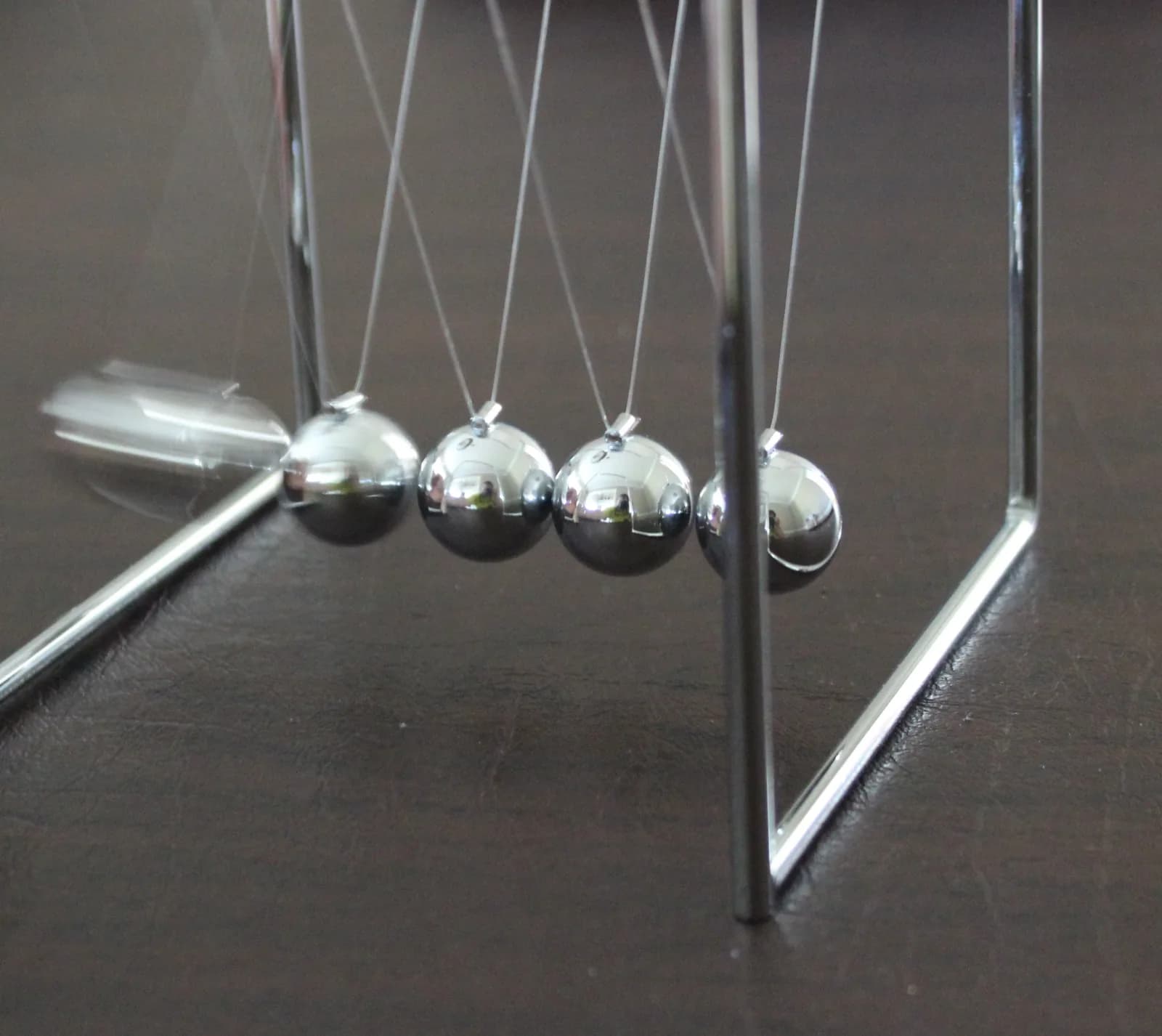
Newton’s three laws of motion are the backbone of school physics: they explain why a puck keeps sliding, why a heavy cart is harder to start than a light one and why a rocket works in empty space. This guide gives each law in plain words, works the numbers for F = m·a, clears up the most common mistake about action and reaction, and says where the laws stop being exact. At the end, a living textbook chapter lets you push the carts yourself.
Key ideas
- First law: with no net force an object keeps its velocity, whether that is zero or constant; this tendency is called inertia.
- Second law: F = m·a. One newton gives 1 kg an acceleration of 1 m/s², so the same push moves a heavy cart less than a light one.
- Third law: forces come in pairs that act on different bodies, so they never cancel each other; this is why a rocket needs no air.
- Newton published the laws in the Principia in 1687; they work extremely well for everyday sizes and speeds, with relativity and quantum physics taking over near the speed of light and inside atoms.
First law: an object keeps doing what it is doing
Newton’s first law says that a body at rest stays at rest, and a body in motion keeps moving in a straight line at constant speed, unless a net external force acts on it. Slide a puck across smooth ice and it glides far; slide it across carpet and it stops almost at once. The ice does not help the puck move: friction is the force that stops it, and on an air hockey table, where a cushion of air nearly removes friction, the puck glides on and on. The tendency to keep the current motion is called inertia, an idea first developed by Galileo and clarified by Newton.
Rest and constant motion are the same case, because both mean that the net force is zero. A book on a table has its weight pulling down and the table pushing up with an equal force, so the net force is zero and nothing changes. In deep space, where almost nothing pushes back, a switched-off probe coasts for millions of kilometres at the same speed. In a braking car, your body tends to keep its forward velocity until the seat belt supplies the force that slows it.
Second law: F = m·a with worked numbers
The second law links a push to its effect: F = m·a, where F is the net force in newtons (N), m is the mass in kilograms and a is the acceleration in m/s². One newton is the force that gives a 1 kg mass an acceleration of 1 m/s²; a 100 g apple weighs about 1 N. Rearranged, a = F/m. A 10 N push on a 2 kg cart gives a = 10/2 = 5 m/s², and the same push on a 5 kg cart gives only 10/5 = 2 m/s².
Acceleration tells how fast the speed changes. From rest, v = a·t and the distance is s = a·t²/2. After 3 s the light cart moves at 5 × 3 = 15 m/s and has gone 5 × 9/2 = 22.5 m, while the heavy cart is at 2 × 3 = 6 m/s and has gone 9 m. For a car, a 1,000 kg car with a net force of 2,000 N accelerates at 2 m/s² and needs about 14 s to reach 100 km/h, which is 27.8 m/s.
Only the net force counts, so friction has to be included. A sliding body feels friction of about f = μ·m·g, where μ is the friction coefficient and g = 9.81 m/s². For a 5 kg cart with μ = 0.2, f = 0.2 × 5 × 9.81 = 9.81 N. Pushed with 20 N, the net force is 20 − 9.81 = 10.19 N and a = 10.19/5 ≈ 2.04 m/s², about half of the 4 m/s² the same push would give without friction. Do not mix up mass and weight: weight is the force m·g, which is 9.81 N for 1 kg on Earth and only 1.62 N on the Moon, while the mass stays 1 kg.
Third law: every push pushes back
Newton’s third law says that when one body exerts a force on a second body, the second exerts an equal force on the first in the opposite direction. Two skaters stand face to face and one pushes the other: both roll away. The forces are equal, but the lighter skater gains more speed. With 50 kg and 70 kg, for example, the lighter one leaves at 1.4 m/s and the other at 1.0 m/s, since 50 × 1.4 = 70 × 1.0.
A common question is why the two forces do not cancel. They act on different bodies: a swimmer pushing off a pool wall pushes the wall, and the wall pushes the swimmer, so only the force on the swimmer changes the swimmer’s motion. A frequent trap is the book on a table. Its weight and the table’s upward push are equal and opposite, but they act on the same body, so they are not a third-law pair. The partner of the book’s weight is the book’s own pull on the Earth.
A rocket works the same way: it throws hot gas backwards, and the gas pushes the rocket forwards. It needs no air to push against, which is why rockets work in space. Walking works too: your foot pushes the ground backwards, and the ground pushes you forwards.
Where the laws come from and where they stop being exact
Isaac Newton set out his three laws in the Principia, published in 1687, together with the law of gravity. With Kepler’s laws they explain why planets move in ellipses, and the same F = m·a describes a hockey puck, a falling stone and the Moon. The method became a model for physics: state simple laws in mathematics, then test them against measurement.
The laws are not the last word. The second law is more generally stated with momentum: the net force equals the change of momentum per unit of time, which is m·a when the mass is constant and also covers a rocket that loses mass as it burns fuel. At speeds close to the speed of light, Einstein’s relativity replaces the laws, and for atoms quantum physics does. For cars, balls, bridges and planets, Newton’s laws are still what engineers use.
Watch the three laws in the VJOURNAL SMART BOOK
The “Newton’s three laws of motion” chapter of the VJOURNAL SMART BOOK physics textbook on VITON13 SCHOOL puts a live experiment beside each paragraph: a puck sliding with almost no friction, two carts given the same 10 N push of which one is heavier, a cart with friction switched on and off, skaters pushing apart, and a rocket throwing gas backwards. Under the picture, a sandbox lets you set the force and the mass and read the acceleration and the speed after 3 s.
Use it as a check on this guide: 10 N on 2 kg should read 5 m/s² and 15 m/s after 3 s, and on 5 kg it should read 2 m/s² and 6 m/s. The chapters that follow apply the same laws to balls, pendulums and planets.
In everyday language
Think of a shopping trolley. Left alone, it keeps standing still or keeps rolling (first law). The same push sends an empty trolley off fast and a full one slowly (second law). And while you push the trolley, it pushes back on your hands (third law).
Try it yourself
In the sandbox, set a force of 10 N and a mass of 2 kg and note the acceleration and the speed after 3 s. Then change the mass to 5 kg and compare.
Expected result
5 m/s² and 15 m/s for 2 kg, then 2 m/s² and 6 m/s for 5 kg.
Check your answer: A 1,200 kg car has a net forward force of 3,000 N. What is its acceleration, and how fast is it moving after 4 s from rest?
a = 3,000 ÷ 1,200 = 2.5 m/s². After 4 s, v = 2.5 × 4 = 10 m/s, which is 36 km/h.
Questions
What are Newton’s three laws of motion in simple words?
First: an object keeps doing what it is doing unless a net force acts on it. Second: the bigger the net force, the bigger the acceleration, and the bigger the mass, the smaller the acceleration, F = m·a. Third: when A pushes B, B pushes A back equally in the opposite direction.
What is the formula for Newton’s second law?
F = m·a: the net force in newtons equals the mass in kilograms times the acceleration in m/s². A 3 kg object with a net force of 12 N accelerates at 4 m/s².
Why do action and reaction forces not cancel out?
Because they act on different bodies. A force only changes the motion of the body it acts on, so the push of a swimmer on the wall and the push of the wall on the swimmer are never added together.
What is the difference between mass and weight?
Mass, in kilograms, is how much matter a body has and how hard it is to accelerate. Weight is the force of gravity, W = m·g: about 9.81 N for 1 kg on Earth and 1.62 N on the Moon.
Do Newton’s laws still hold today?
Yes, for everyday sizes and speeds, which covers most engineering. Close to the speed of light Einstein’s relativity is needed, and inside atoms quantum physics.
Say the three laws in your own words, then test the second one with numbers: 10 N on 2 kg must give 5 m/s². Open the Newton chapter and check it in the sandbox.
Sources and further reading
- OpenStax College Physics 2e: Newton’s first law of motion, inertia ↗Sources checked:
- NASA Glenn Research Center: Newton’s laws of motion ↗Sources checked:
- OpenStax College Physics 2e: Newton’s third law of motion, symmetry in forces ↗Sources checked:
- The Physics Classroom: Newton’s laws ↗Sources checked: