
Foucault pendulum: how it proves that the Earth rotates, with the numbers
A Foucault pendulum is a long, heavy pendulum whose plane of swing slowly appears to turn, which shows that the Earth rotates. Léon Foucault first showed it in Paris in 1851, and the famous version hung in the Panthéon on a 67 m wire. At latitude φ the plane turns by about 15° × sin φ per hour: one full turn a day at the poles, about 32 hours in Paris and no turn at the equator.
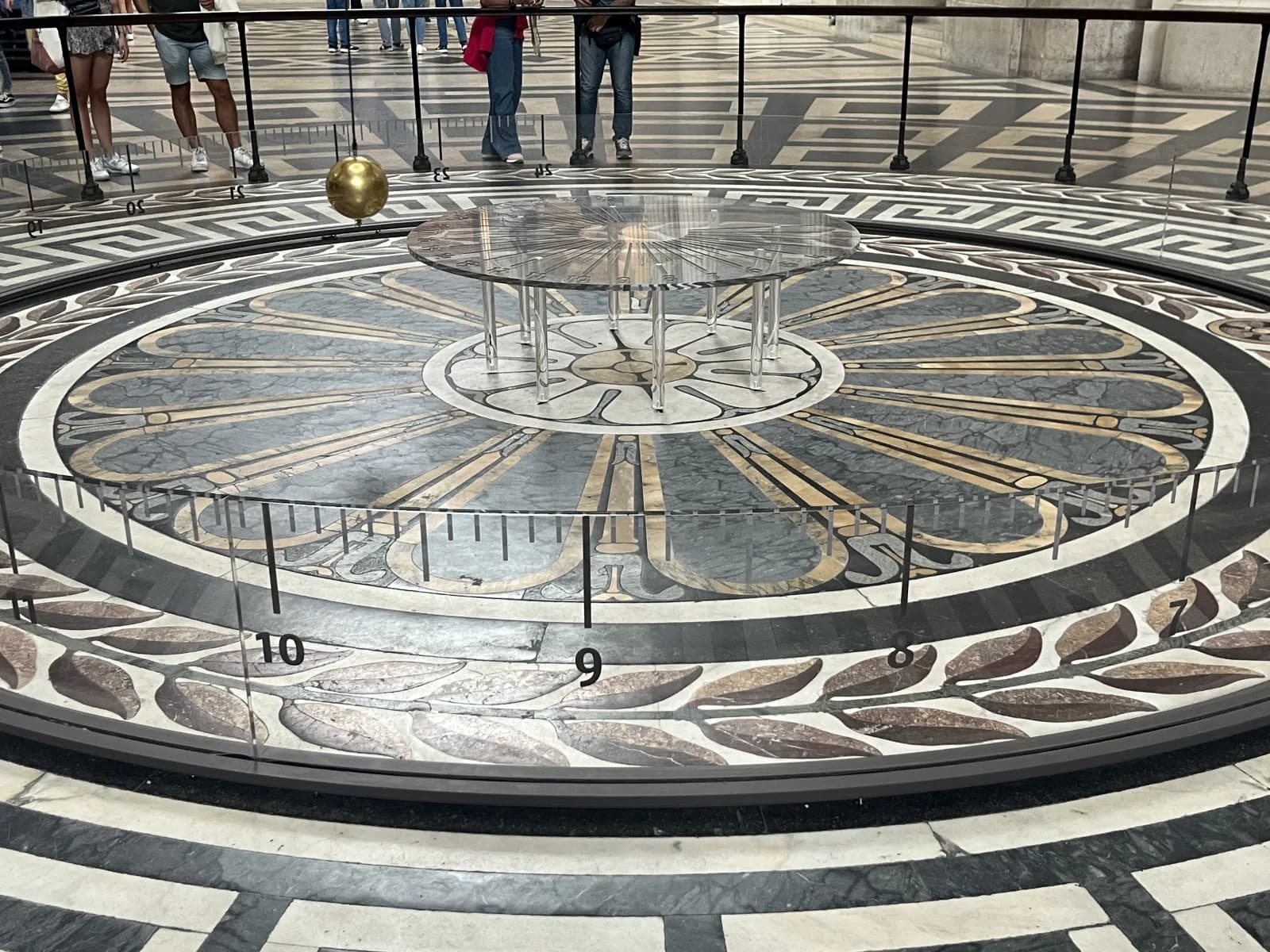
A pendulum in a hall seems to do nothing remarkable, yet over a few hours its line of swing slowly turns, and that turning is a direct sign that the floor under it is rotating. This guide explains what a Foucault pendulum is, how Léon Foucault built the first ones in 1851, how to calculate how fast the plane turns at any latitude and which misunderstandings to avoid. At the end, a living textbook chapter lets you change the length and the planet and compare with the formula.
Key ideas
- The pendulum swings in a plane that stays fixed relative to the stars; the Earth turns beneath it, so the swing appears to rotate.
- The plane turns about 15° × sin(latitude) per hour: one turn a day at the poles, about 11.3° per hour (a turn in about 32 hours) in Paris, nothing at the equator.
- In the Panthéon in 1851 a 28 kg bob hung from a 67 m wire, and its period was T = 2π√(L/g) ≈ 16.4 s.
- The plane turns clockwise in the northern hemisphere and anticlockwise in the southern one.
What a Foucault pendulum is and what it shows
A Foucault pendulum is a very long, heavy pendulum hung so that it can swing freely in any direction. Set swinging in one plane, it seems after some time to change direction: its path slowly rotates relative to the floor. In some museums the bob knocks over pegs or balls set out in a circle, one after another, as the line of swing moves round. The effect is greatest at the poles, becomes smaller towards lower latitudes and disappears at the equator.
The reasoning rests on Newton’s first law. Once a pendulum is swinging, nothing pushes it sideways: gravity and the wire act in the vertical plane, so inertia keeps the plane of swing fixed relative to space, that is, to the distant stars. The Earth turns from west to east under it, so from the floor the swing seems to rotate. At the North Pole the plane stays fixed while the Earth makes one full turn in a sidereal day of 23 hours 56 minutes.
The numbers: how fast the plane turns at your latitude
Foucault gave the rule himself, as a sine law: the time for the plane to come back to its starting direction is 24 hours divided by the sine of the latitude (more exactly, one sidereal day of 23 h 56 min divided by sin φ). As a rate, the plane turns about 15° × sin φ per hour. In Paris, φ ≈ 48.85° and sin φ ≈ 0.753, so the plane turns 15° × 0.753 ≈ 11.3° per hour and needs about 32 hours for a full circle.
The same rule gives other cities. At the latitude of Moscow, 55.75° N, the plane turns about 12.4° per hour and needs about 29 hours; at New York, 40.7° N, about 9.8° per hour and about 37 hours; at Sydney, 33.9° S, about 8.4° per hour and about 43 hours, turning anticlockwise. At 30° latitude the rate is exactly 15° × 0.5 = 7.5° per hour, so a full turn takes about two days.
Each swing turns the plane by a tiny amount. The Paris pendulum has a period T = 2π√(L/g) = 2π√(67/9.81) ≈ 16.4 s, so in one swing the plane turns only 11.3° × 16.4/3,600 ≈ 0.05°. With a swing amplitude of about 6 m, that shifts the path by about 5 mm per swing. This is why a visitor needs patience, and why a long wire and a heavy bob, which keep swinging for hours despite air resistance, make the effect visible.
Paris, 1851: how Foucault did it
Léon Foucault, a French physicist, was inspired by a thin flexible rod on the axis of a lathe, which kept vibrating in the same plane while the lathe turned. In January 1851 he built a pendulum in the cellar of his house and saw it keep its plane in space while the Earth turned. On 3 February 1851 he repeated it for the scientists of Paris at the Paris Observatory, and a few weeks later he hung his most famous pendulum from the dome of the Panthéon: a 28 kg brass-coated lead bob on a 67 m wire.
Starting the pendulum is delicate. The traditional launch ties the bob in its starting position with a thread and burns the thread through with a flame, so that the bob is released with no sideways push. The effect had even been seen before: in 1661 Vincenzo Viviani, a student of Galileo, noticed a pendulum veer, but he took it for a nuisance and did not link it to the Earth’s rotation.
The original 1851 bob was moved in 1855 to the Conservatoire des Arts et Métiers, and an exact copy has swung under the dome of the Panthéon since 1995. Foucault pendulums now hang in many science museums and universities, such as the Griffith Observatory in Los Angeles and the UN General Assembly Building in New York. St Isaac’s Cathedral in Saint Petersburg had one on a 98 m wire from 1931 to 1986.
Why it works, and what people get wrong
Seen from space, the plane of swing stays put and the Earth turns under it. Seen from the Earth, which is a rotating frame of reference, the same thing is described with a fictitious sideways push, the Coriolis force, that bends the bob’s path. Both descriptions predict the same rotation of the plane, 15° × sin φ per hour.
Mass is not what makes it work. Like any pendulum, its period T = 2π√(L/g) does not depend on the mass; the heavy bob only helps it fight air resistance. A symmetrical bob and a suspension with no preferred direction of swing keep the pendulum from veering by itself, which could hide the effect. Because air slows the swing, some museums add an electromagnetic drive, while others restart the pendulum regularly.
A second misunderstanding is that the Earth pushes the pendulum round. Nothing pushes it: the pendulum keeps its direction and the floor moves. That is also why the answer depends on where you stand: the plane does not turn at the equator, turns clockwise seen from above in the northern hemisphere and anticlockwise in the southern. At 30° south latitude, a full anticlockwise turn takes about two days.
Watch it turn in the VJOURNAL SMART BOOK
The “The pendulum” chapter of the VJOURNAL SMART BOOK physics textbook on VITON13 SCHOOL builds up to Foucault in five moments: Galileo and the swinging lamp, the period that depends on the length and not on the weight, energy trading between height and speed, friction turning the swing into heat, and finally Foucault’s pendulum in Paris in 1851, turning with the Earth. A live experiment sits beside each paragraph, and under the picture a sandbox lets you drag the length between 0.3 m and 2.6 m and choose Earth, the Moon or Jupiter.
Check yourself against this guide: a 2 m pendulum should show a period of 2.84 s on Earth, 6.98 s on the Moon and 1.78 s on Jupiter, matching T = 2π√(L/g). Then work out the Foucault rate for your own latitude and see how many hours a full turn of the plane would take.
In everyday language
Hold a pencil still above a record spinning on a turntable. The pencil keeps its direction while the record turns underneath, so from the record the pencil seems to turn. The pendulum’s plane of swing is the pencil, and the Earth is the record.
Try it yourself
In the sandbox, set a pendulum length of 2 m on Earth and note the period, then choose the Moon and note it again. Compare both with T = 2π√(L/g).
Expected result
About 2.84 s on Earth and about 6.98 s on the Moon, where gravity is 1.62 m/s².
Check your answer: At what rate does the plane of a Foucault pendulum turn at latitude 30°, and how long does a full turn take?
15° × sin 30° = 15° × 0.5 = 7.5° per hour, so a full turn takes 360° ÷ 7.5° = 48 hours, about two days.
Questions
How does a Foucault pendulum prove that the Earth rotates?
Nothing pushes the swinging bob sideways, so its plane of swing stays fixed relative to the stars. The floor under it turns with the Earth, so visitors see the plane rotate. If the Earth stood still, the plane would never move.
How fast does a Foucault pendulum turn at my latitude?
About 15° × sin(latitude) per hour. At 40° that is about 9.6° per hour and a full turn in about 37 hours; at the poles it is 15° per hour, one turn a day, and at the equator there is no turn.
Why must a Foucault pendulum be so long?
A long wire gives a long period and a wide, slow swing that keeps going for hours. Wires of 12 to 30 m are common, and the Panthéon’s is 67 m. The sideways drift per swing is only a few millimetres, so a big, slow swing makes it easier to see.
Where can I see a Foucault pendulum?
In the Panthéon in Paris, where an exact copy of the 1851 pendulum swings, and in science museums and universities around the world, such as the Griffith Observatory in Los Angeles and the UN General Assembly Building in New York. Check opening times before you go.
Does a Foucault pendulum work at the equator?
It shows no turning there: at latitude 0° the sine is 0, so the plane stays fixed relative to the ground. The effect grows with latitude and is largest at the poles.
Look up your latitude, multiply 15° by its sine, and you know how fast a Foucault pendulum would turn where you live. Then open the pendulum chapter and watch Foucault’s experiment in its place.
Sources and further reading
- Wikipedia: Foucault pendulum ↗Sources checked:
- MacTutor, University of St Andrews: Léon Foucault ↗Sources checked:
- Wikipedia: List of Foucault pendulums ↗Sources checked:
- HyperPhysics, Georgia State University: The simple pendulum ↗Sources checked: