
How do magnets work? Poles, field lines, domains and why a magnet sticks to iron
A magnet works because a magnetic field surrounds it, and that field pulls on iron and on other magnets. In iron, the tiny magnetic fields of the atoms line up in regions called domains, so their effects add up instead of cancelling. Unlike poles attract and like poles repel. A fridge magnet makes about 5 mT at its surface, roughly 100 times the Earth’s field of about 50 µT, but only within a few centimetres.
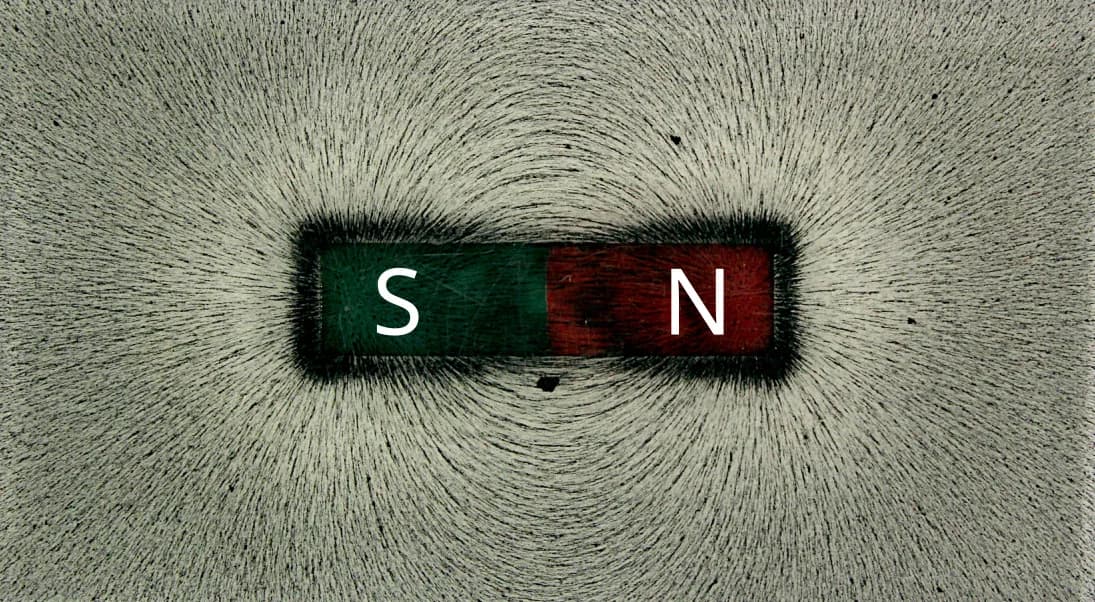
Magnets seem to pull on things through empty space, and it is easy to take that for granted. This guide explains how it works: the poles and the invisible field lines, why a magnet sticks to a steel fridge door but not to wood, what happens inside a piece of iron, and why the whole Earth behaves like a giant magnet that turns a compass needle. It works the numbers, from a fridge magnet to a compass bearing, and ends with a living textbook chapter where you can watch the field lines yourself.
Key ideas
- Every magnet has two poles: unlike poles attract and like poles repel. Cut a magnet in half and you get two smaller magnets, each with both poles; a single isolated pole has never been found.
- Magnetism comes from moving electric charge. In iron, the spin of electrons makes each atom a tiny magnet, and in a magnet these line up in regions called domains.
- Iron, nickel and cobalt are strongly attracted to a magnet; copper, aluminium, wood and plastic are not. Above the Curie point, about 770 °C for iron, iron stops being a magnet.
- The Earth is a giant magnet with a field of about 50 µT at the ground (roughly 25 to 65 µT), made by moving liquid iron in its core. A compass follows it to magnetic north, which is not exactly geographic north.
Poles and field lines
A lump of lodestone, a natural magnet made of the mineral magnetite, sits on a sheet of paper. Sprinkle iron filings around it and they line up in curves that run from one end, the north pole, round to the other, the south pole. Those curves are the field lines, and the field is strongest where they crowd together. Cut a magnet in half and you do not get a lone north and a lone south; you get two smaller magnets, each with both poles. A single isolated magnetic pole has never been observed.
Every magnetic field is made by moving electric charge. An electromagnet uses a current in a coil of wire. In a permanent magnet the “current” is the spin of electrons inside iron atoms, each of which acts as a tiny magnet. In 1820 Hans Christian Ørsted noticed that a current in a wire deflects a compass needle, the first clear sign that electricity and magnetism are two sides of the same force.
Why magnets attract, repel and stick to iron
Bring two magnets together. North against north pushes apart and north against south pulls together: like poles repel and opposite poles attract. A typical fridge magnet makes a field of about 5 mT at its surface, while the Earth’s field at the ground is about 50 µT. Divide: 5 × 10⁻³ / 50 × 10⁻⁶ = 100, so the fridge magnet is a hundred times stronger than the planet at its own surface. The field fades fast with distance. Well beyond the size of a small magnet it falls as the cube of the distance, so at twice the distance only one eighth is left.
A magnet sticks to a steel door because the magnet’s field lines up the domains in the nearby iron, which makes the iron a temporary magnet with its opposite pole facing the magnet. The two attract. Iron, nickel and cobalt, and many alloys of them, respond this strongly. Copper, aluminium, wood, glass and plastic are not attracted in everyday life, and stainless steel depends on the alloy: some types are magnetic and some are not.
Inside iron: domains, heat and a home-made compass
Zoom into iron and you find tiny regions called domains, each a crowd of atoms whose own small magnets point the same way. In an ordinary nail the domains point every which way and cancel out. A magnet is iron whose domains have lined up. Hammering or heating shakes them out of line. Above the Curie point, which Pierre Curie studied in the 1890s, iron stops being magnetic. For iron it is about 770 °C, which is 770 + 273.15 ≈ 1043 K. Once cooled, the domains usually do not line up again by themselves.
You can line domains up yourself. Ask an adult to help, then stroke a steel sewing needle about 50 times in one direction along one end of a magnet, lifting it clear at the end of every stroke. Float the needle on a small piece of cork or a leaf in a bowl of still water and it slowly turns to point roughly north and south. Take care of the sharp point, and keep to small magnets.
The Earth as a magnet, and a compass with numbers
Earth itself is a magnet, and scientists think its field is made by moving liquid iron in the outer core. A magnetised needle on a pivot swings to point roughly north. Chinese writers describe magnetised needles in the 11th century, and Shen Kuo’s Dream Pool Essays, about 1088, notes that such a needle does not point exactly north and south. A compass finds magnetic north, which is not the geographic north of the spin axis. The gap is called declination: at 10°, a 5 km march along the compass bearing ends 5 × tan 10° ≈ 0.9 km to the side of the true line.
Earth’s field reaches far into space and forms the magnetosphere. It bends the charged particles of the solar wind around the planet, and some of them spiral down the field lines near the poles to meet the thin upper air, where they make the glowing curtains of the aurora. Rocks remember the field too: lava that cools on the seabed locks in its direction. The stripes of alternating direction on either side of mid-ocean ridges show that the field has reversed many times, most recently about 780,000 years ago.
Watch a magnet’s field in the VJOURNAL SMART BOOK
The “Magnets and the Earth’s field” chapter of the VJOURNAL SMART BOOK physics textbook (Volume II) on VITON13 SCHOOL puts a living 3D scene beside every paragraph: a lodestone with iron filings settling into field lines, two magnets that push apart or pull together, a compass needle turning to the north, a zoom into iron where the domains line up or scatter with heat, and the Earth’s field wrapped around the globe with a stream of solar particles sliding past. Under the picture, a compass sandbox shows the needle following the field.
Use it as a check on this guide: look for the block that compares a fridge magnet with the planet and divide the two numbers yourself. Everything in the chapter happens on the page. The next chapters show how a current makes a magnet and how a moving magnet makes a current, which is how motors and generators work.
In everyday language
Think of iron as a crowd of tiny compass needles. In an ordinary nail they point every which way, so nothing adds up. In a magnet most of them point the same way, so their pulls add up into one strong field with a north and a south end.
Try it yourself
In the magnets chapter, find the block that compares a fridge magnet with the Earth’s field. Divide the two numbers, 5 mT by 50 µT, and then watch how the iron filings and the compass needle follow the field.
Expected result
5 × 10⁻³ / 50 × 10⁻⁶ = 100: the fridge magnet is about a hundred times stronger than the Earth’s field at its surface.
Check your answer: A compass has a declination of 8°. You walk 10 km along its bearing. How far to the side of the true line do you end up?
10 × tan 8° ≈ 10 × 0.141 ≈ 1.4 km.
Questions
How do magnets work in simple words?
A magnet has a magnetic field around it. In iron, the tiny magnetic fields of the atoms point the same way inside regions called domains, so they add up. The field pulls on iron and on other magnets: unlike poles attract and like poles repel.
Why do magnets attract and repel each other?
Each magnet has a north and a south pole, and its field lines run from north to south. Opposite poles join the lines of the two magnets into one loop and pull together; like poles push the lines apart and repel.
Why do magnets stick to iron but not to wood or aluminium?
Iron, nickel and cobalt have domains that line up in an outside field, so they become temporary magnets and are attracted. Wood, plastic, glass, copper and aluminium have no such domains and show almost no attraction.
Why does heat destroy a magnet?
Heat shakes the domains out of line. Above the Curie point, about 770 °C for iron, the alignment is lost entirely and iron is no longer a magnet. Even hammering or strong shaking can weaken one.
How does a compass work?
A magnetised needle on a pivot lines up with the Earth’s magnetic field and points to magnetic north. It differs from geographic north by the declination, which depends on where you are and can be several degrees.
Are strong magnets dangerous?
Small strong magnets are a hazard if swallowed: two or more can attract each other across the gut walls and cause serious injury, so keep them away from small children. Health agencies also advise keeping strong magnets about 15 cm (6 inches) from pacemakers and other implants.
Put the idea in one sentence: a magnet is iron whose tiny magnets point the same way. Then open the magnets chapter, watch the filings trace the field and divide 5 mT by 50 µT yourself.
Sources and further reading
- HyperPhysics: Magnetic field ↗Sources checked:
- HyperPhysics: Ferromagnetism ↗Sources checked:
- NOAA National Ocean Service: Magnetic poles ↗Sources checked:
- OpenStax University Physics Volume 2: Magnetism and its historical discoveries ↗Sources checked: