
Northern lights explained: what causes the northern lights and why they glow green
The northern lights (aurora borealis) are caused by energy from the solar wind that Earth’s magnetic field funnels toward the polar regions. There, electrons accelerated along the magnetic field lines crash into oxygen and nitrogen in the upper atmosphere, typically 80 to 500 km up, and the excited atoms give the energy back as light: green and red from oxygen, blue and purple from nitrogen.
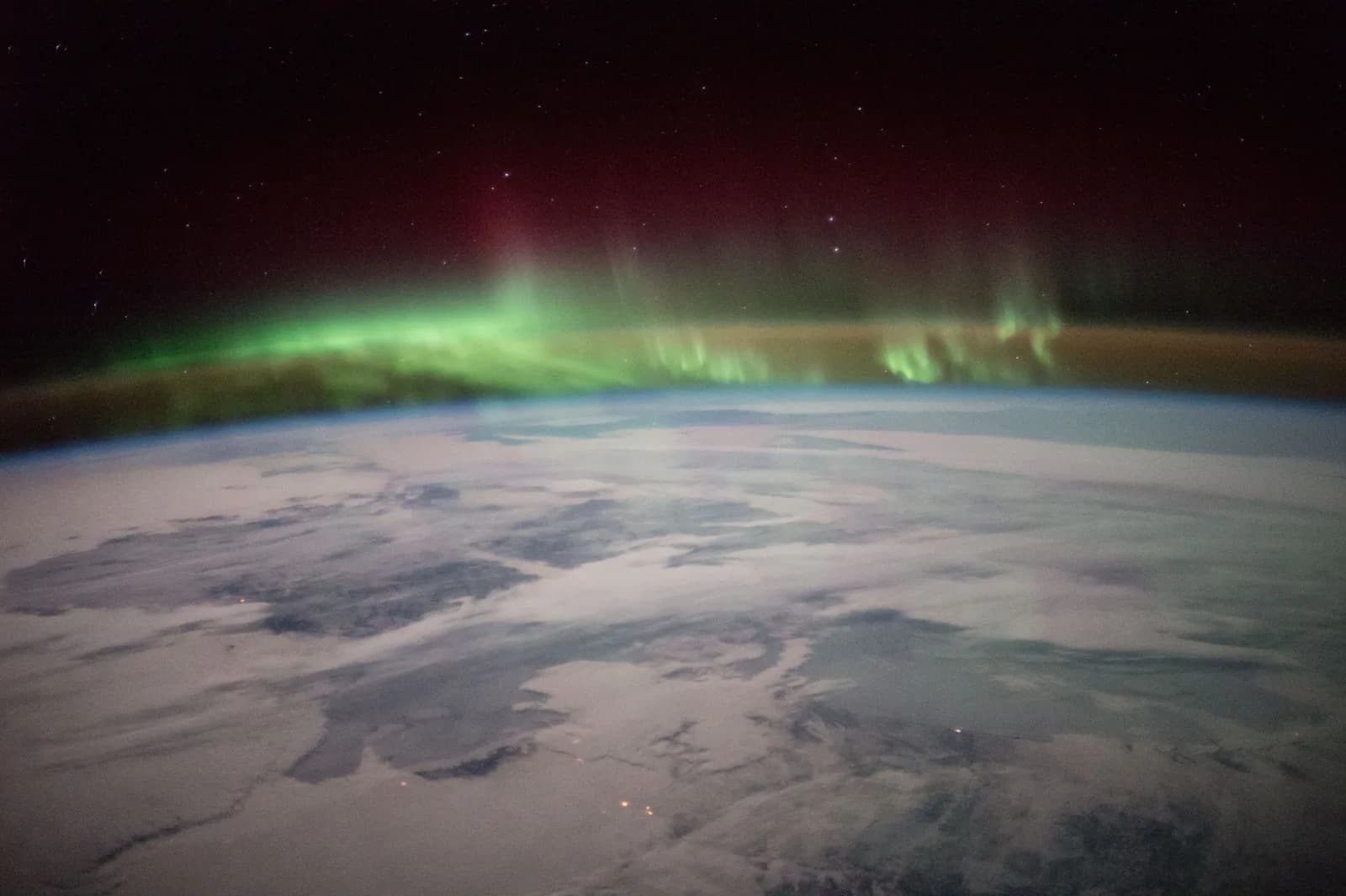
If you ask what causes the northern lights, the honest answer has three actors: the Sun, Earth’s magnetic field and the thin air high above you. This guide follows the energy from one to the next, explains the colours with real wavelengths, shows how the Kp index tells you how far from the pole to expect them, and ends with a short list of what helps you actually see one.
Key ideas
- The Sun sends out a steady solar wind, usually about 400 km/s, and sometimes eruptions; Earth’s magnetic field turns part of that energy toward the poles.
- The glow is the air itself: electrons hit oxygen and nitrogen atoms and molecules, which release the energy as light, the same way a neon sign works.
- Oxygen gives the common green (557.7 nanometres, mostly 100 to 150 km up) and a red glow higher up; nitrogen gives blue and purple.
- The aurora sits in two ovals around the magnetic poles; the Kp index from 0 to 9 says how far they spread, and in extreme storms they reach southern Europe and the southern United States.
- It is not sunlight reflecting off ice, and on the ground it is harmless, though the same storms can disturb satellites, radio and power grids.
The short answer: a wind from the Sun meets a magnet
The Sun constantly blows out a thin stream of charged particles, mostly protons and electrons, called the solar wind. It usually flows at about 400 km/s and in fast streams at up to 800 km/s. The Sun is about 150 million km away, so at 400 km/s the wind needs 150,000,000 ÷ 400 = 375,000 seconds, a little over 4 days. Big eruptions called coronal mass ejections can arrive in one to three days.
The Earth is a magnet, and its field forms a bubble, the magnetosphere, that deflects most of the solar wind around the planet. Some of the wind’s energy still gets in, and the magnetosphere accelerates electrons along the field lines toward the poles. NOAA describes how they then collide with oxygen and nitrogen atoms and molecules, which transfer energy to the air and light up as they relax.
So the aurora is not sunlight bouncing off snow or ice. It is a glow of the upper atmosphere itself, in the same way that a neon light glows when current excites the gas inside. That is also why it needs no sunlight at your location, only darkness to be seen.
Why the aurora sits near the poles: the oval and the Kp index
The field lines of the Earth’s magnet run down into the atmosphere near the two magnetic poles, so the accelerated electrons land in a ring around each pole, the auroral oval. The best place to see it is under the oval, between roughly 60 and 75 degrees of latitude, where NOAA says the aurora can be seen on more than half the nights of the year.
The size of the oval depends on how hard the solar wind pushes. Scientists measure this with the planetary K index, Kp, from 0 to 9. NOAA gives a rule in geomagnetic latitude: at Kp 0 the equator-ward edge of the oval is at about 66 degrees, and it moves about 2 degrees toward the equator for each step of Kp, reaching 48 degrees at Kp 9. The scale is approximate and the numbers are averages.
The southern lights, the aurora australis, form in a matching oval around the south magnetic pole. The two often appear at about the same time and look alike.
Where the colours come from
Each gas glows in its own colours. Excited oxygen atoms give the familiar green at a wavelength of 557.7 nanometres, mostly at heights of 100 to 150 km. Higher up, above about 200 km, oxygen gives a deep red. The red glow takes roughly two minutes to be emitted, so it appears only where the air is so thin that atoms rarely collide first.
Nitrogen gives blue and purple light and sometimes a pink or red fringe at the lower edge of a curtain. NOAA says the aurora typically forms 80 to 500 km above the surface, so it lies far above airplanes and weather and well below the International Space Station, which is why astronauts see it from above.
The eye is poor at faint colour in the dark, so many aurora look pale green or grey to it. A phone or camera collects light for several seconds and often shows more colour than you saw, including pink and red.
When and how to see it
The number of sunspots follows a cycle of about 11 years, and strong solar activity makes strong aurora more likely. Solar Cycle 25 approached its maximum around 2024. On 10 and 11 May 2024 an extreme storm rated G5 by NOAA, the top of its scale, was the strongest in more than twenty years, and people saw aurora in places that almost never see it, including southern Europe, Florida and Mexico. In 1859 the Carrington storm made aurora visible as far south as the Caribbean.
To see an aurora, NOAA’s advice comes down to four things: geomagnetic activity (check the Kp forecast), location (go toward the magnetic pole and find a clear view to the north, or to the south in the Southern Hemisphere), darkness (away from city lights and the Moon, and not in the summer midnight sun) and clear sky. Then be patient, because a display can change in minutes.
On the ground an aurora is harmless to people. The risk is for technology: a storm like the one in 1859 today could damage satellites and power grids, which is why NOAA monitors the Sun all the time.
How the VJOURNAL SMART BOOK shows it
The chapter “The aurora” in the free SMART BOOK “Everything about everything”, Volume II, on VITON13 SCHOOL follows the energy in five short moments. Beside the text there is a living 3D picture that you can turn with your finger or mouse, in which particles pour out from the Sun in thin streams.
Under the picture is a sandbox where you slide the Kp index and see how the auroral oval changes. The chapter also tells the story of the storm of 1859 and of May 2024, shows auroras on Jupiter and other planets, and ends with a three-question quiz with explanations and sources you can open.
In everyday language
Think of the Sun blowing a gentle, constant wind and of the Earth as a magnet that steers part of it toward the poles. The steered particles hit the thin air up there and make it glow, just as electricity makes the gas in a neon sign glow.
Try it yourself
Use NOAA’s rule for the edge of the auroral oval in geomagnetic latitude: 66° minus 2° for every step of Kp. Work out the edge for Kp 0, 3, 5, 7 and 9.
Expected result
You get 66°, 60°, 56°, 52° and 48°. The higher the Kp, the farther the oval spreads from the pole, and at Kp 9 it reaches the latitudes of southern Europe and the southern United States.
Check your answer: A town is at 54° geomagnetic latitude. By this rule, which Kp puts the edge of the oval over it?
(66 − 54) ÷ 2 = 6, so about Kp 6. The rule is approximate, so a clear, dark sky and a good view to the north still matter.
Questions
Are the northern lights and the southern lights the same thing?
Yes. Aurora borealis is the northern one and aurora australis the southern one. They are made the same way around the two magnetic poles and often appear at about the same time.
Why are the northern lights green?
Excited oxygen atoms emit green light at 557.7 nanometres, mostly at 100 to 150 km, and our eyes are most sensitive to green. Higher oxygen gives red and nitrogen gives blue and purple.
What does the Kp index mean for seeing the aurora?
Kp runs from 0 to 9 and measures geomagnetic activity. A higher Kp means a brighter aurora that spreads farther from the poles, and NOAA’s storm scale uses Kp 9 for an extreme G5 storm.
Can the northern lights be seen far from the Arctic?
Only during strong storms. In the extreme storm of May 2024 aurora was reported in southern Europe, Florida, Mexico and, in the south, Australia and New Zealand.
Are the northern lights dangerous?
Not to people on the ground. Strong geomagnetic storms can disturb satellites, radio and power grids, and agencies such as NOAA monitor the Sun for that reason.
Is the aurora sunlight reflected from polar ice?
No. It is light emitted by oxygen and nitrogen in the upper atmosphere after electrons excite them, and it needs no sunlight at the place where you stand.
Remember the chain: solar wind, Earth’s magnetic field, electrons striking oxygen and nitrogen, then light, with the Kp index telling you how far from the pole to look. Then open the chapter and slide Kp yourself to watch the oval grow.
Sources and further reading
- NOAA Space Weather Prediction Center: Aurora ↗Sources checked:
- NOAA Space Weather Prediction Center: Tips on viewing the aurora (Kp and the auroral oval) ↗Sources checked:
- NOAA Space Weather Prediction Center: Solar wind ↗Sources checked:
- NOAA Space Weather Prediction Center: Planetary K-index ↗Sources checked:
- NOAA Space Weather Scales (G1 to G5 geomagnetic storms) ↗Sources checked: