
How hot is the sun? Core, surface and corona temperatures explained
The Sun’s visible surface, the photosphere, is about 5,500 °C (10,000 °F), but that is only one of three temperatures. The core, where hydrogen fuses into helium, is about 15 million °C (27 million °F), and the thin outer atmosphere, the corona, is hotter than the surface again, typically 1 to 3 million °C. Temperature drops from the core to the surface, then jumps up in the corona, which is one of the Sun’s biggest open puzzles.
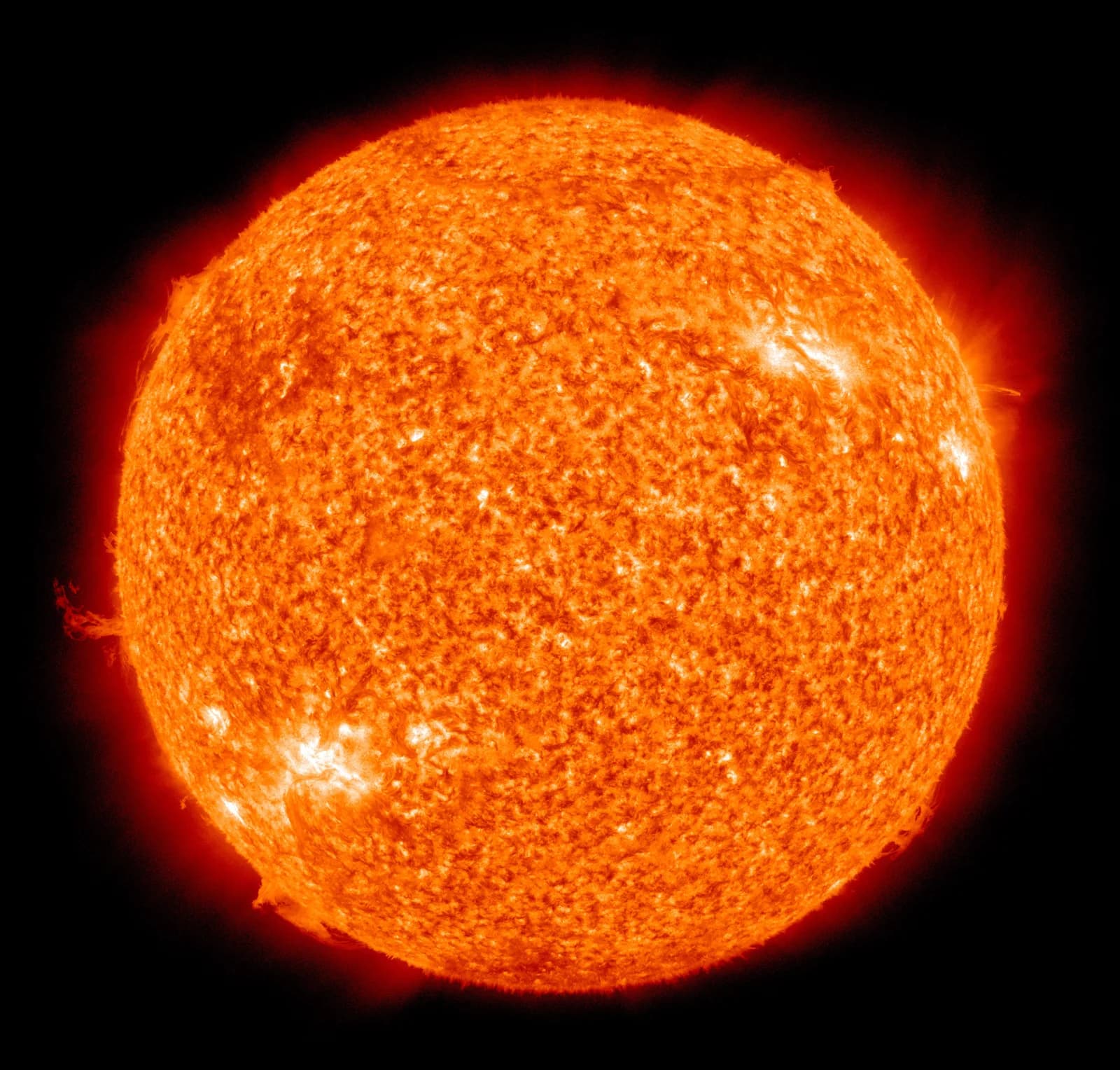
When people ask how hot is the sun, they usually expect one number, and the honest answer has three. Which one you need depends on the layer: the core, the surface we see, or the glowing crown around it. Below is each temperature with its source, how scientists know it without a thermometer, one worked example with a formula, and the open question that astronomers still argue about.
Key ideas
- The Sun has no single temperature: about 15 million °C in the core, about 5,500 °C at the visible surface and 1 to 3 million °C in the corona.
- The core is hot because gravity squeezes it to about 150 times the density of water, which keeps hydrogen fusing into helium and releasing energy.
- The surface temperature is measured from the Sun’s light: the colour at which it shines brightest points to about 5,800 K, nominally 5,772 K.
- The corona is much hotter than the layers below it, and why is not yet settled; it is also so thin that it carries little heat.
- Sunspots look dark because they are cooler, about 3,500 to 4,500 °C, not because they are cold.
The short answer: three temperatures, not one
NASA gives the temperature of the Sun’s core as about 15 million °C (27 million °F). The photosphere, which is the layer we call the surface, is about 5,500 °C (10,000 °F). The corona, the outer atmosphere, reaches 1 to 3 million °C; NASA quotes up to 2 million °C (3.5 million °F). So the temperature falls from the core to the surface and then rises again.
The Sun has no solid surface to stand on. It is a ball of hot gas, mostly hydrogen and helium, and the photosphere is simply the thin layer, about 400 km thick, from which most of its light escapes into space. Compared with the core, 5,500 °C is cool, but it is still hot enough to boil carbon, including diamond and graphite.
Why the core is 15 million degrees
The core is squeezed by the weight of the whole Sun above it. NASA gives its density as about 150 grams per cubic centimetre, around 150 times the density of water, and its temperature as more than 15 million °C. Under those conditions hydrogen nuclei fuse into helium, and this fusion is what keeps the Sun hot and stops it from collapsing under its own weight.
Four hydrogen nuclei make one helium nucleus, which weighs about 0.7 percent less, and the missing mass becomes energy according to E = mc². Every second the Sun turns about 4 million tonnes of mass into energy and about 600 million tonnes of hydrogen into helium. The energy takes a very long time to leave: estimates of the trip from the core to the surface range from about 10,000 to 170,000 years.
How we know the surface is about 5,500 °C
Nobody can put a thermometer in the Sun, so astronomers read its light. A hot glowing body shines most strongly at a wavelength that depends on its temperature, and Wien’s law gives it: the peak wavelength in micrometres equals 2,898 divided by the temperature in kelvins. The Sun’s light peaks near 0.50 micrometres, a blue-green colour, which gives about 5,800 K. The standard value agreed by astronomers is 5,772 K, which is 5,499 °C.
A sunspot is a patch where strong magnetic fields hold back heat from below. It is cooler, about 3,500 to 4,500 °C, and it looks dark only against the brighter 5,500 °C around it. Lightning is a useful comparison: a flash briefly heats a thin channel of air to about 28,000 °C, about five times the Sun’s surface, but only for a moment.
The corona puzzle: hotter than the surface
Above the photosphere lie the chromosphere and the corona. In the corona the temperature rises again to millions of degrees, so it is hotter than the surface below it, like warming up as you walk away from a bonfire. NASA calls the source of this coronal heating a major unsolved puzzle in solar physics.
A very high temperature is not the same as a lot of heat. The corona is extremely thin, so a spacecraft flying through it receives far less heat than the number suggests. NASA’s Parker Solar Probe has flown into the corona since 2021 to measure it directly, and researchers use its data to test ideas about waves and magnetic reconnection that might carry energy upward.
How the VJOURNAL SMART BOOK shows it
The chapter “The Sun” in the free SMART BOOK “Everything about everything”, Volume II, on VITON13 SCHOOL covers these layers in five short moments. Beside the text there is a living 3D picture that you can turn with your finger or mouse, with a tiny blue Earth next to the glowing disc so that you can feel the proportions.
Under the picture is a sandbox where you pick a planet and compare the sunlight it receives. The chapter also covers fusion in the core, the eight minutes light needs to reach us, sunspots, flares and the 11-year cycle, and the Sun’s future as a red giant and then a white dwarf, with a three-question quiz and sources you can open.
In everyday language
Think of an onion with three layers of heat. The middle is a furnace at 15 million degrees, the layer we see is a glowing 5,500 degrees, and the thin outer haze is hotter again, at millions of degrees, though it is so thin that it holds little heat.
Try it yourself
Use Wien’s law, peak wavelength = 2,898 µm·K ÷ temperature. The Sun’s light peaks near 0.50 µm. Find the temperature in kelvins, then subtract 273 to get degrees Celsius.
Expected result
2,898 ÷ 0.50 is about 5,800 K, and 5,800 − 273 is about 5,500 °C, which agrees with NASA’s value for the surface.
Check your answer: A hot blue-white star shines brightest at 0.29 µm. What is its surface temperature, roughly?
2,898 ÷ 0.29 is about 10,000 K, so about 9,700 °C. That is nearly twice as hot as the Sun’s surface.
Questions
How hot is the sun in Fahrenheit?
The surface is about 10,000 °F, the core about 27 million °F and the corona up to roughly 3.5 million °F by NASA’s figure. To convert from Celsius, multiply by 9/5 and add 32.
Why is the Sun’s corona hotter than its surface?
Nobody is sure. NASA lists coronal heating as a major unsolved puzzle. Leading ideas involve magnetic waves and sudden reconnection of magnetic field lines that deposit energy in the thin outer atmosphere.
Are sunspots cold?
No. They are cooler than their surroundings, about 3,500 to 4,500 °C against 5,500 °C, and look dark only by contrast. A sunspot taken alone would still shine very brightly.
Is the Sun the hottest kind of star?
No. Many red stars have surfaces at about 3,000 K, and hot blue stars exceed 30,000 K. The Sun is an ordinary middle-sized star of the G type.
What colour is the Sun?
Its light is white, a mix of all colours with a peak in blue-green. It looks yellow or orange from the ground because air scatters some blue light away, and NASA calls it a yellow dwarf by convention.
Will the Sun keep shining as hot as it does today?
For about 5 billion more years. It is slowly brightening, around 10 percent every billion years by model predictions, and will later swell into a red giant and shrink into a white dwarf.
Remember the three temperatures: about 15 million °C in the core, about 5,500 °C at the surface and 1 to 3 million °C in the corona, and the unsolved question of why the corona is so hot. Then open the chapter and compare the sunlight each planet receives.
Sources and further reading
- NASA Science: Sun facts ↗Sources checked:
- NASA Science: The Sun ↗Sources checked:
- NASA Science: Solar Dynamics Observatory ↗Sources checked:
- NASA Science: Parker Solar Probe ↗Sources checked:
- NOAA Space Weather Prediction Center: Sunspots and the solar cycle ↗Sources checked: