
What is a black hole? Event horizon, size and how we know they exist
A black hole is a region of space where gravity is so strong that nothing, not even light, can escape once it crosses a boundary called the event horizon. Stellar black holes form when a massive star runs out of fuel and its core collapses, and a black hole with the mass of the Sun would have a horizon only about 3 km in radius. It is not a hole but a very large mass packed into a very small space.
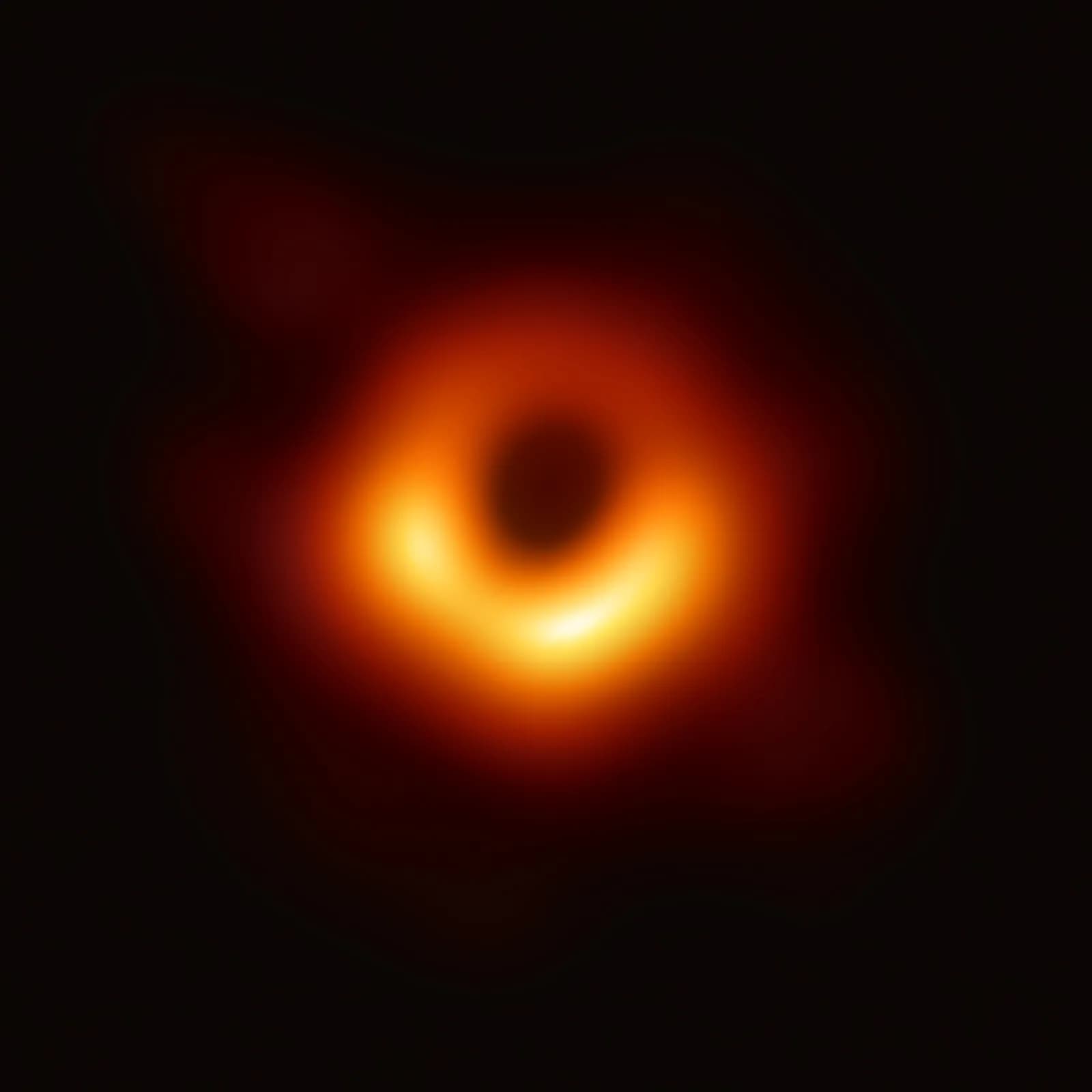
The question what is a black hole has a short answer and a long list of things people get wrong: it is not a cosmic vacuum cleaner, not a hole in anything and, since 2019, not just a drawing. This guide gives the definition first, then the size of a black hole as a number you can calculate, what would happen near one, and the evidence that they are real. Reading time is about six minutes.
Key ideas
- A black hole is a mass so concentrated that the escape velocity at its event horizon is greater than the speed of light, 299,792 km/s, so nothing can come back out.
- The size of the horizon is r = 2GM/c², about 2.95 km for each solar mass, so the Sun would be a black hole 3 km in radius and the Earth one about 9 mm in radius.
- A black hole does not pull things in from far away: replace the Sun with a black hole of the same mass and the planets keep their orbits. The danger is only close to the horizon, where tidal forces stretch matter, which is called spaghettification.
- Evidence is direct: LIGO detected gravitational waves from merging black holes in September 2015, and the Event Horizon Telescope imaged the shadow of M87* in 2019 and of Sagittarius A* in 2022.
- What happens inside the horizon is unknown: general relativity predicts a singularity, but physics as we know it stops working there.
The short answer: gravity so strong that light cannot leave
Throw a ball upwards and it falls back unless you throw it faster than the escape velocity, which is 11.2 km/s for the Earth. The heavier and smaller an object is, the higher that speed. If the mass is squeezed so much that the escape velocity at some distance passes the speed of light, 299,792 km/s, then nothing can leave from inside that distance. That boundary is the event horizon.
NASA stresses that the event horizon is not a surface like the Earth’s or the Sun’s. It is a boundary that contains all the matter of the black hole, and from outside you cannot see what is inside. General relativity predicts a point of infinite density at the centre, the singularity, but scientists agree that our physics stops working there, and NASA says that there is much we do not know about what matter looks like inside the horizon.
How a black hole forms and how small it is
The most familiar kind, a stellar black hole, is born when a massive star runs out of fuel. The core can no longer hold up the weight of the star, collapses, and in many cases the outer layers are thrown off in a supernova explosion. Stars of very roughly 20 times the mass of the Sun or more are thought to leave black holes, though the exact limit is uncertain. The lightest known black hole, according to NASA, is only 3.8 times the Sun’s mass. The idea of a star so heavy that light could not escape was first discussed by John Michell in 1783.
In 1916, a few months after Einstein published general relativity, Karl Schwarzschild found the size of the horizon: r = 2GM / c², where G is the gravitational constant, M the mass and c the speed of light. For one solar mass this gives about 2.95 km. So the Sun squeezed into a ball with a radius of 3 km would be a black hole, and the Earth would have to be squeezed to about 9 millimetres, the size of a pea.
The radius grows in proportion to the mass, about 2.95 km per solar mass. The black hole at the centre of our Galaxy, Sagittarius A*, has about 4 million solar masses and a horizon radius of about 12 million km. M87*, in a nearby galaxy, has about 6.5 billion solar masses, and its horizon has a radius of roughly 130 times the distance from the Earth to the Sun, wider than our whole planetary system.
What would happen near one
A black hole does not suck things in from afar. NASA points out that if the Sun were replaced by a black hole of the same mass, the solar system would get much colder, but the planets would stay in their orbits. Gravity at a distance depends only on the mass, and the Sun’s mass would be unchanged. The danger is only in getting close.
Gravity grows stronger as you approach, and the pull on your feet would be stronger than the pull on your head. This difference, called a tidal force, stretches an astronaut into a long thin shape, and scientists call it spaghettification. Near a small black hole it happens before the horizon, while near a giant one you would cross the horizon before the stretching became deadly.
Gravity also slows time. A clock near the horizon ticks more slowly, as seen from far away. A weaker form of the same effect is real and measured: the clocks of GPS satellites run at a slightly different rate from clocks on the ground, and the system corrects for it.
How we know black holes exist
On 14 September 2015 the LIGO detectors recorded gravitational waves, ripples of space-time, from two black holes merging about 1.3 billion light-years away. They had about 36 and 29 times the Sun’s mass and merged into one of about 62, so roughly 3 solar masses were turned into gravitational waves, according to E = mc². LIGO can detect a change in length smaller than one ten-thousandth of the width of a proton. The discovery was announced on 11 February 2016.
On 10 April 2019 the Event Horizon Telescope, a network of radio dishes on several continents that works like one telescope as big as the Earth, showed the first image of a black hole: a bright ring around a dark shadow at the heart of the galaxy M87, 55 million light-years away. In May 2022 the same team presented the black hole at the centre of the Milky Way, Sagittarius A*, about 27,000 light-years away. These pictures are assembled by computers from radio signals, not taken like an ordinary photograph.
The Nobel Prize in Physics 2020 went half to Roger Penrose for showing that black hole formation is a robust prediction of general relativity, and half to Reinhard Genzel and Andrea Ghez for discovering a supermassive compact object at the centre of our Galaxy by following the orbits of stars around it. The nearest known black hole, Gaia BH1, is about 1,500 light-years from us, according to NASA, so there is no danger to the Earth.
How the VJOURNAL SMART BOOK shows it
The chapter “Black holes” in the free SMART BOOK “Everything about everything”, Volume II, on VITON13 SCHOOL follows these ideas in five short moments. Beside the text there is a living 3D picture that you can turn with your finger or mouse.
Under the picture is a sandbox where you move the mass and read the radius of the horizon. The chapter also covers spaghettification and slowed time, the shadow of M87* and the picture of Sagittarius A*, and the first gravitational waves, followed by a three-question quiz with explanations and sources you can open.
In everyday language
Imagine a hill so steep that, to climb out, you would have to run faster than light, which nothing can do. A black hole is that hill in space. Its edge is the event horizon, and inside it every path leads only inward.
Try it yourself
Use the rule r ≈ 2.95 km × (mass in solar masses) to find the horizon radius of black holes of 3, 10 and 100 solar masses.
Expected result
About 8.9 km, 29.5 km and 295 km. A black hole with the mass of a big star is no larger than a city, and the radius grows in step with the mass.
Check your answer: Sagittarius A* has about 4 million solar masses. Roughly how large is its horizon radius, and how does it compare with the Sun’s radius of 696,000 km?
4,000,000 × 2.95 km is about 11.8 million km, or roughly 12 million km. That is about 17 times the Sun’s radius, yet smaller than the distance from the Sun to Mercury.
Questions
Can a black hole swallow the Earth or the Sun?
Not from a distance. Far away a black hole pulls just like any object of the same mass. The nearest known one, Gaia BH1, is about 1,500 light-years away, according to NASA.
What is inside a black hole?
Nobody knows. General relativity predicts a singularity of infinite density, but physics as we know it breaks down there, and no observation can look inside the event horizon.
How big is the biggest black hole?
NASA lists TON 618 as the most massive observed, at about 66 billion times the Sun’s mass. Such values are estimates, and the record may change.
Can we see a black hole?
We cannot see the black hole itself, but we can see the hot gas around it and its dark shadow. The Event Horizon Telescope imaged M87* in 2019 and Sagittarius A* in 2022.
What would happen if you fell into a black hole?
Tidal forces would stretch you, called spaghettification, and clocks near the horizon would run slow as seen from outside. Where exactly the stretching becomes fatal depends on the mass of the black hole.
Do black holes last forever?
In theory they slowly lose energy as Hawking radiation. For a black hole of one solar mass this is so weak that evaporation would take far longer than the present age of the Universe, and the radiation has never been observed.
Remember the one-line definition: a black hole is a mass packed so tightly that nothing, not even light, can leave from inside its event horizon, and its size grows by about 2.95 km for every solar mass. Then open the chapter and move the mass in the sandbox.
Sources and further reading
- NASA Science: Black holes (essential facts) ↗Sources checked:
- LIGO Caltech: Observation of gravitational waves from a binary black hole merger (GW150914) ↗Sources checked:
- ESO: Astronomers capture the first image of a black hole (M87*, 2019) ↗Sources checked:
- ESO: First image of the black hole at the centre of our Galaxy (Sagittarius A*, 2022) ↗Sources checked:
- Nobel Prize in Physics 2020: press release (Penrose, Genzel, Ghez) ↗Sources checked: