
How does the internet work? Packets, routers, undersea cables and DNS explained
The internet is a network of networks. Your device cuts every message into small numbered packets, routers pass each packet on hop by hop under the TCP/IP rules, and the receiver puts them back in order. Between continents the packets travel as pulses of light in glass fibres, in cables on the sea floor that carry about 99 percent of intercontinental data. The ITU estimated that about 6 billion people, roughly three-quarters of humanity, were online in 2025.
You use it every hour, yet the internet is not a cloud and not one machine: it is cables, routers and agreed rules. Below you will find what a packet is, how routers choose a road, why the long roads lie under the ocean, what DNS does, and how to time a signal yourself.
Key ideas
- The internet is a network of networks, not one computer or a cloud. About 6 billion people were online in 2025, according to the ITU.
- Messages are cut into packets of at most about 1,500 bytes. Each carries addresses and a number, so a lost piece can be re-sent on its own.
- A router reads the destination address and passes the packet to the neighbour that looks closest. A trip often takes 10 to 20 hops, and packets of one file may take different roads.
- About 99 percent of intercontinental data goes through cables on the sea floor. Light in glass travels at about 200,000 km/s, which sets a minimum delay that no engineer can remove.
- DNS turns a name into an IP address. The Web is only one service on the internet, next to email, calls and games.
A network of networks
The internet is not one thing owned by one company. It is tens of thousands of independent networks, run by internet providers, universities, companies and governments, which agree to pass each other’s traffic. What joins them is a set of shared rules called protocols, above all TCP/IP. The ITU estimated that about 6 billion people used the internet in 2025, and about 2.2 billion did not.
The ancestor was ARPANET, which sent its first message between two American computers on 29 October 1969. On 1 January 1983 every machine on it switched to TCP/IP, and many people call that day the birthday of the internet.
Cut it into packets
Say you send a 3 MB photo. The internet does not push it down a wire as one lump. Your device cuts it into pieces of at most about 1,500 bytes, which makes roughly 2,000 packets, and writes on each one the sender, the destination and its number in the sequence.
Why bother? Many people can share one line, because their packets take turns. And if one packet is lost, only that small piece is sent again, not the whole photo.
TCP is the careful half of the rules: the receiver sends back confirmations such as “got packets 1 to 40”, and the sender repeats any packet that is missing. IP is the addressing half. An IPv4 address has 32 bits, about 4.3 billion in total, which ran short, so IPv6 uses 128 bits, a number with 39 digits.
Routers: hop, hop, hop
Now every packet travels on its own. At each junction a router reads the destination address and hands the packet to the neighbour that looks closest to the goal. A trip often takes 10 to 20 such hops, and two packets of the same photo may take different roads. At the far end the numbers put them back in order.
Nobody plans the whole route in advance. If a link fails, routers learn about it and send the next packets around the gap, so a broken link usually costs a short delay rather than a lost message.
Cables under the sea
The internet is not in the sky. About 99 percent of the data between continents travels through cables lying on the ocean floor, and the TeleGeography cable map lists more than 500 systems in service. Inside each cable are hair-thin glass fibres. A laser at one end blinks pulses of light, the glass guides them, and a detector at the other end turns the blinks back into bits. Repeaters boost the light every few dozen kilometres.
Light in glass moves at about 200,000 km/s, around a third slower than in empty space. Moscow to New York is about 7,500 km in a straight line, so light needs 7,500 / 200,000 = 0.0375 s, which is 37.5 milliseconds one way. Real cables wind around coasts and routers add pauses, so a real round trip usually takes well over 100 ms. The 37.5 ms is a floor, because nothing travels faster than light.
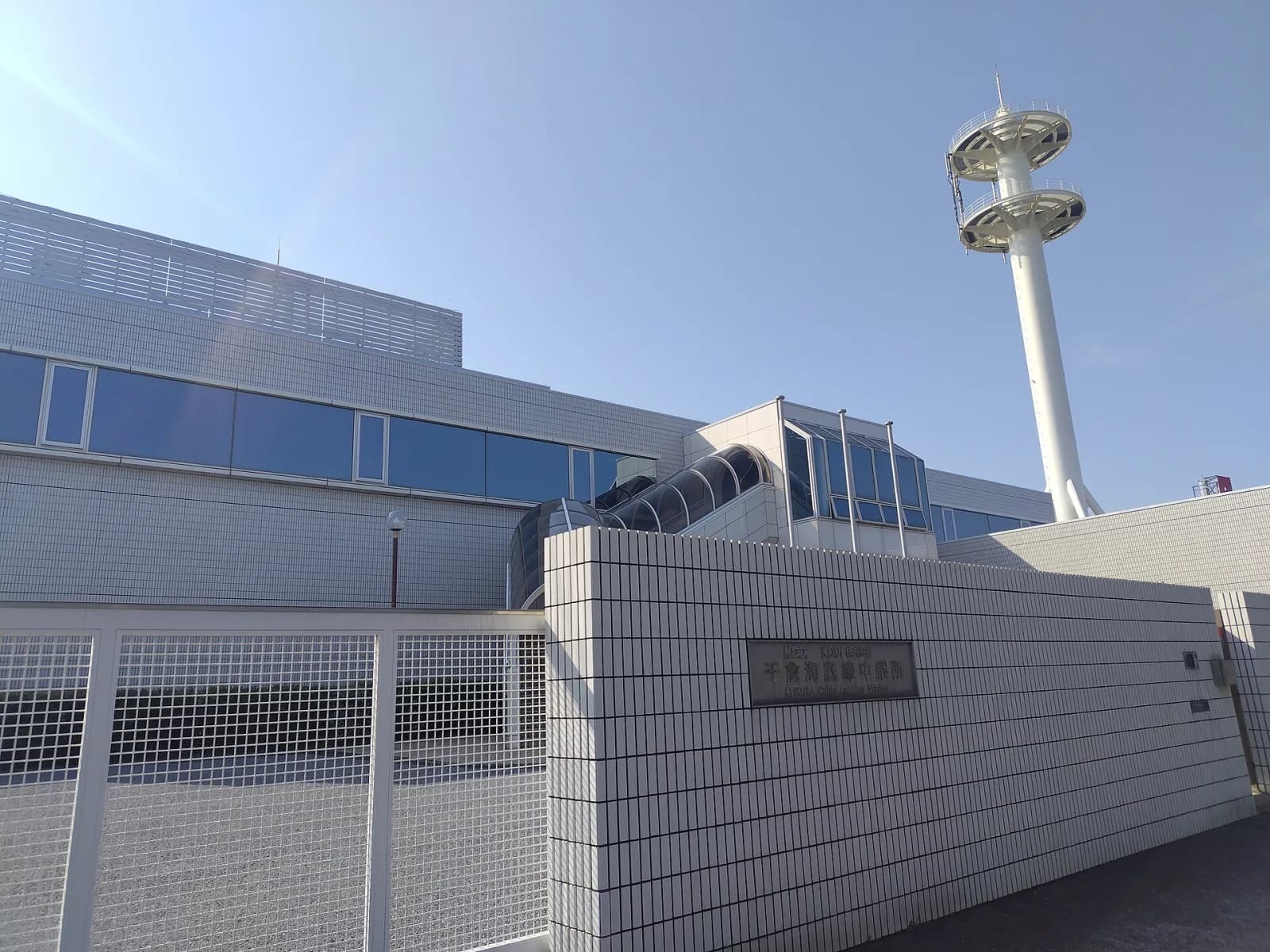
The photo shows the point where such a cable meets the land: a cable landing station of the Japanese company KDDI at Chikura, the building where a sea cable comes ashore and joins the land network.
DNS, and what happens when you open a page
Computers want numbers, people prefer names. The Domain Name System, DNS, is a giant phonebook spread across the world, designed by Paul Mockapetris in 1983. When you type a name, your device asks a resolver, which asks the root servers, then the servers for the ending such as .com, then the servers of the site itself. The last one answers with an IP address. Answers are remembered for minutes or hours, so repeat visits are fast.
After the lookup, the browser opens a connection to that address, sets up encryption for HTTPS and sends its request. In simple terms that costs about three round trips before the first bytes of the page come back. At an 80 ms round trip that is roughly 240 ms, which is why popular sites keep copies of their content on servers close to you. Newer protocols such as HTTP/3 trim the count.
The Web is one service riding on the internet, like email, video calls and online games. In March 1989 Tim Berners-Lee at CERN proposed a system of linked pages. The first browser and server ran by the end of 1990, the Web opened to the world in 1991, and on 30 April 1993 CERN released the software into the public domain.
How the VJOURNAL SMART BOOK shows it
The chapter “The Internet” in the VJOURNAL SMART BOOK “How it works”, Volume I, has five animated moments: a photo breaks into numbered packets, routers pass them on hop by hop, light crosses the oceans in glass on the sea floor, DNS turns a name into a number, and the Web appears as one service among others. A 3D model plays the exact moment that the text block describes.
Under the picture is a sandbox. Send a message and watch every hop add its small delay, or pick two cities and compare the estimate with the 37.5 ms sum above. The chapter also has key facts, a three-question quiz with explanations and the sources.
In everyday language
Think of the post. You tear a long letter into numbered postcards, each card finds its own way through many sorting offices, and the receiver puts them back in order and asks for any that went missing.
Try it yourself
A 6 MB photo (6,000,000 bytes) is cut into packets of 1,500 bytes. How many packets is that? Then find the least time light needs in fibre, at 200,000 km/s, for a straight-line 8,800 km from Tokyo to Los Angeles.
Expected result
6,000,000 / 1,500 = 4,000 packets. Light needs 8,800 / 200,000 = 0.044 s, which is 44 ms one way.
Check your answer: So what is the least possible round-trip time for a ping between Tokyo and Los Angeles?
About 88 ms, twice the one-way time. Real paths are longer than a straight line and routers add pauses, so real pings are higher, but never lower.
Questions
Is the internet the same as the Web?
No. The internet is the network of cables, routers and rules. The Web is one service on it, made of pages, URLs and the HTTP protocol. Email, video calls and online games use the same network without being the Web.
Where is the internet physically?
In cables, routers, radio masts, data centres and the devices you hold. Between continents about 99 percent of the data travels through cables on the sea floor, not through the sky.
Does the internet work through satellites?
Mostly not. Satellites serve ships, aircraft and remote places, but the bulk of long-distance traffic goes through glass fibre, which carries far more data and has lower delay for most routes.
What is an IP address?
It is the number that says where a device is on the network, like a postal address. IPv4 uses 32 bits, about 4.3 billion addresses, and IPv6 uses 128 bits, a number with 39 digits.
Who owns the internet?
Nobody owns all of it. Thousands of networks, each with its own owner, cooperate under shared standards. Bodies such as the IETF write the protocols, and ICANN coordinates the system of names and numbers.
Why is there a delay even on a fast connection?
Speed in megabits per second says how much data flows each second. Delay says how long a signal needs to arrive, and it is limited by distance, because light in glass covers about 200,000 km in a second.
Remember three lines: messages travel as numbered packets over many hops, most long roads lie on the sea floor, and DNS turns names into numbers. Then open the chapter, send a message and watch the delay build up.
Sources and further reading
- Internet Society: A Brief History of the Internet ↗Sources checked:
- CERN: info.cern.ch, home of the first website ↗Sources checked:
- Cloudflare Learning Center: What is DNS? ↗Sources checked:
- ITU: Facts and Figures 2025, connecting the world and beyond ↗Sources checked:
- TeleGeography: Submarine Cable Map ↗Sources checked: