
How does a generator work? Faraday’s induction, turbines, AC and the grid
A generator turns motion into electricity by electromagnetic induction: when a coil of wire turns in a magnetic field, the changing magnetic flux induces a voltage in the coil. A turbine driven by steam, water or wind, or a petrol engine, supplies the motion. The voltage follows EMF = N·ΔΦ/Δt, so a 200-turn coil whose flux changes by 0.002 Wb in 0.1 s gives 200 × 0.002 / 0.1 = 4 V.
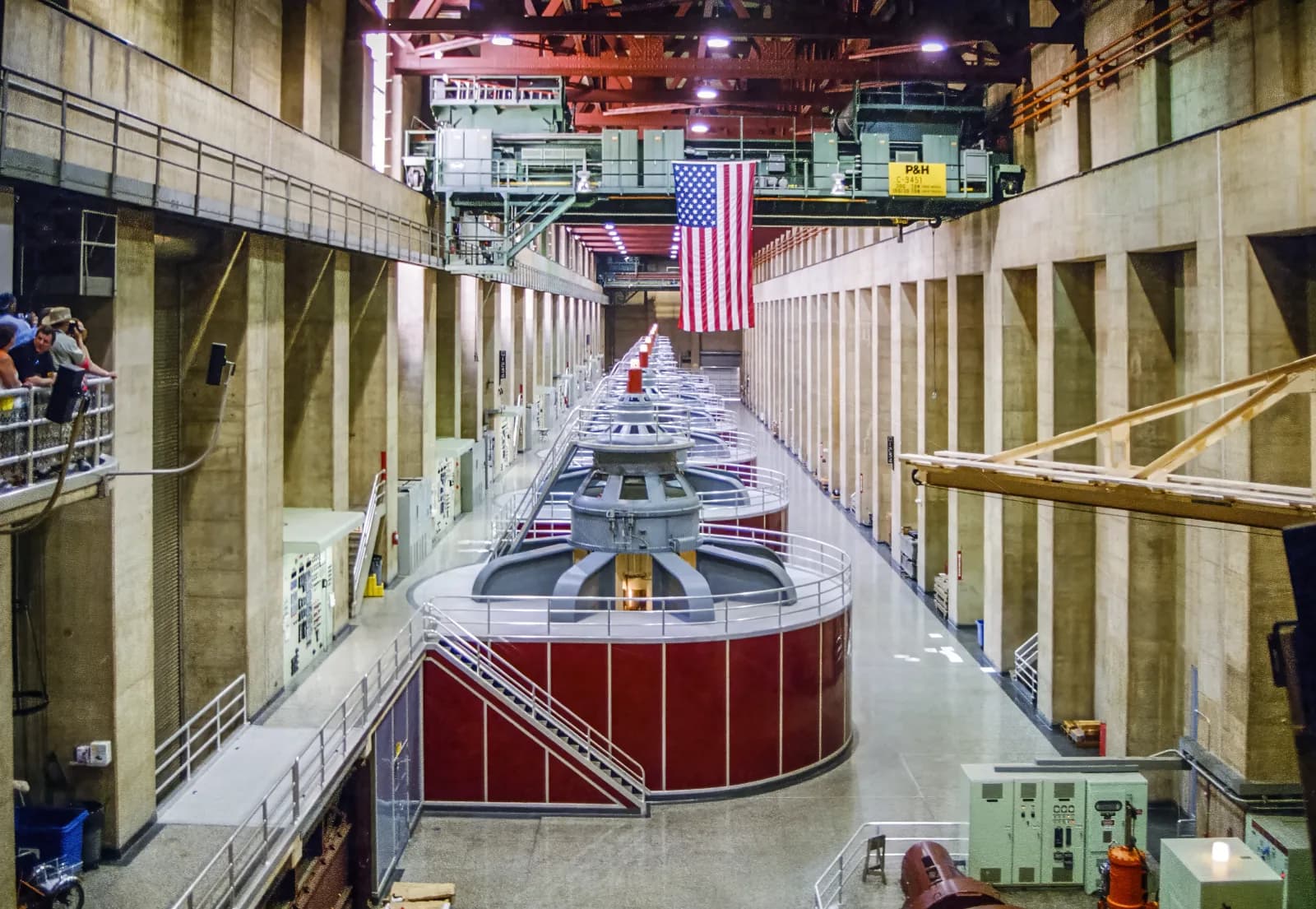
Almost all the electricity in the world comes from a spinning coil in a magnetic field. This guide explains how a generator works, from Faraday’s experiment of 1831 to a power station turbine hall. It works the numbers for induction, for the peak voltage of a spinning coil, for a wind turbine and for a transformer, explains why power lines use very high voltage and says how to use a portable generator safely. At the end, a living textbook chapter lets you turn the turbine and change the magnet yourself.
Key ideas
- Faraday discovered induction in 1831: a changing magnetic field creates a voltage. A magnet held still beside a coil does nothing; moving it in or out does.
- A generator is induction on repeat. A coil turning in a field gives an alternating voltage with a peak of N·B·A·ω: 100 turns, 0.5 T, 0.02 m² and 50 turns per second peak at about 314 V, which is 222 V effective.
- A generator does not make energy. Steam, falling water, wind or an engine turns the shaft, and the electrical energy is paid for by the work of turning it.
- Transformers raise the voltage for long lines: 10 MW through a line of 5 Ω loses 5 MW at 10 kV but only 50 kW at 100 kV, a hundred times less.
Induction: how motion makes a voltage
In 1831 Michael Faraday pushed a magnet into a coil and the needle of a meter jumped; pulling it out made the needle jump the other way. The American Joseph Henry saw the same effect independently. A changing magnetic field creates a voltage. Its size is EMF = N·ΔΦ / Δt, where N is the number of turns, ΔΦ the change of magnetic flux in webers and Δt the time in seconds. A coil of 200 turns with the flux changing by 0.002 Wb in 0.1 s gives 200 × 0.002 / 0.1 = 4 V. Hold the magnet still and nothing happens. Move it twice as fast and the voltage doubles.
The induced current always opposes the change that makes it, a rule found by Heinrich Lenz in 1834. In a generator this means the coil pushes back on whatever turns it, and the harder the generator is loaded, the harder it is to turn. That is energy conservation at work: the electrical energy you take out is paid for by the work done on the shaft. A generator converts energy; it does not create it.
Inside a generator: a spinning coil
A generator is induction on repeat. A coil spins in a strong magnetic field, the flux through it rises and falls, and the voltage swings back and forth. For N turns of area A in a field B turning at angular speed ω, the peak voltage is N·B·A·ω. With N = 100, B = 0.5 T, A = 0.02 m² and 50 turns per second (ω = 2π × 50 ≈ 314 rad/s), the peak is 100 × 0.5 × 0.02 × 314 ≈ 314 V. The effective value, the one that heats a lamp as much as the same direct voltage would, is the peak divided by √2: about 222 V. Double the field to 1 T and the peak doubles to about 628 V.
The voltage alternates, so we call it alternating current, AC. In Europe and Russia mains alternates 50 times a second (50 Hz) at 230 V; in the USA it is 60 Hz at 120 V. In the simplest machine, one turn of the coil gives one cycle, so 50 Hz needs 50 turns a second, 3,000 revolutions per minute, and 60 Hz needs 3,600. Large power-station machines put an electromagnet on the spinning rotor and the coils on the fixed outer part, but the principle is the same. A commutator, a split ring that swaps the connections every half turn, turns the output into direct current, as in a dynamo.
A portable petrol generator is an engine joined to a small alternator. Treat it with care. Run it only outdoors and well away from windows and doors, because its exhaust carries carbon monoxide, which can kill without warning. Never plug it into a house socket: the current can flow backwards into the street network and endanger the workers repairing the line. A connection to house wiring belongs to a qualified electrician with a proper transfer switch.
What turns the shaft: steam, water and wind
Something has to spin the coil. In coal, gas and nuclear stations, heat boils water into steam that blows on turbine blades; in a dam falling water does the job; in a wind farm, the wind. A wind turbine catches P = ½·ρ·A·v³, where ρ ≈ 1.2 kg/m³ is the density of air, A the area swept by the rotor and v the wind speed. For a rotor 100 m across, A = π × 50² ≈ 7,850 m². At 10 m/s the wind carries ½ × 1.2 × 7,850 × 10³ ≈ 4.7 MW, and a real turbine captures about 40 percent, roughly 1.9 MW. No turbine can capture more than about 59 percent, the Betz limit. The cube matters: double the wind speed and the power grows eight times.
Not every source needs a generator. A solar panel has no moving parts: light knocks electrons loose at the junction between two layers of silicon, which creates a voltage, the photovoltaic effect. In full sun, about 1,000 W per square metre, a 1.7 m² panel with 20 percent efficiency gives 1.7 × 1,000 × 0.20 = 340 W. An inverter then turns the direct current into alternating current for the grid.
AC, transformers and the road to your socket
In the 1880s Edison’s direct-current systems competed with alternating-current systems backed by George Westinghouse and Nikola Tesla, and AC won because a transformer can change its voltage. A transformer has two coils on one iron core: V₂ / V₁ = N₂ / N₁. With 230 V on 1,000 turns and 50 turns on the other side, the output is 230 × 50 / 1,000 = 11.5 V. The same device in reverse steps the voltage up.
High voltage matters because long lines waste energy as heat, P_loss = I²·R. Send 10 MW through a line of 5 Ω. At 10 kV the current is 10,000,000 / 10,000 = 1,000 A, and the loss is 1,000² × 5 = 5 MW, half of everything sent. Step up to 100 kV and the current falls to 100 A, so the loss is 100² × 5 = 50 kW, only 0.5 percent. Ten times the voltage gives a hundred times less loss. A transformer at the station steps the voltage up, lines carry it across the country, substations step it down in stages and a last transformer on your street brings it to 230 V. Your meter counts kilowatt-hours: a 2 kW kettle running for 3 minutes uses 2 × 0.05 = 0.1 kWh, which is 360 kJ. Stay far away from pylons, substations and fallen wires.
See a generator turn in the VJOURNAL SMART BOOK
The “Generators, transformers and the grid” chapter of the VJOURNAL SMART BOOK physics textbook (Volume II) on VITON13 SCHOOL puts a living 3D scene beside every paragraph: Faraday’s magnet moving in and out of a coil, a turbine hall where steam, water or wind spins the rotor, pylons that carry a city’s energy at hundreds of kilovolts, the transformer and the meter, then solar panels facing the Sun and a wind turbine. Under the picture, a sandbox lets you turn the turbine and change the magnet’s strength and watch the voltage follow.
Use it as a check on this guide: 200 turns with 0.002 Wb in 0.1 s should give 4 V, and 100 turns at 0.5 T should peak near 314 V. Everything in the chapter happens on the page, with no mains involved. Never try to build a generator that connects to house wiring.
In everyday language
Think of a bicycle dynamo. A small magnet spins next to a coil of wire, and while it spins the lamp glows; stop pedalling and it goes dark. A power-station generator is the same idea made enormous, with a steam turbine or falling water doing the pedalling.
Try it yourself
In the sandbox of the generators chapter, turn the turbine faster and then strengthen the magnet, and watch the voltage rise. Compare the result with N·B·A·ω for 100 turns, 0.5 T, 0.02 m² and 50 turns per second.
Expected result
A peak of about 314 V, which is about 222 V effective. Doubling the field to 1 T doubles the peak to about 628 V.
Check your answer: A coil of 50 turns sees its magnetic flux change by 0.004 Wb in 0.02 s. What EMF is induced, and what if the same change takes 0.01 s?
EMF = 50 × 0.004 / 0.02 = 10 V. In 0.01 s, EMF = 50 × 0.004 / 0.01 = 20 V: the same change twice as fast gives twice the voltage.
Questions
How does a generator work in simple words?
A generator spins a coil of wire inside a magnetic field, or a magnet inside a coil. The changing magnetic field pushes the electric charges in the wire, which creates a voltage and, with a circuit connected, a current. A turbine or an engine supplies the turning.
What is the difference between a generator and an electric motor?
A motor uses electricity to make something turn; a generator uses something turning to make electricity. They are built alike and one can often run as the other.
Does a generator create energy?
No. It converts the energy of motion into electrical energy. Because the induced current opposes the change that causes it, a loaded generator is harder to turn, and the extra effort pays for the electricity.
What is the difference between AC and DC?
Direct current (DC) flows one way, as from a battery. Alternating current (AC) reverses direction many times a second, 50 Hz in Europe and Russia and 60 Hz in the USA. AC won because transformers can change its voltage.
Is it safe to use a portable generator at home?
Only with care. Run it outdoors, far from windows, because exhaust contains deadly carbon monoxide, and never plug it into a house socket, which can send current back into the network. Wiring it to the house needs a qualified electrician.
Why is electricity sent through power lines at high voltage?
For the same power, a higher voltage means a smaller current, and the heat lost in the wire grows with the square of the current. At 100 kV instead of 10 kV the loss in the example falls a hundred times.
Remember the chain: motion, changing flux, voltage. Then check it with numbers, 200 turns, 0.002 Wb and 0.1 s giving 4 V, and open the generators chapter to turn the turbine yourself.
Sources and further reading
- HyperPhysics: Generators ↗Sources checked:
- OpenStax University Physics Volume 2: Faraday’s law ↗Sources checked:
- HyperPhysics: Transformer ↗Sources checked:
- U.S. Energy Information Administration: How electricity is generated ↗Sources checked: