
Ohm’s law: V = I·R explained, with worked examples and series and parallel circuits
Ohm’s law says that the current through a conductor equals the voltage across it divided by its resistance: I = V/R, or V = I·R. A 9 V battery across a 450 Ω resistor drives 9 / 450 = 0.02 A, which is 20 mA. Double the resistance and the current halves; double the voltage and the current doubles. The law holds well for metals and resistors at steady temperature, but not for every device.
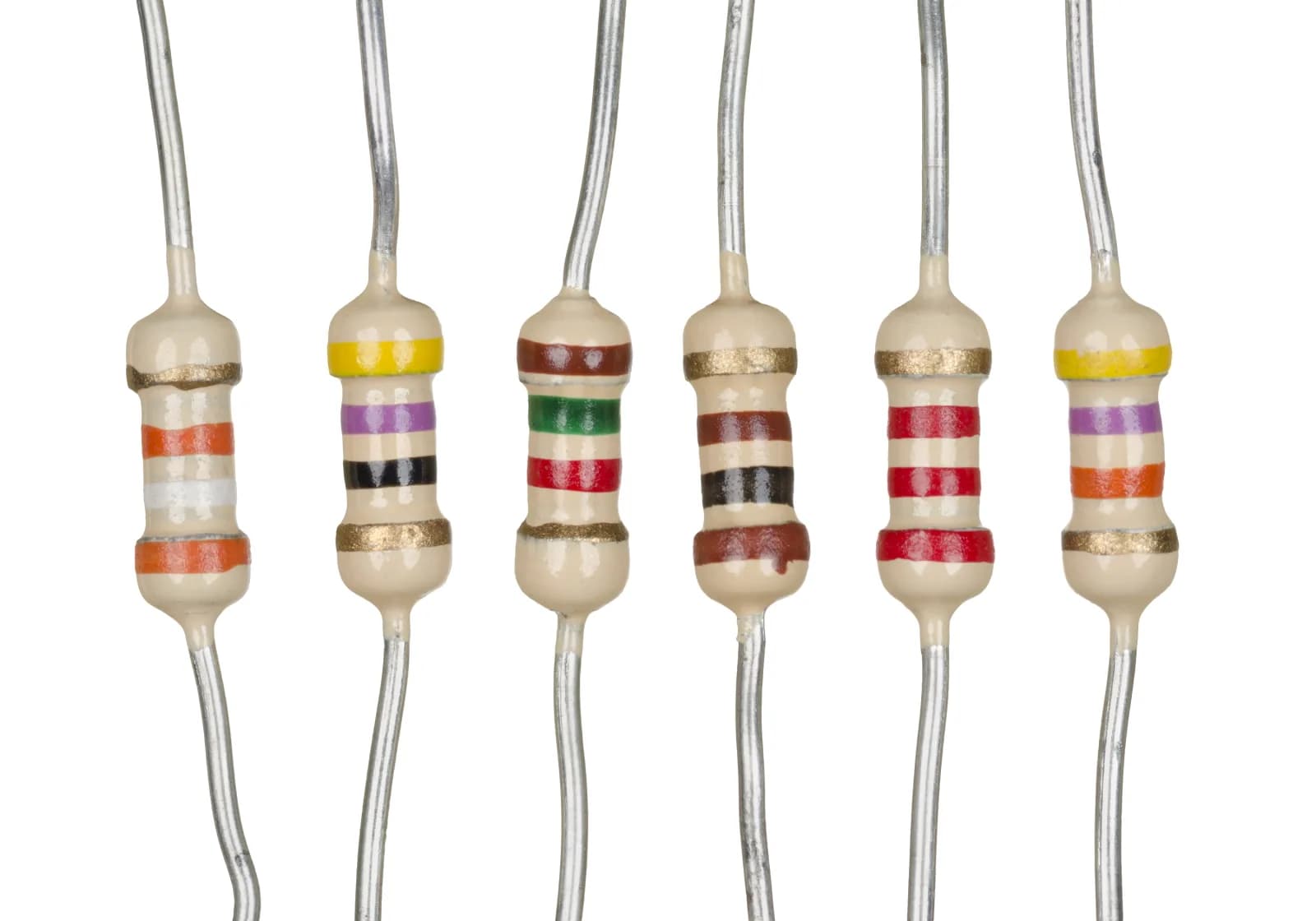
Ohm’s law is the first rule a student of electricity learns and the one used most often. It ties together the push of a battery, the flow of current and the resistance of a wire or a component. This guide gives the formula in all three forms, works the numbers for an LED resistor, a copper wire and a pair of resistors, adds the power formula and shows where the law stops being exact. At the end, a living textbook chapter lets you change the battery and the resistor yourself.
Key ideas
- Ohm’s law: V = I·R. Voltage in volts equals current in amperes times resistance in ohms; rearranged, I = V/R and R = V/I.
- For the same voltage, doubling the resistance halves the current: 9 V across 450 Ω gives 20 mA, and across 900 Ω only 10 mA.
- In series resistances add up; in parallel the total falls. Two 6 Ω resistors make 12 Ω in series and 3 Ω in parallel.
- Georg Ohm published the relation in 1827. It is an excellent model for metals and resistors at steady temperature, but diodes and glowing lamp filaments do not obey it.
The formula: V = I·R and its three forms
Ohm’s law links three quantities of an electric circuit. Voltage V, in volts, is the push that a battery or a socket gives to the charges. Current I, in amperes, is how much charge passes a point each second. Resistance R, in ohms (Ω), is how strongly a wire or a component holds the flow back. The law states V = I·R. The German teacher Georg Simon Ohm published this relation in 1827, after careful measurements, and the unit of resistance now carries his name.
The formula can be turned round to find any of the three. I = V/R gives the current when you know the voltage and the resistance, and R = V/I gives the resistance from a measurement. A 6 V battery across a 12 Ω resistor drives 6 / 12 = 0.5 A. If a meter shows 0.15 A when 3 V is applied, then R = 3 / 0.15 = 20 Ω. Think of water in a pipe: voltage is the pressure, current is the flow and resistance is how narrow or rough the pipe is. More pressure gives more flow; a narrower pipe gives less.
Prefixes keep the numbers short: 1 mA is 0.001 A, 1 kΩ is 1,000 Ω and 1 MΩ is 1,000,000 Ω. A 9 V battery across 450 Ω gives 9 / 450 = 0.02 A, which is 20 mA. The same battery across 900 Ω gives 9 / 900 = 0.01 A, or 10 mA: twice the resistance, half the current.
Worked examples: an LED resistor and a copper wire
A common use of Ohm’s law is choosing a resistor for an LED. Take a 5 V supply, such as a USB port, and a red LED that needs 20 mA and drops about 2 V across itself. The resistor must take the remaining 5 − 2 = 3 V at 0.02 A, so R = 3 / 0.02 = 150 Ω. It turns 3 × 0.02 = 0.06 W into heat, so a small quarter-watt resistor is plenty. Without it nothing would limit the current, and the LED would burn out in moments.
Wires obey the same law, and their resistance depends on the material and the shape: R = ρ·L/A, where ρ is the resistivity, L the length and A the cross-section. For copper ρ is about 1.7 × 10⁻⁸ Ω·m. A 10 m length of copper wire with a cross-section of 1 mm² (10⁻⁶ m²) has R = 1.7 × 10⁻⁸ × 10 / 10⁻⁶ = 0.17 Ω. With 2 A flowing, the voltage lost along the wire is V = I·R = 2 × 0.17 = 0.34 V. A longer or thinner wire has more resistance, which is why heavy-duty extension leads use thicker wire.
Series and parallel circuits
Take two identical 6 Ω resistors and a 6 V battery. In series the current has one road, so the resistances add: R = 6 + 6 = 12 Ω. The current is I = 6 / 12 = 0.5 A through both, and each takes half of the voltage, 0.5 × 6 = 3 V. If one of them breaks, the loop is open and the current stops everywhere.
In parallel each resistor sits straight across the battery, so each gets the full 6 V and carries 6 / 6 = 1 A, and the battery supplies 2 A in all. The combined resistance follows 1/R = 1/6 + 1/6, so R = 3 Ω, and the check 6 / 3 = 2 A agrees. Adding a branch lowers the total resistance. That is why buildings are wired in parallel: every lamp gets the full voltage, and one failed lamp leaves the others on.
Power, and where Ohm’s law stops working
Power is the rate at which energy is used: P = V·I, in watts. Combined with Ohm’s law it also reads P = I²·R and P = V²/R. For the pair of 6 Ω resistors on 6 V, the parallel layout takes 6 × 2 = 12 W and the series layout 6 × 0.5 = 3 W, four times less. The check with P = V²/R gives 6² / 12 = 3 W. Heat grows with the square of the current, so doubling the current makes four times as much heat every second, which is why wires are protected by fuses and circuit breakers.
Ohm’s law is a good description, not a rule that every object must follow. For metals and resistors at steady temperature the graph of current against voltage is a straight line. A diode, including an LED, does not follow it, and neither does a lamp filament, whose resistance climbs sharply as the metal goes from cold to white-hot. A 60 W lamp on 230 V has a hot resistance of V²/P = 230² / 60 ≈ 880 Ω and draws about 60 / 230 ≈ 0.26 A, while cold it has far less. Do such sums on paper only. A mains socket is no place for experiments, because a current of a few tens of milliamperes through the chest can disturb the heart. For practice at home, use small batteries.
Try Ohm’s law in the VJOURNAL SMART BOOK
The “Circuits, voltage and Ohm’s law” chapter of the VJOURNAL SMART BOOK physics textbook (Volume II) on VITON13 SCHOOL shows a battery, two wires and a bulb joined in a ring, with dots streaming through the wire. The dots slow down and crowd together when you raise the resistance. Five moments tell the story: Volta’s first battery, current and voltage, Ohm’s law, series against parallel, and power with the fuse that guards the wire. Each paragraph has a worked example with real numbers, and the sandbox under the picture does the sums as you change the voltage and the resistance.
Use it as a check on this guide: 6 V across 12 Ω should read 0.5 A, 9 V across 450 Ω should read 20 mA, and two 6 Ω bulbs should total 12 Ω in series and 3 Ω in parallel. Everything in the chapter happens on the page, with no mains involved. The neighbouring chapters carry on to static charge, magnets and generators.
In everyday language
Picture water running down a hose. Voltage is how high the tank stands, current is how much water comes out and resistance is how pinched the hose is. A higher tank gives more water; a pinched hose gives less. Ohm’s law is that same idea written with numbers.
Try it yourself
In the sandbox of the circuits chapter, set a 9 V battery and a 450 Ω resistor and note the current. Then raise the resistance to 900 Ω and compare.
Expected result
20 mA (0.02 A) for 450 Ω, then 10 mA (0.01 A) for 900 Ω.
Check your answer: A 4.5 V battery, made of three 1.5 V cells in series, is connected to a 220 Ω resistor. What current flows, and how much power does the resistor turn into heat?
I = 4.5 / 220 ≈ 0.0205 A, about 20 mA. P = V·I = 4.5 × 0.0205 ≈ 0.092 W, about 0.09 W.
Questions
What is Ohm’s law in simple words?
The current through a component grows with the voltage across it and shrinks with its resistance. In symbols, V = I·R, or I = V/R. A 12 V battery across a 24 Ω resistor drives 0.5 A.
What is the Ohm’s law triangle?
A memory aid: write V on top and I and R side by side below it. Cover the quantity you want. Covering V leaves I × R, covering I leaves V / R, and covering R leaves V / I.
What are the units of voltage, current and resistance?
Voltage is measured in volts (V), current in amperes (A) and resistance in ohms (Ω). One ohm is the resistance that lets 1 A flow when 1 V is applied.
Does Ohm’s law always apply?
No. It works for metals and resistors at a steady temperature. Diodes, LEDs, transistors and lamp filaments are non-ohmic: their current does not rise in a straight line with the voltage.
What is the difference between Ohm’s law and the power formula?
Ohm’s law relates voltage, current and resistance. The power formula P = V·I says how fast the circuit uses energy. Together they give P = I²·R and P = V²/R.
Why does a thin wire get hotter than a thick one?
Resistance follows R = ρ·L/A, so halving the cross-section doubles the resistance. At the same current the heat per second, I²·R, doubles too.
Write V = I·R on a card and test it with 9 V and 450 Ω: you must get 20 mA. Then open the circuits chapter and try other resistors in the sandbox.
Sources and further reading
- HyperPhysics: Ohm’s law ↗Sources checked:
- OpenStax College Physics 2e: Ohm’s law, resistance and simple circuits ↗Sources checked:
- OpenStax University Physics Volume 2: Resistivity and resistance ↗Sources checked:
- HyperPhysics: Electric power ↗Sources checked: