
Static electricity: what it is, why you get shocks and how Coulomb’s law works
Static electricity is an imbalance of electric charge that builds up on the surface of an object, usually when two materials are rubbed together and electrons move from one to the other. Like charges repel and unlike charges attract, with a force F = k·q₁·q₂ / r². A balloon holding 10 nC of extra charge has gained about 6.2 × 10¹⁰ electrons. The charge stays in place on insulators and drains away through conductors and moist air.
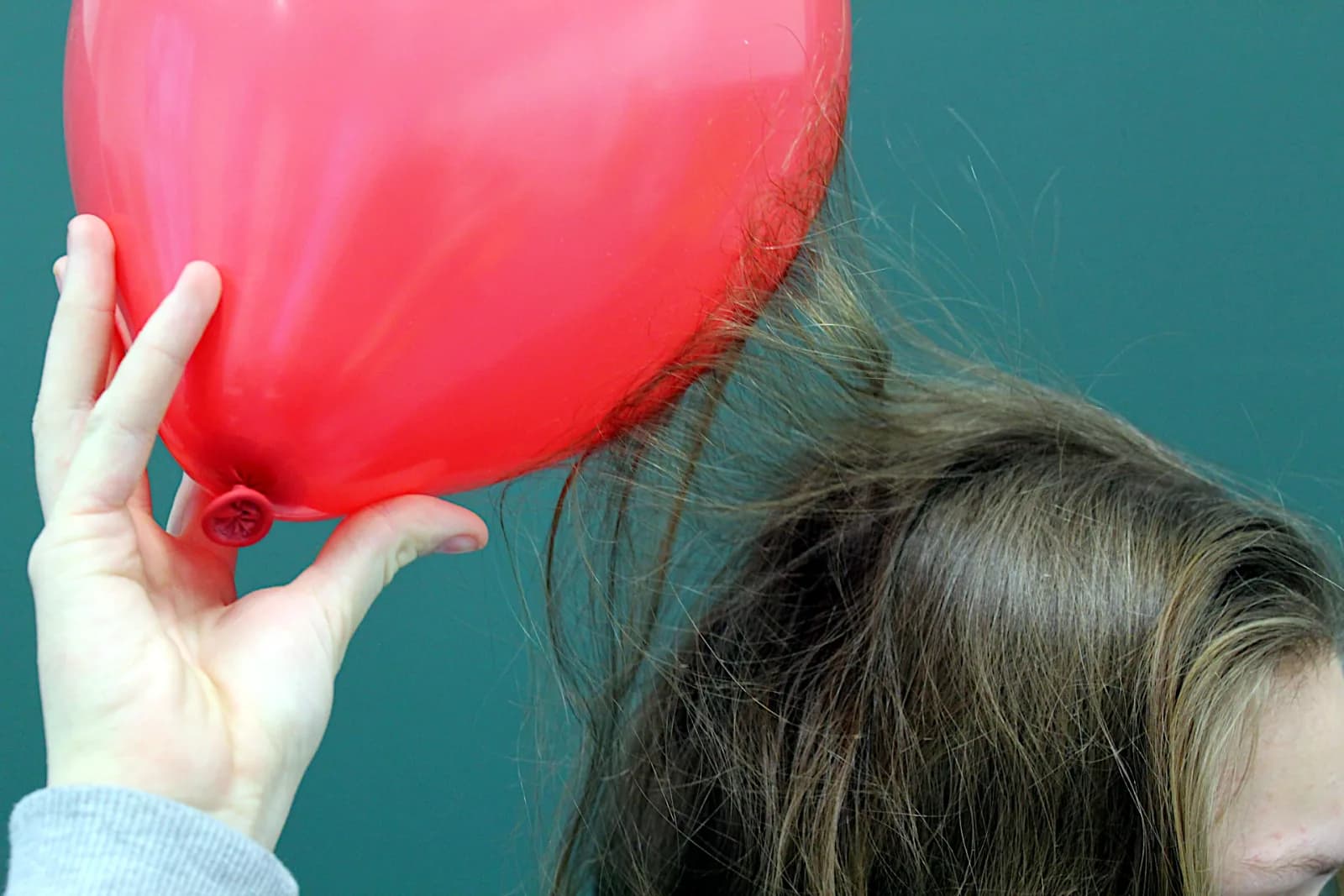
Static electricity is the crackle of a jumper, the shock from a door handle and the hair that rises towards a balloon. It is ordinary electric charge that has nowhere to go. This guide explains where the charge comes from, works the numbers with Coulomb’s law, shows why shocks come in dry winter air and how big a spark really is, and says how to avoid them. At the end, a living textbook chapter lets you set the charges and the distance yourself.
Key ideas
- Rubbing moves electrons, not protons: the object that gains electrons becomes negative and the one that loses them positive. One electron carries 1.602 × 10⁻¹⁹ C.
- Coulomb’s law: F = k·q₁·q₂ / r², with k = 8.99 × 10⁹ N·m²/C². Two charges of 1 µC, 0.10 m apart, push or pull with about 0.90 N, and twice the distance leaves a quarter of the force.
- A spark in air needs roughly 3 × 10⁶ V/m, so a 1 mm gap takes about 3,000 V. The energy in such a spark is only about half a millijoule, which startles but does not injure.
- Dry air, synthetic fabrics and insulating shoes let charge build up; humid air, metal and natural fibres let it leak away.
Where static electricity comes from
The Greek word for amber is elektron, and ancient writers credit Thales of Miletus, around 600 BC, with noticing that rubbed amber picks up feathers. Today we know why. Atoms hold positive protons, which sit locked in the nucleus, and negative electrons, which can be pulled away. Rubbing two materials together drags some electrons from one onto the other, so one ends up slightly negative and the other slightly positive. Charge is measured in coulombs, and one electron carries 1.602 × 10⁻¹⁹ C. A balloon with 10 nC (10⁻⁸ C) of extra charge has gained about 10⁻⁸ / 1.602 × 10⁻¹⁹ ≈ 6.2 × 10¹⁰ electrons, a huge number that is still a tiny fraction of the electrons in the rubber.
Which material takes the electrons depends on the pair. Rubber usually takes them from hair, so the balloon turns negative and the hair positive, and charges are never created, only moved: the total stays the same. Lists called triboelectric series rank materials by how readily they gain electrons, but they are only a rough guide, and the detailed physics of contact charging is still being researched.
Push and pull: Coulomb’s law with numbers
Like charges push apart and unlike charges pull together. In 1785 Charles-Augustin de Coulomb measured the force with a delicate torsion balance and found F = k·q₁·q₂ / r². F is the force in newtons, q₁ and q₂ are the charges in coulombs, r is the distance between them in metres and k = 8.99 × 10⁹ N·m²/C². Because r is squared, twice the distance means a quarter of the force. For two charges of 1 µC (10⁻⁶ C) each, 0.10 m apart, F = 8.99 × 10⁹ × 10⁻⁶ × 10⁻⁶ / 0.10² = 8.99 × 10⁻³ / 0.01 ≈ 0.90 N, close to the weight of a 90 g apple. At 0.20 m the force falls to about 0.22 N.
A charged balloon also sticks to a neutral wall. Its charge nudges the charges inside the wall: the opposite sign shifts slightly closer and the same sign slightly farther, so the pull on the near side wins. The wall stays neutral overall, yet the balloon is attracted. The same effect lifts small bits of paper and bends a thin stream of tap water towards a charged balloon.
You can feel all of this at the kitchen table with a balloon and no other equipment. Rub it on dry hair or a woollen jumper, hold it a few centimetres above small scraps of paper, then near a thin stream of water from a tap. Keep to balloons and batteries: never use the mains socket or any high-voltage device for such tests.
Why you get shocks, and how big a spark really is
Walking across a carpet in synthetic shoes rubs charge onto your body. Insulating soles and dry air keep it there, so your potential can rise to several thousand volts. Touch a metal handle and the charge jumps across the last millimetres as a spark. Air breaks down at about 3 × 10⁶ V/m, so a 1 mm gap needs 3 × 10⁶ × 0.001 = 3,000 V and a 1 cm gap about 30,000 V. People commonly start to feel a spark at around 3,000 V.
The sting is out of proportion to the energy. A body stores about 100 pF, so the energy released at 3,000 V is E = ½·C·V² = ½ × 100 × 10⁻¹² × 3,000² = 4.5 × 10⁻⁴ J, about 0.45 mJ. That is millions of times less than an AA battery holds, which is why such a shock startles but does not injure. Sparks do matter around fuel vapour, flammable dust and delicate electronics, where a tiny discharge can ignite a mixture or damage a chip, so workshops use earthed wrist straps and petrol stations carry warnings.
To cut down on shocks, raise the humidity, since a thin film of moisture on surfaces lets charge leak away. Wear natural fibres and leather soles, and touch a metal object before you touch the person or the device. Holding a key and touching the door handle with the key makes the spark jump from the metal, which you barely feel.
Conductors, insulators and lightning
In a copper wire each atom lets go of an outer electron that wanders freely, so charge flows easily. In glass, rubber and dry plastic the electrons stay bound to their atoms, so charge stays where it was put. The resistivity of copper is about 1.7 × 10⁻⁸ Ω·m, while glass is at least 10¹⁰ Ω·m, more than 10¹⁷ times larger. That is why a metal ball spreads its charge over the whole surface in a flash while a glass rod keeps it on one patch, and why a cable is metal wrapped in plastic.
A Van de Graaff generator takes the idea to the extreme. A moving rubber belt carries charge into a hollow metal dome, and big machines reach millions of volts. Someone standing on an insulating stool with a hand on the dome gets charged, every hair carries the same sign, and the strands repel and spread out. The charge is tiny, so the shock is mild, but such a machine belongs in a supervised lesson. Lightning is static electricity on a huge scale, with currents of tens of thousands of amperes. Never experiment with it. When thunder is audible, stay indoors, and treat Franklin’s kite as history, not as an experiment.
See static charge in the VJOURNAL SMART BOOK
The “Static electricity and charge” chapter of the VJOURNAL SMART BOOK physics textbook (Volume II) on VITON13 SCHOOL opens on a piece of amber and a wool cloth. A living 3D scene sits beside every paragraph: two charged balloons that swing apart or together, arrows that point apart for like charges and together for unlike ones, clouds over a small house with a lightning rod, charge spreading over a metal ball but not over glass, and a Van de Graaff generator raising hair. Under the picture, a sandbox lets you set both charges and the distance and read the force.
Use it as a check on this guide: two 1 µC charges at 0.10 m should read about 0.90 N, and at 0.20 m about 0.22 N. Everything in the chapter happens on the page, with no mains and no storm involved.
In everyday language
Think of static electricity as tiny charges that cannot go anywhere. Rub a balloon on your hair and some electrons hop from the hair to the balloon. Now the balloon has extra electrons and the hair is short of them, and opposite charges pull each other, which is why your hair rises to meet the balloon.
Try it yourself
In the sandbox of the static charge chapter, set two charges of 1 µC and a distance of 0.10 m and note the force. Then change the distance to 0.20 m and compare.
Expected result
About 0.90 N at 0.10 m, then about 0.22 N at 0.20 m: twice the distance, a quarter of the force.
Check your answer: Two charges of 2 µC and 3 µC, both positive, are 0.30 m apart. What is the force between them, and does it push or pull?
F = 8.99 × 10⁹ × 2 × 10⁻⁶ × 3 × 10⁻⁶ / 0.30² = 0.0539 / 0.09 ≈ 0.60 N. The charges have the same sign, so they push apart.
Questions
What causes static electricity?
Contact and rubbing between two materials move electrons from one to the other. One object ends up with extra electrons and a negative charge, the other with a shortage and a positive charge. On insulators the imbalance stays in place.
Why do I get static shocks more in winter?
Cold winter air, and air in heated rooms, holds little moisture. With less moisture on surfaces, charge cannot leak away, so it builds up on you until a spark jumps to a metal object.
Why does a balloon stick to the wall after rubbing it on hair?
The balloon carries a negative charge, which shifts the charges in the neutral wall so that the positive side faces the balloon. The nearer opposite charges pull harder than the farther like charges push, so the balloon is attracted.
Is static electricity dangerous?
Ordinary static shocks are harmless to people: about 0.5 mJ at 3,000 V. The danger is where a spark can ignite petrol vapour, flammable dust or gases, or damage electronic parts. Lightning is static electricity on a huge scale and is deadly.
How do you get rid of static electricity?
Give the charge a path away: raise the humidity, wear natural fibres, touch a metal object, or use an earthed wrist strap for electronics. Fabric softener and antistatic sprays make surfaces slightly conductive.
What is the difference between static electricity and current electricity?
In static electricity the charge stays in one place. In current electricity charge flows round a closed circuit. It is the same kind of charge: a spark is a brief current that discharges the static build-up.
Rub a balloon, watch the paper jump and then check the numbers: two 1 µC charges 0.10 m apart give 0.90 N. Open the static charge chapter and test other distances in the sandbox.
Sources and further reading
- OpenStax College Physics 2e: Static electricity and charge, conservation of charge ↗Sources checked:
- OpenStax University Physics Volume 2: Coulomb’s law ↗Sources checked:
- HyperPhysics: Electric force ↗Sources checked:
- HyperPhysics: Van de Graaff generator ↗Sources checked: