
What causes earthquakes? Moving plates, locked faults and the snap that shakes the ground
Earthquakes are caused by a sudden slip of rock along a fault, usually where two of the Earth’s tectonic plates meet. The plates creep a few centimetres a year, friction locks their edges, and the rock bends like a stretched spring until the stress is stronger than the rock; then it snaps to a new position and sends out seismic waves. Most earthquakes happen at plate boundaries, and fewer than 10 per cent occur inside plates.
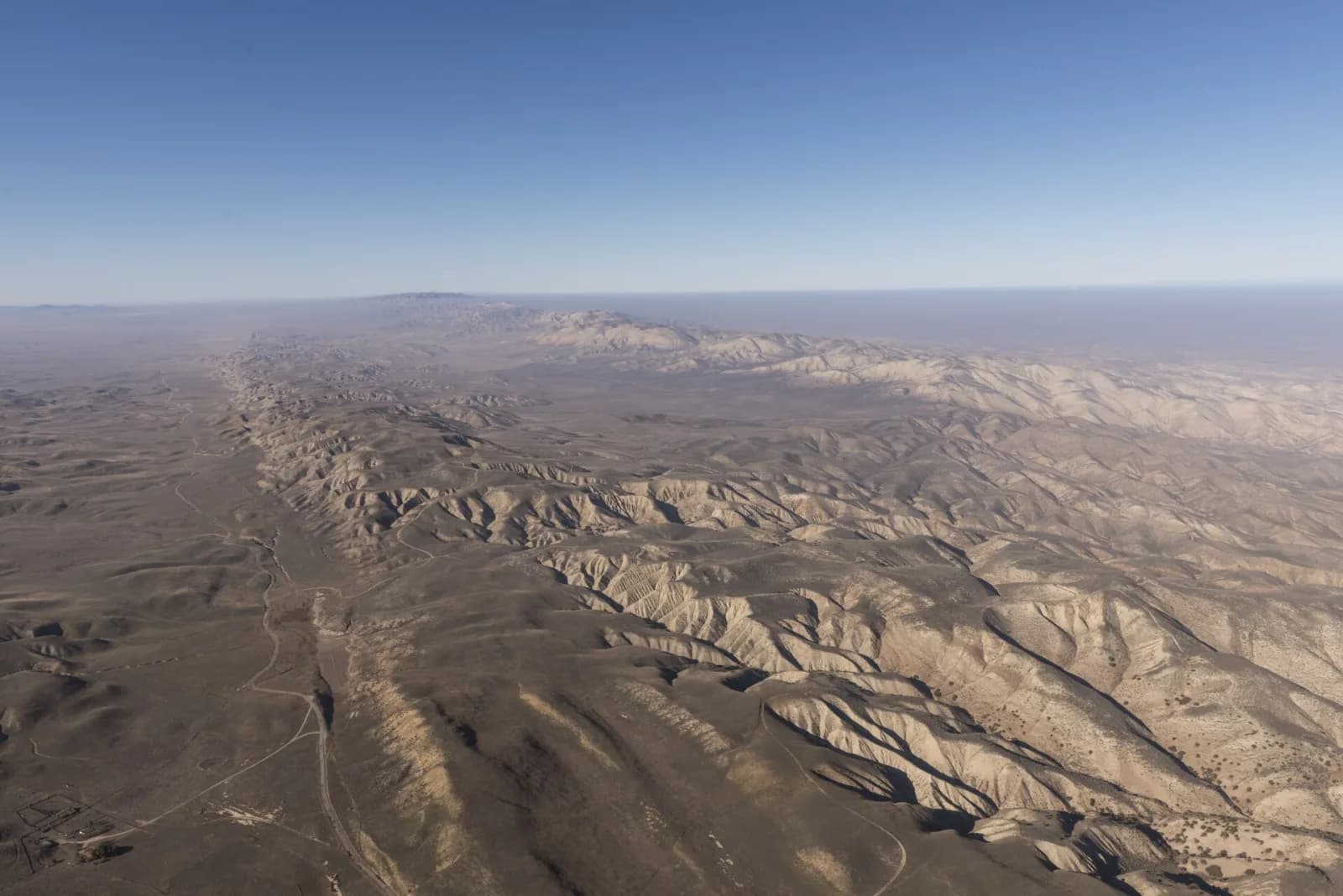
This guide follows one earthquake from start to finish: the slow push that loads a fault, the moment it slips, the waves that race out, and the scales scientists use to say how big it was. It ends with the short list of what official services such as USGS and Ready.gov advise people to do when the ground shakes. It is general information, not a plan for your home; for your own region, follow your local emergency service.
Key ideas
- An earthquake is rock snapping along a fault: plates move 2 to 10 cm a year, the edges lock, stress builds, and the fault slips when the stress beats the rock’s strength.
- Most earthquakes occur where plates meet (spreading zones, transform faults and subduction zones); fewer than 10 per cent occur inside plates.
- P waves arrive first and S waves later; every second between them means roughly 8 km of distance.
- Each whole step of magnitude means about 10 times larger ground motion and about 32 times more energy; the largest recorded was magnitude 9.5 in Chile in 1960.
- Earthquakes cannot be predicted; official advice is to Drop, Cover and Hold On until the shaking stops.
The short answer: rock that bends and then snaps
The Earth’s outer shell is not one piece. It is cracked into plates that ride on hotter, softer rock below and move 2 to 10 centimetres a year, about as fast as fingernails grow. Where two plates touch, friction can hold them for decades while the rock on both sides slowly bends. USGS describes it this way: the crust may first bend and then, when the stress exceeds the strength of the rocks, break and “snap” to a new position.
That break is a fault slipping, and the idea behind it is called elastic rebound, worked out by scientists after the San Francisco earthquake of 1906. Think of bending a plastic ruler: nothing seems to happen, then it snaps and the ruler shakes. The place underground where the slip starts is the focus, and the point on the ground directly above it is the epicentre. As the rock breaks, vibrations called seismic waves spread outward through the Earth.
Faults are grouped by how they move. In a normal fault the rock is pulled apart and the upper block slides down. In a thrust (reverse) fault the rock is squeezed and the upper block rides up. In a strike-slip fault the two blocks slide sideways past each other. Volcanic eruptions and explosions can also shake the ground, but USGS notes that most destructive quakes come from the crust slipping along faults.
Where do earthquakes happen, and why there?
Most earthquakes happen at the edges of plates, and the places where they strike help scientists draw the plate boundaries. USGS names three kinds. At spreading zones such as the Mid-Atlantic Ridge, molten rock rises and pushes plates apart at about 2.5 cm a year; the quakes there are shallow. At transform faults the plates slide past each other, as along the San Andreas Fault in California, which is about 1,300 km long, where the Pacific Plate moves past the North American Plate at about 5 cm a year. At subduction zones one plate dives under another.
Subduction zones produce the deepest and often the strongest quakes. Off South America the Nazca Plate sinks under the continent along the Peru-Chile trench, and USGS lists strong, destructive earthquakes among the results, together with the rise of the Andes. When two continents collide, as India does with Asia, neither one sinks; the crust buckles upward, and that is how the Himalayas grew.
Not every earthquake is on a boundary. USGS says that fewer than 10 per cent occur inside plate interiors, in old zones of weakness. The New Madrid earthquakes of 1811 and 1812 in the central United States and the Charleston earthquake of 1886 both happened inside the North American Plate, far from its edge.
How deep, how fast and how big: waves and magnitude
Earthquakes are sorted by depth. USGS calls those with a focus from the surface down to about 70 km shallow, those between 70 and 300 km intermediate, and the deepest, which can lie more than 700 km down, deep. Even the deepest start in a thin part of a planet whose centre is about 6,370 km away.
A quake sends out two kinds of body waves. P waves push and pull the rock, travel about 6 km/s in the crust and arrive first. S waves shake it from side to side, travel about 3.5 km/s and arrive later. Surface waves come last and usually do the most damage. A seismograph records all of them, and the gap between P and S gives the distance: roughly 8 km for every second. If S arrives 10 seconds after P, the epicentre is about 80 km away; three stations drawing three circles find the spot where they cross.
Magnitude says how big the quake was at its source, and the scale is logarithmic. USGS explains that a magnitude 7 means ground motion 10 times as large as a magnitude 6, and each whole step releases about 32 times more energy (10 to the power 1.5). A magnitude 7 therefore releases about 1,000 times the energy of a magnitude 5. The largest earthquake ever recorded was magnitude 9.5, off southern Chile on 22 May 1960. Intensity is a different measure: the Modified Mercalli scale, from I to XII, describes how strongly shaking was felt and what damage it did at one place.
Can earthquakes be predicted, and what should you do?
No. Scientists know which faults are active and roughly where strong quakes are likely over decades, but nobody can say the exact time, place and size of the next one. Some countries run early warning systems that detect the first P waves and send alerts seconds, and sometimes tens of seconds, before the stronger shaking arrives. Ready.gov suggests signing up for earthquake alerts where they exist.
Official advice is the same everywhere in the United States and is short. Drop to your hands and knees, cover your head and neck with one arm and hand (and crawl under a sturdy table if one is close), and hold on until the shaking stops. If you are inside, stay inside, do not run outside and avoid doorways. In bed, turn face down and cover your head and neck with a pillow. In a car, pull over, stop and set the parking brake. Outside, move to an open area away from buildings, trees, streetlights and power lines.
Most deaths in earthquakes come from collapsing buildings, so the best preparation is done in advance: secure heavy furniture and objects that could fall, keep a family communication plan and a supply kit, and learn what your local authorities recommend. After the shaking stops, expect aftershocks and be ready to Drop, Cover and Hold On again, and watch for damaged buildings, gas and water leaks and downed power lines. Near the coast, strong shaking can also be a warning to move to high ground.
How the VJOURNAL SMART BOOK shows it
The chapter “Earthquakes” in the free SMART BOOK “Everything about everything”, Volume II, on VITON13 SCHOOL tells the same story in five short moments: Wegener’s puzzle of the continents, plates that creep as fast as nails grow, a fault that locks and slips, the magnitude scale, and tsunamis and buildings that bend. Beside the text there is a living 3D picture in which the two sides of a fault jerk past each other and rings of waves spread out.
Below the picture is a sandbox where you can set the gap between S and P waves and read off the distance, or pick a magnitude and compare it with the scale. The chapter ends with three facts and a three-question quiz, and every number comes from the sources listed below.
In everyday language
Bend a plastic ruler slowly. For a while nothing happens except that it gets more tense. Then it snaps, springs back and shakes. A fault is a crack in the Earth that does the same thing: plates keep pushing, the rock keeps bending, and the snap, travelling as waves, is the earthquake.
Try it yourself
Open the chapter “Earthquakes” in the SMART BOOK “Everything about everything”, Volume II, set the gap between S and P waves in the sandbox to 10 seconds and read the distance to the epicentre.
Expected result
About 80 km (roughly 8 km for each second of gap).
Check your answer: A seismograph records the S wave 25 seconds after the P wave. About how far away is the epicentre?
About 200 km: 25 seconds times roughly 8 km per second.
Questions
What causes most earthquakes?
Most are caused by a sudden slip along a fault, where stress built up by the slow motion of tectonic plates becomes stronger than the rock can bear. The rock snaps to a new position and releases the energy as seismic waves.
Can scientists predict earthquakes?
No. They can say where strong earthquakes are likely over decades, but not the exact time, place and size of the next one. Early warning systems can only give seconds to tens of seconds of notice once a quake has started.
Why do some places have so many earthquakes?
They sit on or near plate boundaries, such as the San Andreas Fault in California or the subduction zone along the coast of Chile and Peru. Fewer than 10 per cent of earthquakes occur inside plates.
What is the difference between magnitude and intensity?
Magnitude measures the size of the earthquake at its source, on a logarithmic scale. Intensity, on the Modified Mercalli scale from I to XII, describes how strongly shaking was felt and what damage it caused at a particular place.
What is the difference between the focus and the epicentre?
The focus is the point underground where the rock first slips. The epicentre is the point on the surface directly above it.
What should I do during an earthquake?
Drop to your hands and knees, cover your head and neck, and hold on until the shaking stops. Ready.gov advises that if you are inside you should stay there and avoid doorways, in a car you should pull over and stop, and outside you should move away from buildings, trees and power lines.
Earthquakes are caused by plates that move a few centimetres a year, lock at faults and then slip; each step of magnitude is about 32 times more energy, and the official advice during shaking is Drop, Cover and Hold On. To set the S–P gap yourself and see the distance appear, open the free “Earthquakes” chapter of the VJOURNAL SMART BOOK.
Sources and further reading
- USGS: Earthquakes, how earthquakes happen (General Interest Publication) ↗Sources checked:
- USGS: Earthquakes, where earthquakes occur ↗Sources checked:
- USGS: Earthquakes, measuring earthquakes ↗Sources checked:
- USGS: This Dynamic Earth, understanding plate motions ↗Sources checked:
- Ready.gov: Earthquakes (what to do before, during and after) ↗Sources checked: