
What is a tsunami? Long waves from a sudden push on the ocean, and why they hit the coast
A tsunami is a series of extremely long ocean waves caused by a large and sudden displacement of the sea, most often by a big earthquake under or near the sea floor. In deep water the waves can travel at over 800 km/h (500 mph) yet stand less than a metre high; near the coast they slow to the speed of a car and grow, and the first wave is not always the largest. The name comes from the Japanese for harbour (“tsu”) and wave (“nami”), and tsunamis have nothing to do with tides.
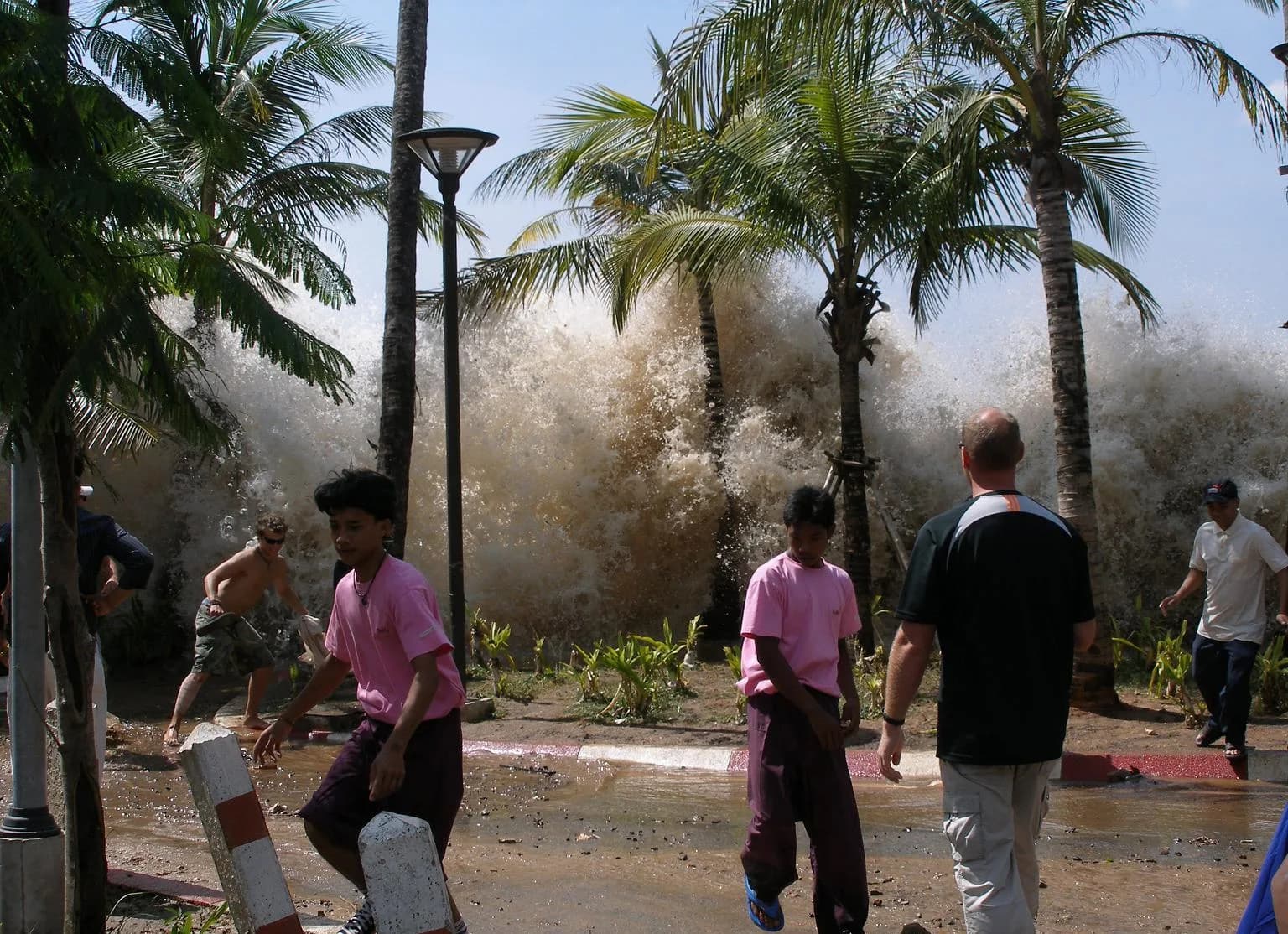
A tsunami looks nothing like a surfing wave, and that is the first thing that surprises people. This guide explains what sets one off, why a wave that no ship notices at sea becomes dangerous on a beach, how fast and how high tsunamis really are, how they are detected, and what official services such as NOAA and Ready.gov say about the natural warning signs. It is general information; for your own coast, follow your local emergency service and its evacuation maps.
Key ideas
- A tsunami is a series of very long waves caused by a large, sudden movement of the ocean; about 88 per cent in NOAA’s database came from earthquakes or earthquake-triggered landslides.
- Speed depends on depth: the square root of gravity times depth gives over 800 km/h in the deep ocean, where the wave is rarely more than 1 m high, and only 30 to 50 km/h near land, where it grows.
- A tsunami is a train of waves that can last hours, with dangerous currents for days; the first wave may not be the largest.
- The deadliest on record, off Sumatra on 26 December 2004 (magnitude 9.1), caused about 230,000 deaths in 15 countries; the 2011 Japan tsunami (also 9.1) killed most of its 18,457 victims.
- Natural warnings are strong or long shaking, a loud roar from the sea, or water suddenly rising or draining away: go to high ground inland at once, without waiting for a siren.
The short answer: a wave train from a sudden push
NOAA defines a tsunami as a series of extremely long waves caused by a large and sudden displacement of the ocean. The most common cause by far is an earthquake under or near the sea floor: when the floor rises or drops, the water above it moves too, and as the water moves up and down to regain its balance, the tsunami radiates out in all directions. Of the events in the Global Historical Tsunami Database, 88 per cent were caused by earthquakes or by landslides that earthquakes set off.
Not every earthquake does it. Most tsunamis come from earthquakes of magnitude over 7.0 that occur under or very near the ocean, usually at subduction zones, where one plate dives under another, and less than 100 km below the surface. An earthquake generally has to exceed magnitude 8.0 to produce a dangerous tsunami on distant shores. About 10 to 15 per cent of damaging tsunamis come from strike-slip earthquakes, where the ground moves sideways, and these usually affect only coasts near the source.
Other things can also push the sea. Underwater or coastal landslides can send waves ashore within minutes. Volcanic activity did it at Krakatoa in 1883, when waves up to 135 feet (about 41 m) killed more than 34,000 people. Fast-moving storm systems can make small “meteotsunamis”, and a large asteroid or comet hitting the ocean could do it too. Calling a tsunami a “tidal wave” is wrong, because tides come from the pull of the Sun and Moon and have nothing to do with it.
How fast and how high is a tsunami?
A tsunami’s speed depends only on the depth of the water, not on how far it has come: speed is the square root of gravity times depth. In 4,000 m of water that is the square root of 9.8 × 4,000, about 200 m/s or 700 km/h; NOAA gives about 475 mph, roughly 765 km/h, for 15,000 feet. In the deep ocean tsunamis can move faster than 800 km/h, like a jet plane, and cross an entire ocean in less than a day. From the Aleutian Islands to Hawaii takes about five hours.
In deep water the wave is barely noticeable: the wavelength, the distance between crests, may be hundreds of kilometres, and the height rarely more than about a metre, so ships at sea do not notice a tsunami passing beneath them. Wind waves have wavelengths of 90 to 180 metres and periods of 5 to 20 seconds; a tsunami has a period of 5 minutes to 2 hours and moves the whole column of water from the surface to the sea floor, not just the surface.
Near land the water gets shallow, the front slows to 30 to 50 km/h, the wavelength shrinks and the height grows. Most tsunamis are less than 3 m high when they strike, but in extreme cases they can exceed 30 m. A big one can flood low-lying land more than 1.6 km inland. On the coast it rarely looks like a towering breaking wave. NOAA says it may look like a fast-rising flood or a wall of water, and sometimes the sea first draws back so far that the sea floor, reefs and fish are exposed, like a very low tide.
Great tsunamis in numbers
On 26 December 2004 a magnitude 9.1 earthquake off northern Sumatra generated the deadliest tsunami in history. Impacts were felt in 15 countries in Southeast and South Asia and East and South Africa, with about 230,000 deaths and 1.7 million people displaced. On the Sumatran coast the waves reached up to 167 feet (about 51 m) and travelled up to 3 miles (about 5 km) inland. NOAA says that the losses were due in part to the lack of an official tsunami warning system in the Indian Ocean at the time. The photograph at the top of this guide shows that tsunami reaching Ao Nang, Thailand.
On 11 March 2011 a magnitude 9.1 earthquake off Honshu, Japan, produced a tsunami that reached 128 feet (about 39 m) high and almost 5 miles (about 8 km) inland. It displaced more than 500,000 people, and most of the 18,457 deaths were due to the tsunami. Outside Japan there was very little loss of life thanks to warnings and evacuations, though there was more than $91 million of damage in the United States and one death.
Where do they happen? Of 754 confirmed events between 1900 and 2015, about 78 per cent were in the Pacific Ocean, around the geologically active Ring of Fire, and about 21 per cent of all tsunamis since 1900 were generated off Japan. Tsunamis that cause damage or deaths near their source occur about twice a year; those that cause damage on distant shores, more than 1,000 km away, about twice a decade. There is no tsunami season: one can happen at any time of year and in any weather.
How tsunamis are detected, and the natural warning signs
NOAA runs two tsunami warning centres staffed around the clock. The first sign of a possible tsunami is usually an earthquake, and seismic waves travel about 100 times faster than tsunamis, so the centres know the location, depth and magnitude of the quake before the water arrives. They then check water-level data, above all from DART systems: a pressure recorder anchored on the ocean floor that senses the passing wave, linked by an acoustic signal to a surface buoy that relays it by satellite. In 2016 the United States had 39 such systems in the Pacific and Atlantic oceans and the Caribbean Sea.
The difficulty is near sources. A local tsunami may reach the coast in less than an hour, and one from a landslide can arrive within minutes, so there may not be time for a detailed official forecast. Ready.gov therefore tells coastal residents to learn the natural signs: an earthquake, a loud roar from the ocean, and unusual ocean behaviour such as a sudden rise or wall of water or sudden draining that exposes the sea floor.
The official advice is short. If an earthquake happens in a tsunami area, protect yourself first: Drop, Cover and Hold On. When the shaking stops, if there are natural signs or an official warning, move at once to high ground as far inland as possible, and do not wait for a siren or an order. Ready.gov suggests shelters at least 100 feet (30 m) above sea level or at least one mile (1.6 km) inland, and notes that evacuation routes are often marked with a wave and an arrow pointing to higher ground. Listen to local authorities and do not go back until they say it is safe, because the waves keep coming, and avoid floodwater, which can hide debris and electrical hazards.
How the VJOURNAL SMART BOOK shows it
The chapter “Earthquakes” in the free SMART BOOK “Everything about everything”, Volume II, on VITON13 SCHOOL ends with the moment “A wave that crosses an ocean”. There you meet the square-root rule from this guide, with the worked example of an ocean 4,000 metres deep, and the official advice to move to high ground at once if the ground shakes strongly near the coast.
The earlier moments of the chapter show what lifts the sea floor: a living 3D picture of two plates and a fault that locks and slips, and a sandbox where you pick a magnitude and compare it with the scale. A three-question quiz and sources you can open close the chapter.
In everyday language
Push down on one end of a bathtub full of water and a long, low swell runs along the tub. A tsunami is the same thing on a planet scale: the sea floor lifts, the whole column of water above it is shoved, and a train of long, low waves sets off in every direction. Out at sea it is gentle; near the shore, where the water is shallow, the same energy is squeezed into a taller, slower wall.
Try it yourself
Open the chapter “Earthquakes” in the SMART BOOK “Everything about everything”, Volume II, read the moment “A wave that crosses an ocean” and work out the tsunami speed for water 4,000 metres deep.
Expected result
The square root of 9.8 × 4,000 is about 200 m/s, roughly 700 km/h, as fast as a passenger jet.
Check your answer: Using the same rule, how fast is a tsunami in water only 10 metres deep, near the shore?
About 10 m/s, around 36 km/h: the square root of 9.8 × 10 is about 9.9, so the wave slows to the speed of a car in town.
Questions
Is a tsunami the same as a tidal wave?
No. Oceanographers discourage the name “tidal wave” because tides have little to do with tsunamis. Tides come from the gravitational pull of the Sun and Moon; a tsunami comes from a large, sudden displacement of the ocean, most often an earthquake.
What causes most tsunamis?
Large earthquakes under or near the sea floor, usually at subduction zones. Of the events in NOAA’s Global Historical Tsunami Database, 88 per cent were generated by earthquakes or earthquake-triggered landslides. Other causes are volcanic activity, landslides, certain weather systems and, very rarely, asteroids.
How fast does a tsunami travel?
In deep water it can move as fast as a jet plane, over 800 km/h, and cross an ocean in less than a day. Near land, in shallow water, it slows to about 30 to 50 km/h. The speed is the square root of gravity times the water depth.
Why does the sea sometimes draw back before a tsunami?
NOAA notes that before the water rushes onto land it sometimes suddenly recedes, exposing the sea floor, reefs and fish like a very low tide. It is one of the natural warning signs, and Ready.gov says to move to high ground at once.
Is the first wave the biggest?
Not necessarily. A tsunami is a train of waves, not one wave, and NOAA says the first wave may not be the last or the largest. Dangerous currents can last for days, so do not go back until officials say it is safe.
Can scientists predict tsunamis?
They cannot predict when and where the next one will strike, just as they cannot predict the earthquakes that cause most of them. But warning centres know which earthquakes are likely to generate tsunamis and can forecast wave heights and arrival times once one is detected.
A tsunami is a train of very long waves set off by a sudden jolt of the ocean, usually an undersea earthquake; it moves at jet speed in deep water, slows and grows near the shore, and the natural warnings are shaking, a roar from the sea, or water that suddenly rises or drains away. To work out the speed for any depth yourself, open the free “Earthquakes” chapter of the VJOURNAL SMART BOOK.
Sources and further reading
- NOAA National Weather Service Tsunami Warning Centers: Tsunami FAQ ↗Sources checked:
- NOAA Ocean Service: What is a tsunami? ↗Sources checked:
- Ready.gov: Tsunamis (before, during and after) ↗Sources checked:
- NOAA National Weather Service: Tsunami safety ↗Sources checked: