
How do volcanoes form? Melted rock, plate edges and hotspots, from mantle to crater
Volcanoes form where rock deep underground melts into magma, which is lighter than the solid rock around it, rises through cracks and erupts at the surface as lava, gas and ash; repeated eruptions pile up into a mountain. Most volcanoes form at the edges of tectonic plates, where one plate sinks under another or two plates pull apart, and a few form over hotspots far from any edge, as in Hawaii. USGS counts about 1,350 potentially active volcanoes on Earth, and about 500 of them have erupted in historical time.
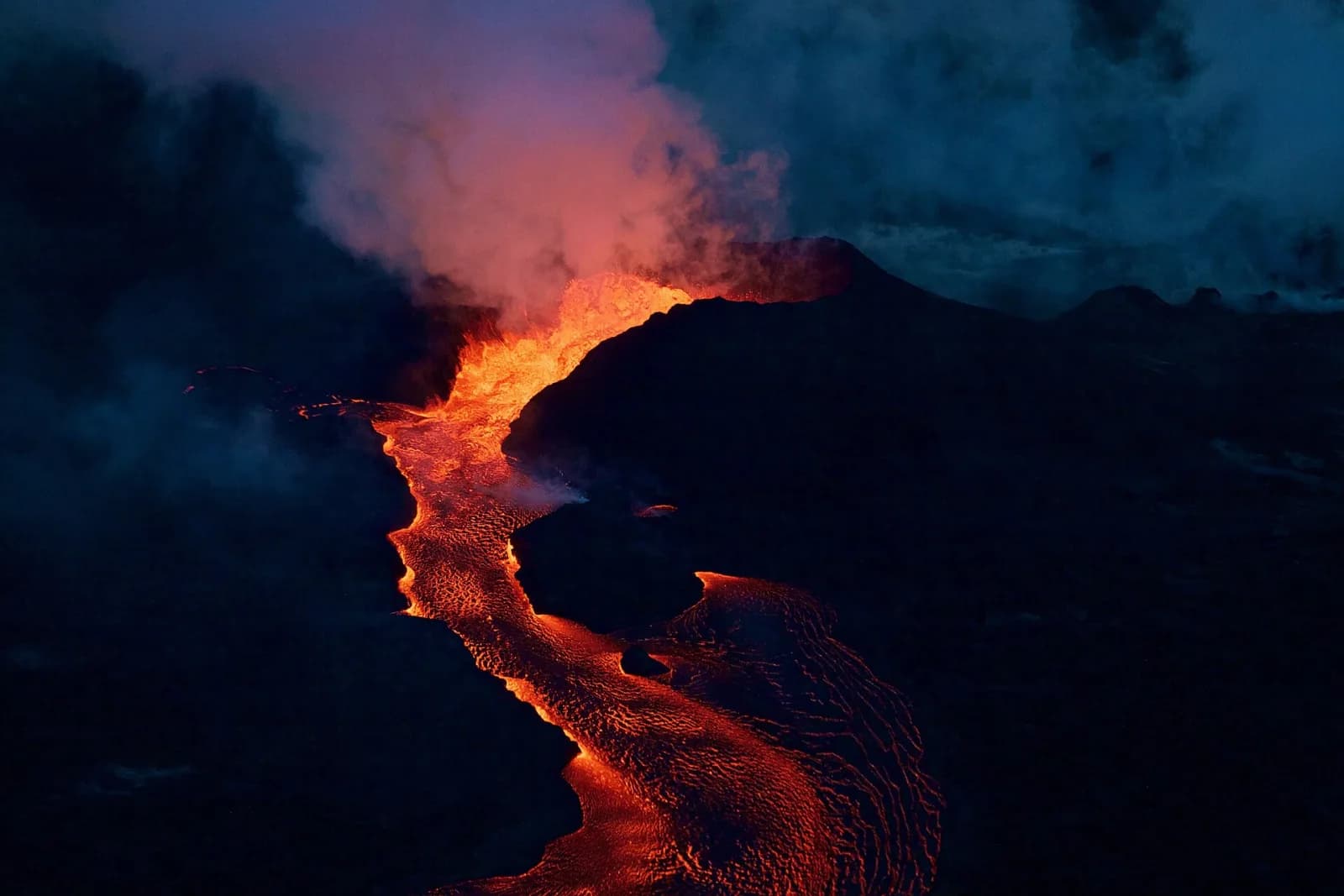
A volcano is not simply a hole that happens to be hot. It is the end of a long journey that starts tens of kilometres down, where a little rock melts. This guide follows that journey in order: how magma is made, where on the planet it finds a way out, why one volcano is a gentle shield and another a steep cone, and how Hawaii’s chain of islands grew over a hot spot. It ends with the official advice for living near an active volcano. It is general information; for your own area, follow your local emergency service and volcano observatory.
Key ideas
- A volcano is an opening in the Earth’s crust where molten rock, gas and debris reach the surface; magma forms when part of the rock melts, and because it is lighter than the rock around it, it rises.
- Volcanoes form in three settings: where one plate sinks under another (subduction zones), where plates pull apart (such as Iceland on the Mid-Atlantic Ridge, spreading about 2.5 cm a year), and over hotspots (Hawaii, more than 3,200 km from the nearest plate boundary).
- USGS counts about 1,350 potentially active volcanoes, about 500 of which have erupted in historical time; many sit around the Pacific Ocean in the Ring of Fire.
- The shape depends on the magma: runny, low-silica basalt (about 50 per cent silica) builds wide shield volcanoes; sticky magma with 65 to 70 per cent silica traps gas and builds steep, explosive cones.
- Official advice for people near a volcano is to follow evacuation orders, to evacuate early, to avoid areas downwind and river valleys downstream, and to shelter from ash.
The short answer: rock that melts, rises and breaks out
Ready.gov describes a volcano as an opening in the Earth’s crust that allows molten rock, gases and debris to escape to the surface. To get there, the rock first has to melt. The Earth’s crust is only about 5 km thick under the oceans and about 30 km on average under the continents, and below it lies the mantle, nearly 2,900 km of hot rock that is mostly solid and flows only very slowly. A volcano begins when a small part of that rock melts into magma, at roughly 700 to 1,300 degrees Celsius.
Magma is lighter than the solid rock around it, so it collects in a chamber and pushes upward through cracks. It carries dissolved gas, mostly water vapour, carbon dioxide and sulphur dioxide. As it rises, the pressure drops and the gas forms bubbles, just as a shaken bottle of fizzy water foams when it is opened. When magma reaches the surface it is called lava. Eruption after eruption, lava and ash pile up around the vent, and that pile is the volcano.
Why does the rock melt at all, when the deep Earth is under such pressure? There are two main reasons that textbooks give. Rock that rises from depth feels less pressure and can start to melt without any extra heat, which is what happens under spreading ridges and hotspots. And water released from a sinking plate lowers the melting temperature of the mantle above it, which is the usual explanation at subduction zones. USGS notes that scientists still debate exactly where the magma at subduction zones comes from, so this part of the story is a good model rather than a closed case.
Where do volcanoes form? Three settings
The first setting is a subduction zone. USGS explains that where an oceanic plate dives under a continent, as the Nazca Plate does under South America, the convergence sustains many of the Earth’s active volcanoes, such as those in the Andes and the Cascade Range in the Pacific Northwest. Where two oceanic plates converge, one is subducted, a deep trench forms, and the erupted lava and debris pile up on the sea floor until a volcano rises above the waves; such volcanoes are typically strung out in curved chains called island arcs, such as the Marianas and the Aleutians.
The second setting is a spreading zone, where plates move apart and magma pushes up from the mantle to create new crust. The Mid-Atlantic Ridge spreads about 2.5 cm a year, and Iceland, which straddles it, is splitting between the North American and Eurasian plates. At Krafla volcano in northeast Iceland, ground cracks widened and rifting between 1975 and 1984 totalled about 7 m, with some episodes accompanied by eruptions. Most of the volcanism along the world’s ridges happens on the ocean floor, out of sight.
The third setting is the hotspot, a long-lived, unusually hot region under a plate. USGS says that the vast majority of earthquakes and eruptions occur near plate boundaries, but there are exceptions: the Hawaiian Islands formed in the middle of the Pacific Ocean, more than 3,200 km from the nearest plate boundary. USGS counts about 1,350 potentially active volcanoes worldwide, not counting the continuous volcanic belts of the ocean floor, and many of them lie around the Pacific in the region called the Ring of Fire.
Why one volcano is flat and another is a steep cone
The shape of a volcano mostly depends on its magma. Basalt magma has about 50 per cent silica and flows like thick syrup, so its gas escapes quietly and the lava runs far; many such flows build a wide, gently sloping shield volcano. Mauna Loa in Hawaii is the textbook example: it rises 4,169 metres above the sea and about 9 to 10 kilometres from the sea floor, and it is the largest active volcano on Earth by volume. Magma with 65 to 70 per cent silica is sticky like cold honey, traps gas until the pressure bursts it, and gives an explosive eruption with ash and ash clouds. Real volcanoes also depend on the shape of the conduit, so this is a simplified model.
USGS groups volcanoes into four main kinds: cinder cones, composite volcanoes, shield volcanoes and lava domes. Composite volcanoes, also called stratovolcanoes, are steep, symmetrical cones built of alternating layers of lava, ash, cinders and blocks, and can rise as much as 8,000 feet (about 2,400 m) above their bases; Mount Fuji, Mount Shasta, Mount Rainier and Mount St. Helens are examples. Cinder cones are the simplest and are built from cinders ejected from a single vent.
A cinder cone was watched from birth. In 1943 a cone started growing on a farm near the village of Parícutin in Mexico. During nine years of activity it built a cone about 1,200 feet (roughly 365 m) high, covered about 100 square miles (260 square kilometres) with ashes and destroyed the town of San Juan. USGS notes that geologists from many parts of the world studied it and learned a great deal about volcanism.
Hawaii, hotspots and what volcanoes build
In 1963 the Canadian geophysicist J. Tuzo Wilson proposed the hotspot idea: a deep, stationary source of heat under the Pacific Plate partly melts rock, and the magma rises to build a volcano on the sea floor, which grows until it becomes an island. Then plate movement carries the island away from the hotspot, volcanism stops, and a new volcano starts over the hotspot. The result is a line of islands that get older and more eroded the farther they are from the hotspot.
The numbers fit. USGS says the oldest volcanic rocks on Kauai, the northwesternmost inhabited Hawaiian island, are about 5.5 million years old and deeply eroded, while on the Big Island, southeasternmost in the chain, the oldest exposed rocks are less than 0.7 million years old and new rock is still being formed. Kauai lies roughly 500 km from the Big Island: dividing 500 km by about 5 million years gives about 10 cm a year, close to the speed of the Pacific Plate (all estimates).
Volcanoes do not only destroy. Iceland and the Hawaiian chain were built by them, and ash and lava break down into soil rich in minerals, which is why people farm on volcano slopes. On the other hand, Ready.gov warns that lava and other debris can flow at up to 100 mph (about 160 km/h) and that ash can travel hundreds of miles and cause severe health problems.
What official advice says about living near a volcano
The advice from Ready.gov is practical. Know your area’s risk and ask local emergency management for evacuation and shelter plans. Sign up for the Volcano Notification Service, a free service that sends notifications about volcanic activity. Prepare supplies for several days, practise a communication and evacuation plan with your family, and have a plan for pets and livestock.
During a volcano warning, listen for emergency information and follow evacuation or shelter orders. If you are advised to evacuate, do so early. Avoid areas downwind and river valleys downstream of the volcano, because rubble and ash are carried by wind and gravity. If you must stay in the ash, take temporary shelter, cover ventilation openings and seal doors and windows, limit your time outdoors, use a well-fitting certified mask such as an N95, and avoid driving in heavy ash.
After an eruption, listen to the authorities to find out when it is safe to go outside or return. Do not climb on your roof to remove ash unless you have guidance or training, because ash makes surfaces slippery and is heavy. Volcano observatories monitor active volcanoes with instruments, but nobody should rely on being able to read the warning signs alone: follow the official services.
How the VJOURNAL SMART BOOK shows it
The chapter “Volcanoes” in the free SMART BOOK “Everything about everything”, Volume II, on VITON13 SCHOOL follows this journey in five short moments: from the Earth’s core up to the crater, magma looking for a way out, runny and sticky magma, Mauna Loa against Mount Fuji, and Krakatoa, Pompeii and the islands and soil that volcanoes build. Beside the text there is a living 3D picture in which the layers of the Earth glow brighter the deeper you go, and a column of glowing rock climbs through the cone.
Under the picture is an eruption sandbox where you raise the silica and the gas content and watch the style change from a calm river of lava to a blast. The chapter ends with three facts and a three-question quiz, and every number comes from the sources listed below.
In everyday language
Shake a bottle of fizzy water and open it: the gas that was held down suddenly escapes and sprays out the liquid. A volcano is the same thing with melted rock. Rock deep down melts a little, the lighter magma floats upward, the pressure on it drops, its gas turns into bubbles, and it breaks out through the top.
Try it yourself
Open the chapter “Volcanoes” in the SMART BOOK “Everything about everything”, Volume II, and in the eruption sandbox first set the silica low and then raise it high, keeping the gas content the same, and note how the eruption changes.
Expected result
With low silica (about 50 per cent) the magma is runny, the gas escapes quietly and you see a calm river of lava; with high silica (65 to 70 per cent) it is sticky, traps the gas and gives an explosive blast.
Check your answer: Kauai is about 5 million years old and lies about 500 km from the Big Island, which sits over the Hawaiian hotspot. How fast did the Pacific Plate move, in cm a year?
About 10 cm a year: 500 km is 50,000,000 cm, and divided by 5,000,000 years it gives 10 cm a year, close to the Pacific Plate’s 7 to 10 cm a year (an estimate).
Questions
How do volcanoes form, in one sentence?
Part of the rock underground melts into magma, which is lighter than the rock around it, rises through cracks and erupts at the surface, and repeated eruptions pile up into a volcano.
Where do most volcanoes form?
Near the edges of tectonic plates: where one plate sinks under another (subduction zones) and where plates pull apart (spreading ridges). Many lie around the Pacific Ocean in the Ring of Fire. A few, such as Hawaii, form over hotspots far from any plate boundary.
How many active volcanoes are there?
USGS counts about 1,350 potentially active volcanoes on Earth, not counting the continuous volcanic belts on the ocean floor, and about 500 of them have erupted in historical time.
What is the difference between magma and lava?
Magma is melted rock underground. When it reaches the surface and flows out, it is called lava.
Why are some eruptions explosive?
Sticky, silica-rich magma (65 to 70 per cent silica) traps its dissolved gas until the pressure bursts it, giving an explosive eruption with ash. Runny basalt magma (about 50 per cent silica) lets the gas escape quietly, so its lava flows far.
How do I get official warnings about volcanic activity?
In the United States, Ready.gov recommends the free Volcano Notification Service, which sends notifications about volcanic activity. Elsewhere, ask your local emergency management or volcano observatory about their alert system, and follow evacuation orders early.
Volcanoes form where rock melts into lighter magma that rises and erupts, mostly at plate edges and over a few hotspots; the stickiness of the magma sets the shape and the violence, and official advice is to follow evacuation orders and leave early. To change the silica and gas yourself and watch the eruption change, open the free “Volcanoes” chapter of the VJOURNAL SMART BOOK.
Sources and further reading
- USGS: This Dynamic Earth, understanding plate motions ↗Sources checked:
- USGS: This Dynamic Earth, hotspots ↗Sources checked:
- USGS: Volcanoes, principal types of volcanoes ↗Sources checked:
- USGS: How many active volcanoes are there on Earth? ↗Sources checked:
- Ready.gov: Volcanoes (before, during and after) ↗Sources checked: