
Morse code alphabet: every letter and number, SOS and how to learn it
The Morse code alphabet writes each letter and number as a pattern of short signals (dots, or dits) and long ones (dashes, or dahs): A is ·−, E is ·, S is ···, O is −−−. A dash lasts three dots; the gap inside a letter is one dot, between letters three and between words seven. SOS is sent as one signal: ···−−−···.
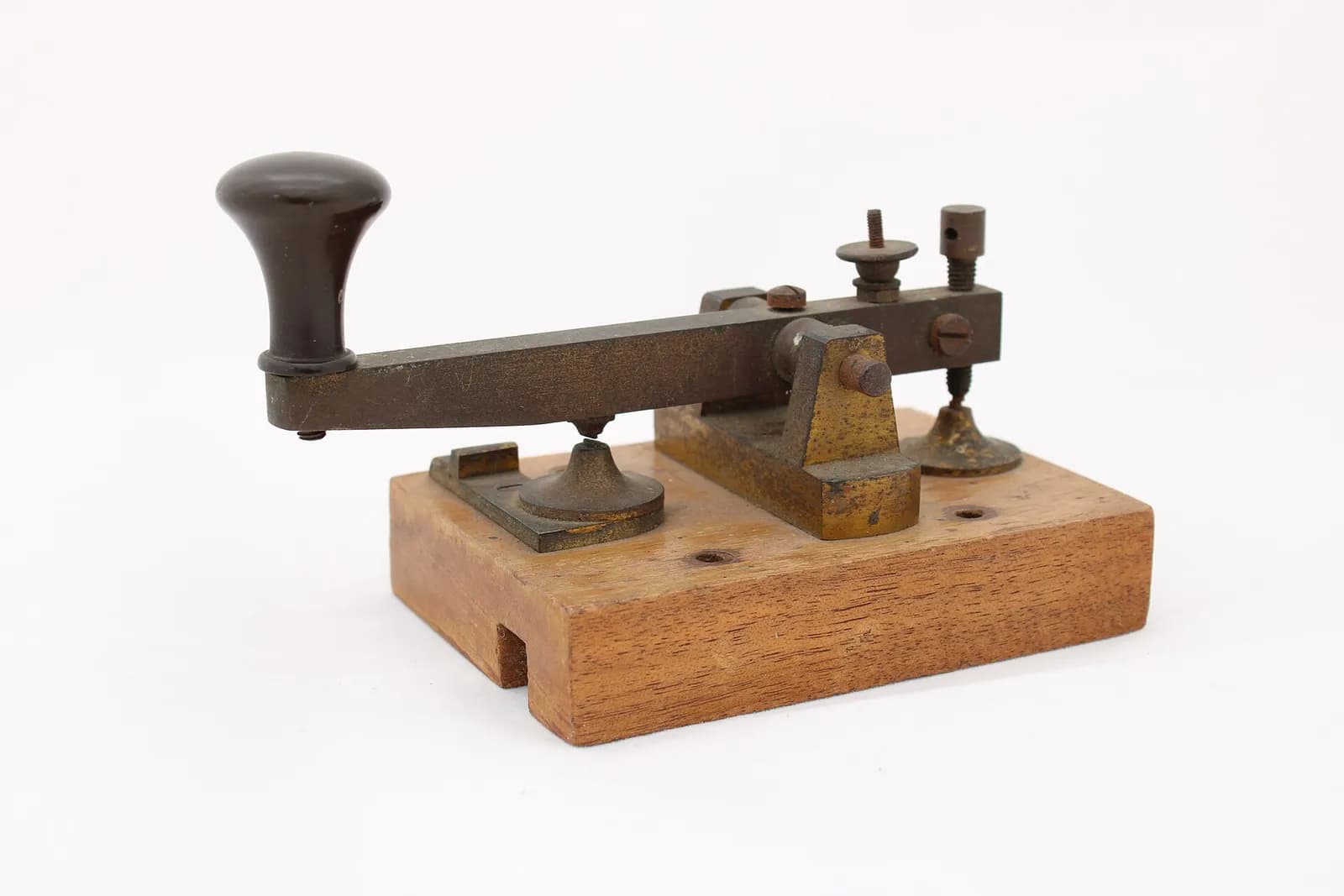
Morse code turns text into two kinds of signal that can travel as sound, light or radio pulses. This guide writes out the complete International Morse code alphabet and the numbers, explains the timing that makes a dot a dot and a dash a dash, shows why SOS is sent as one signal rather than three letters, tells how Samuel Morse and Alfred Vail built the code, and gives the two methods that work for learning it. At the end you can hear any message in a free Morse code translator.
Key ideas
- International Morse code is set out in Recommendation ITU-R M.1677-1: E is the shortest letter (·), and every number has exactly five signals.
- Timing is fixed in units: dot 1, dash 3, gap inside a letter 1, between letters 3, between words 7.
- SOS is one procedural signal, ···−−−···, keyed without the usual gaps between its letters.
- Learn Morse by sound, not by looking at dots: the Koch and Farnsworth methods both keep each character at full speed.
The Morse code alphabet from A to Z
Morse code gives every letter its own short sequence of dots and dashes, and the international version is defined by the International Telecommunication Union in Recommendation ITU-R M.1677-1 (2009). The recommendation notes that versions of Morse code have been in use since 1844, and that the code is still used in some radio services, including amateur radio. The table below follows that standard.
The letters are: A ·−, B −···, C −·−·, D −··, E ·, F ··−·, G −−·, H ····, I ··, J ·−−−, K −·−, L ·−··, M −−, N −·, O −−−, P ·−−·, Q −−·−, R ·−·, S ···, T −, U ··−, V ···−, W ·−−, X −··−, Y −·−−, Z −−··.
A few patterns make the table easier to remember. E (·) and T (−) are single signals; I (··) and M (−−) are two of a kind; S (···) and O (−−−) are three. Several letters are mirror images of each other: A ·− and N −·, D −·· and U ··−, G −−· and W ·−−, B −··· and V ···−, F ··−· and L ·−··, Q −−·− and Y −·−−. No letter has more than four signals. The ITU list also includes one accented letter, é, sent as ··−··.
Morse code numbers 0–9 and the timing rules
Every number in Morse code has exactly five signals: 1 ·−−−−, 2 ··−−−, 3 ···−−, 4 ····−, 5 ·····, 6 −····, 7 −−···, 8 −−−··, 9 −−−−·, 0 −−−−−. From 1 to 5 the dots grow from the left and the dashes give way; from 6 to 0 the dashes grow from the left. If you know that 1 is one dot and four dashes, you can work out the rest.
The timing is part of the code. A dash lasts three dots. Inside a letter, the silence between signals lasts one dot; between letters it lasts three dots, and between words seven. That is how a listener tells I (··) from two separate E’s (· ·). As a worked example, the letters S, O, S with normal gaps take 27 units: S is 5 units, a 3-unit gap, O is 11, another 3-unit gap, and S again 5.
Speed is measured in words per minute, using the word PARIS as the standard word: with the gap after it, PARIS lasts exactly 50 units. So one dot lasts 1,200 divided by the speed in milliseconds: 60 ms at 20 words per minute, which makes a dash 180 ms. Farnsworth spacing, named after Donald R. Farnsworth, keeps the letters at full speed but lengthens the gaps between them, so a learner hears each letter with its real rhythm while getting time to think.
SOS in Morse code and where the code came from
SOS in Morse code is ···−−−···: three dots, three dashes, three dots, sent as one continuous signal. It is a procedural signal, or prosign, keyed without the gaps between characters, and it means that a distress message is starting. Sent that way it takes 23 units instead of the 27 of the three separate letters S, O, S.
The code grew out of the electric telegraph. Around 1837 Samuel Morse worked out an early forerunner, and the engineer Alfred Vail, who worked with him, replaced it with an alphabet-based code. On 24 May 1844 Morse sent “What hath God wrought”, a phrase from the Bible (Numbers 23:23) chosen by Annie Ellsworth, from the Supreme Court chamber in the U.S. Capitol in Washington to the Mount Clare station in Baltimore, opening the line.
Vail’s version became American Morse code, used on land-line telegraphs in the United States. In Europe, Friedrich Gerke revised it in 1848, and his Hamburg alphabet became the basis of International Morse code, standardised by the International Telegraph Convention in Paris in 1865. Some letters differ between the two systems. The international code is the one used today and the one in the ITU recommendation.
How to learn Morse code
The best way to learn Morse code is by ear: learn each letter as a sound, not as a picture of dots and dashes. For radio use there is little point in reading Morse written out, because what you will hear is a rhythm, and counting dots in your head is too slow once the speed rises. Say the letters as sounds, “di-dah” for A and “dah-di-dit” for D, and treat the code like a language you are learning to hear.
Two methods are built on that idea. The Koch method, published by Ludwig Koch in 1936, uses the full target speed from the very first lesson but starts with just two characters; a new character is added only when you copy the current set with 90% accuracy. The Farnsworth method also sends each character at full speed but stretches the spaces between them, then shrinks those spaces as you improve. Both stop you from learning a slow version of each letter that you would have to unlearn later.
The free Morse code translator at VITON13 SCHOOL lets you practise both ways. Type text and it turns into Morse, or paste dots and dashes and read the text. Play the result as sound and watch it as a flashing light, set the speed in words per minute and add Farnsworth spacing to slow the gaps while the letters keep their rhythm. When you are ready, switch to the learning mode and train your ear one character at a time.
In everyday language
Morse code is like a tune with only two notes, a short one and a long one. Each letter is its own little rhythm: A goes “di-dah”, N goes “dah-di”. The gaps are the rests between the notes, and they matter as much as the notes themselves.
Try it yourself
Open the Morse code translator, type your name and SOS, and play both as sound and light at a slow speed with Farnsworth spacing. Then try decoding a word by ear before you look at the text.
Expected result
Your name and SOS in dots and dashes, a tone and a flashing light that follow each signal, and the gaps between letters clearly longer than the gaps inside them.
Check your answer: Decode this word: −− −−− ·−· ··· ·
MORSE. M is −−, O is −−−, R is ·−·, S is ··· and E is ·.
Questions
Is Morse code still used?
Yes. The ITU recommendation notes that it continues to be used in some radio services, including the amateur and amateur-satellite services, and to a diminishing extent in the mobile and fixed services.
How do you show spaces between words in written Morse code?
In sound, a word gap is a silence of seven units. When Morse is written out, letters are usually separated by a space and words by a slash, for example ··· −−− ··· / ··· −−− ···.
Open the free VITON13 SCHOOL Morse code translator, listen to the alphabet at full character speed with Farnsworth spacing, and learn it by sound a few letters at a time until you can hear ···−−−··· as SOS without counting.