
Smallest countries in the world: the top 10 by area, from Vatican City to Malta
Vatican City is the smallest country in the world: 0.44 km² (44 hectares) in the UN Statistics Division’s figures, though some references give 0.49 km². Next come Monaco (2 km²), Nauru (21 km²), Tuvalu (26 km²) and San Marino (61 km²). The ten smallest countries together cover only about 1,327 km².
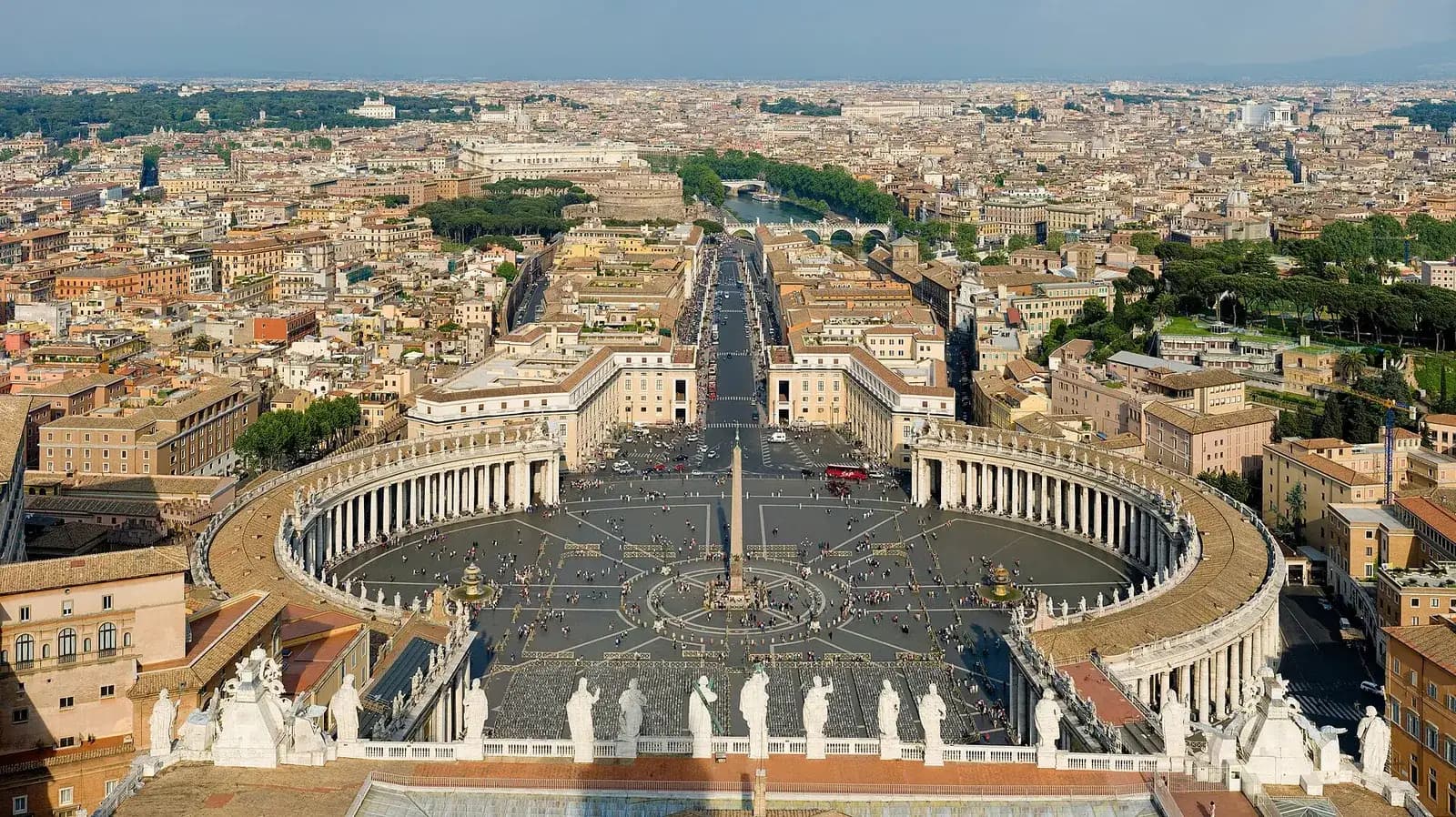
Some countries are smaller than a city park or an airport. This guide lists the ten smallest countries in the world by area from one consistent source, the UN Demographic Yearbook 2024, explains why Vatican City’s area is given as 0.44 or 0.49 km², shows where the smallest states are, sets out why such microstates exist and how they survive next to large neighbours, and ends with how they appear on a world map, where they are too small to draw and are shown as dots.
Key ideas
- The ten smallest countries by area (UN Demographic Yearbook 2024): Vatican City 0.44 km², Monaco 2, Nauru 21, Tuvalu 26, San Marino 61, Liechtenstein 160, Marshall Islands 181, Saint Kitts and Nevis 261, Maldives 300 and Malta 315.
- Vatican City is not a UN member: the Holy See is a non-member observer state, so the smallest UN member state is Monaco.
- Five of the ten are in Europe, three in the Pacific, one in the Caribbean and one in the Indian Ocean.
- There is no agreed definition of a microstate; many of them rely on larger states for defence and other services.
What is the smallest country in the world?
The smallest country in the world is Vatican City. The UN Demographic Yearbook 2024 gives its area as 0.44 km², that is 44 hectares, while some references give 0.49 km²; either way it is smaller than many city parks. The whole state lies inside Rome and holds St Peter’s Basilica, the Apostolic Palace, the Sistine Chapel, the Vatican Library and the Vatican Museums, and its gardens alone cover about 23 hectares, roughly half of the territory.
The state in its present form was created by the Lateran Treaty, signed on 11 February 1929 between the Holy See and the Kingdom of Italy. St Peter’s Square belongs to Vatican City and is separated from Italy only by a white line along the edge of the square. Vatican City is also the least populous country, with fewer than 1,000 residents.
Vatican City is not a member of the United Nations. The Holy See, which holds sovereignty over it, has the status of a non-member observer state, the only other state in that position being the State of Palestine. That is why the smallest UN member state is Monaco, with about 2 km², even though the smallest country is Vatican City.
The 10 smallest countries in the world by area
By surface area in the UN Demographic Yearbook 2024, the ten smallest countries are: 1. Vatican City, 0.44 km²; 2. Monaco, 2 km²; 3. Nauru, 21 km²; 4. Tuvalu, 26 km²; 5. San Marino, 61 km²; 6. Liechtenstein, 160 km²; 7. Marshall Islands, 181 km²; 8. Saint Kitts and Nevis, 261 km²; 9. Maldives, 300 km²; 10. Malta, 315 km². Added together they cover about 1,327 km², and Malta, the largest of them, is more than 700 times the size of Vatican City.
Five of the ten are in Europe: Vatican City, Monaco, San Marino, Liechtenstein and Malta. Three are Pacific island states: Nauru, Tuvalu and the Marshall Islands. Saint Kitts and Nevis is the smallest country in the Americas, and the Maldives the smallest in Asia; Africa’s smallest, the Seychelles, has 457 km² and just misses the list.
The yearbook also lists smaller places that are not countries, such as Pitcairn with 5 km², Gibraltar with 6 km² and Tokelau with 12 km². They are dependent territories of larger states, not sovereign states, so they are not among the 195 countries and not in this ranking.
Why do microstates exist?
Microstates exist because being a sovereign state does not depend on size: a very small territory can still have its own people, its own government and its own relations with other states. There is no agreed definition of how small a microstate is. The commonly accepted examples are the five historic European microstates, Andorra, Liechtenstein, Monaco, San Marino and Vatican City, and small, isolated island states in the Pacific such as Nauru, Palau and Tuvalu; Malta and Luxembourg are sometimes added but are usually thought too populous.
Microstates often rely on other countries, because they have little military capacity and few resources. Research has shown that they do this strategically, trading some privileges with the partners that can best advance their interests. One definition, proposed by the political scientist Dumienski in 2014, calls microstates “modern protected states”: sovereign states that hand some attributes of sovereignty to larger powers in return for protection.
Their histories differ. The European five are known as historic microstates, while Vatican City in its present form dates only from 1929. Most of the small island states became independent from colonial powers, many of them from Britain, and many kept a parliamentary system of the British kind. Studies have also found that microstates are more likely than larger states to be democracies.
How do the smallest countries appear on a world map?
On a world map most microstates are far too small to draw, so the free world map at VITON13 SCHOOL shows them as dots. The map is interactive, drawn from Natural Earth outlines, and covers the 195 countries: the 193 UN members and the 2 observer states, the Holy See among them. Tap a dot and you see the country’s name, its capital and its flag, just as for Russia or Brazil.
First choose Europe in the continent filter and find the European microstates in and around Italy, France and the Alps; then switch to Oceania and look for Nauru, Tuvalu and the Marshall Islands among the Pacific dots. Then play the quiz “find the country on the map” for those continents: the small states are the hardest questions, and your score shows how many you have learned.
Last, print the blank outline map and mark the ten smallest countries by hand with dots and their areas. Then learn their flags in the flags of the world quiz, which uses the same list of 195 states.
In everyday language
A microstate is a country so small you could walk across it in an afternoon, or even in a few minutes. It still has its own government, flag and seat at international meetings. On a world map it would vanish, so the map draws it as a dot you can tap.
Try it yourself
Open the world map, choose Europe in the continent filter and find the five smallest European countries: Vatican City, Monaco, San Marino, Liechtenstein and Malta. Tap each one for its capital and flag, then do the same for Nauru and Tuvalu in Oceania.
Expected result
Seven small countries, most of them shown as dots, each with its name, capital and flag.
Check your answer: Using the UN figures, about how many times larger is Malta (315 km²) than Vatican City (0.44 km²)?
About 716 times: 315 ÷ 0.44 ≈ 716.
Questions
What is the smallest country in Africa?
The Seychelles, an island country in the Indian Ocean, with 457 km² in the UN Demographic Yearbook 2024. It is the only African country smaller than 500 km².
Which country has the fewest people?
Vatican City, with fewer than 1,000 residents. It is both the smallest country by area and the least populous.
The smallest countries in the world are Vatican City, Monaco, Nauru, Tuvalu and San Marino, and the top ten together cover about 1,327 km². Open the free VITON13 SCHOOL world map, tap the dots that stand for the microstates and play the quiz until you can find every one.