
How do neurons work? From an electrical spike to a chemical message
A neuron is a nerve cell that carries messages as brief electrical pulses. At rest its membrane holds a voltage of about −70 millivolts; when a stimulus lifts it to a threshold near −55 millivolts, an all-or-nothing pulse called an action potential runs along the axon and lasts a millisecond or two. At the end of the axon the message crosses a tiny gap, the synapse, as a chemical called a neurotransmitter, which can make the next cell more or less likely to fire.
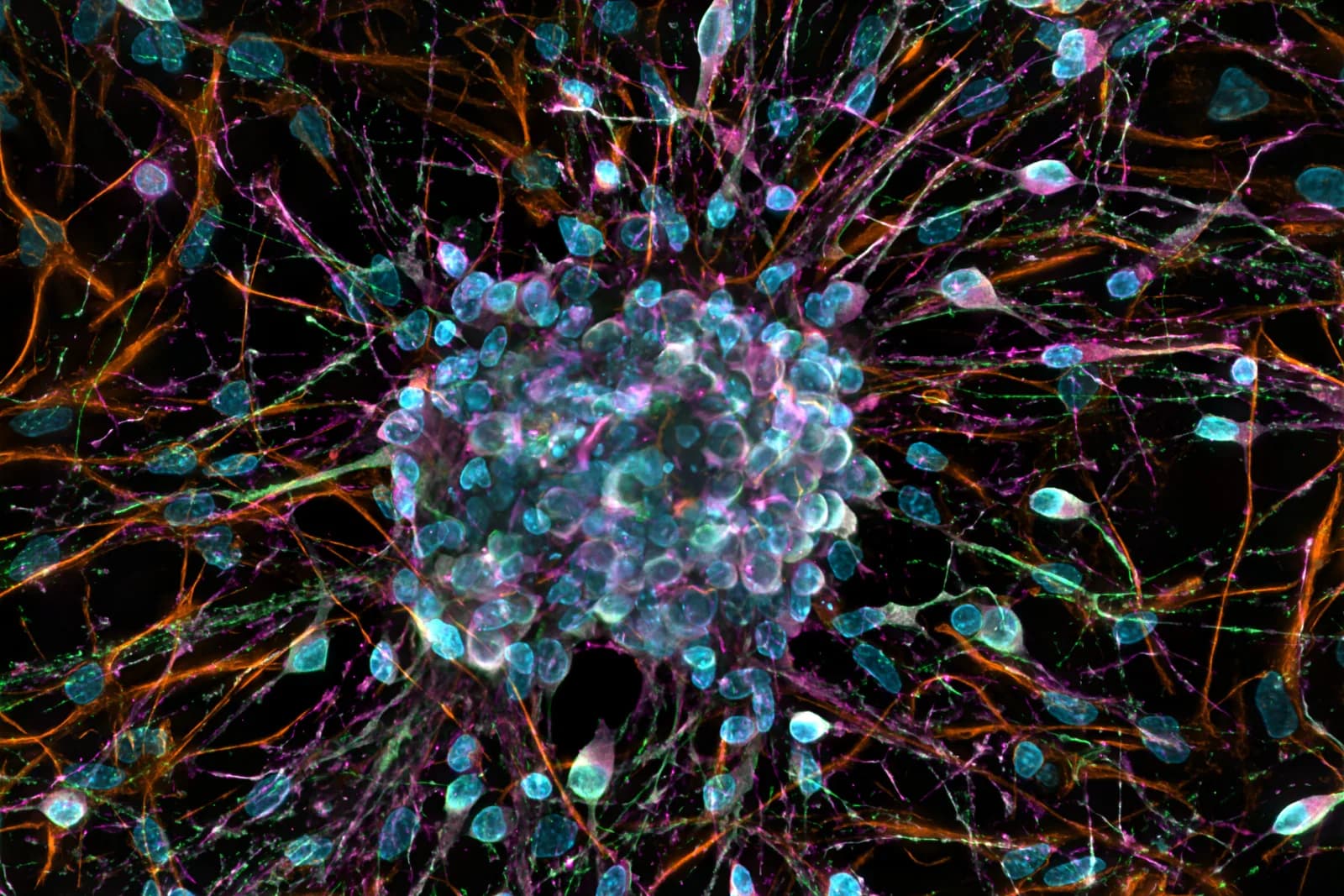
Neurons are the cells behind every thought, movement and sensation, and their trick is to combine two kinds of signal: electricity for speed along the cell and chemistry for the jump to the next one. This guide follows one message from the dendrites to the synapse.
Key ideas
- A neuron has dendrites that receive messages, a cell body that integrates them, an axon that sends the signal and terminals that pass it on.
- At rest the inside of the cell is about 70 millivolts more negative than the outside, written as a resting potential of about −70 mV.
- The action potential is all or nothing: it starts at a threshold near −55 mV, peaks near +30 mV, and a stronger stimulus gives more spikes per second, not a bigger spike.
- Myelin lets the impulse leap from node to node, so the fastest fibres conduct at about 100 to 120 metres per second.
- Between neurons the message crosses a gap about 20 to 40 nanometres wide as a neurotransmitter; the human brain has about 86 billion neurons.
The parts of a neuron
A neuron has a few distinct parts. Branches called dendrites collect messages from other cells. They feed the cell body, or soma, which holds the nucleus and combines everything that arrives. The signal leaves along the axon, a thin fibre that can be about a metre long in the leg. At its far end the axon splits into terminals that pass the message on.
Many axons are wrapped in myelin, a fatty sheath interrupted at small gaps called nodes of Ranvier. A neuron is never alone: a 2009 count by Azevedo and colleagues, summarised by Herculano-Houzel, found about 86 billion neurons and about as many non-neuronal cells in the brain of an adult man.
At rest: a battery in the membrane
At rest a neuron behaves like a charged battery. Its membrane keeps sodium ions mostly outside and potassium ions mostly inside, and a molecular pump, the sodium-potassium pump, works constantly to hold that balance. The result is a voltage across the membrane: the inside is about 70 millivolts more negative than the outside. The exact value varies between cells, and −70 mV is the figure most often used.
A millivolt is a thousandth of a volt, so the cell runs on a tiny voltage. The whole swing of an action potential, from −70 mV to about +30 mV, is about 0.1 volt, against 1.5 volts for an AA battery.
The action potential: all or nothing
A weak stimulus only makes the voltage wobble and fade. But if the stimulus lifts the voltage from −70 mV to the threshold of about −55 mV, voltage-gated sodium channels open, sodium ions rush in and the voltage shoots up to about +30 mV. Then potassium channels open, potassium leaves and the voltage falls back. The whole spike takes roughly 2 milliseconds.
The action potential is all or nothing. Every spike peaks at about the same voltage, so a stronger stimulus does not make a bigger spike; it makes spikes follow one another more quickly. While a spike is in progress another cannot start, an interval called the refractory period.
The spike is not a current flowing down a wire. It is a wave that renews itself along the membrane, each patch of membrane triggering the next.
Why myelin makes the signal faster
Nerve impulses travel at speeds from about 0.5 metres per second in slow, unmyelinated fibres to over 100 metres per second in the fastest myelinated ones. On a bare axon the spike spreads continuously, patch by patch, and that is slow.
Myelin insulates the axon, so the spike jumps from one node of Ranvier to the next. This is called saltatory conduction, from the Latin saltare, to leap. In the fastest myelinated fibres the impulse reaches about 100 to 120 metres per second, which is more than 400 kilometres an hour. Width matters too: a wide axon conducts faster than a narrow one, much as water runs faster in a wide river than in a narrow creek.
Crossing the gap: the synapse, and learning
When the spike reaches an axon terminal it meets a gap, the synapse, about 20 to 40 nanometres wide and thousands of times narrower than a human hair. The electrical pulse cannot jump it. Calcium ions flow in, and tiny bubbles called vesicles release a chemical messenger, a neurotransmitter, into the gap. It drifts across and binds to receptors on the next cell, pushing that cell toward firing or away from it. Glutamate, GABA and dopamine are examples.
The psychologist Donald Hebb suggested in 1949 that connections strengthen when two cells are active together, an idea often summed up as neurons that fire together wire together. It is a simplified slogan, yet it captures why practice helps: repeated use strengthens the pathways involved.
Fire a neuron yourself: the VJOURNAL SMART BOOK chapter
The Biology book of the VJOURNAL SMART BOOK series in VITON13 SCHOOL has a chapter called Neurons and nerve impulses. A living 3D neuron stands beside the text and moves through five moments: its anatomy, the resting voltage near −70 millivolts, the spike that jumps from node to node, the synapse and a network of neurons that wire together.
In the sandbox under the picture you drag a stimulus slider and watch the voltage trace on a voltmeter overlay, then switch myelin off and see the impulse slow down. The chapter ends with a short quiz and the sources behind its facts.
In everyday language
A neuron is like a line of dominoes. Tip the first one hard enough and the whole line falls in the same way, however hard you tipped it. At the end of the line a runner carries the message across a gap to the next line.
Try it yourself
Open the neurons chapter, drag the stimulus slider from weak to strong while you watch the voltage trace, then switch myelin off.
Expected result
A weak push fades without a spike; above the threshold every spike has the same size, and a stronger push only adds spikes per second. Without myelin the impulse travels more slowly.
Check your answer: A neuron rests at −70 mV and its threshold is −55 mV. By how many millivolts must a stimulus raise the voltage to trigger a spike?
By 15 mV, because −55 minus −70 is 15. A smaller change fades away; one that reaches the threshold produces a spike of the usual size.
Questions
What is the difference between a neuron and a nerve?
A neuron is a single nerve cell. A nerve is a bundle of many axons, wrapped together, that carries signals between the brain or spinal cord and the rest of the body.
How many neurons are in the human brain?
About 86 billion, together with roughly as many non-neuronal cells, according to a 2009 count of an adult male brain by Azevedo and colleagues, summarised by Herculano-Houzel. Such counts are estimates and vary between individuals.
How fast do nerve impulses travel?
From about 0.5 metres per second in the slowest fibres to roughly 100 to 120 metres per second in the fastest myelinated ones, which is about 430 kilometres an hour.
Is a nerve signal electricity flowing like in a wire?
Not quite. Charged particles called ions move across the membrane through channels, and the spike renews itself along the axon. It is a self-propagating wave, much slower than a signal in a copper wire.
What is a neurotransmitter?
A chemical messenger released at a synapse. It crosses the gap, binds to receptors on the next cell and can make that cell more or less likely to fire. Acetylcholine, which passes the signal from a motor neuron to a muscle, is one example.
Follow the chain: dendrite, cell body, axon spike, synapse, next cell. Then open the neurons chapter, drag the stimulus slider and switch myelin off to see why each step matters.
Sources and further reading
- OpenStax Anatomy and Physiology 2e: The Action Potential ↗Sources checked:
- OpenStax Anatomy and Physiology 2e: Communication Between Neurons ↗Sources checked:
- Herculano-Houzel, Frontiers in Human Neuroscience, 2009: The human brain in numbers ↗Sources checked:
- Wikipedia: Nerve conduction velocity ↗Sources checked:
- Wikipedia: Chemical synapse ↗Sources checked: