
What is pi? The number 3.14159 explained, from circles to trillions of digits
Pi (π) is the number you get when you divide the distance around any circle by the distance across it: about 3.14159. It is the same for every circle, from a coin to the equator of a planet. Pi is irrational, so its decimals never end or repeat, and 3.14 or 22/7 are only approximations.
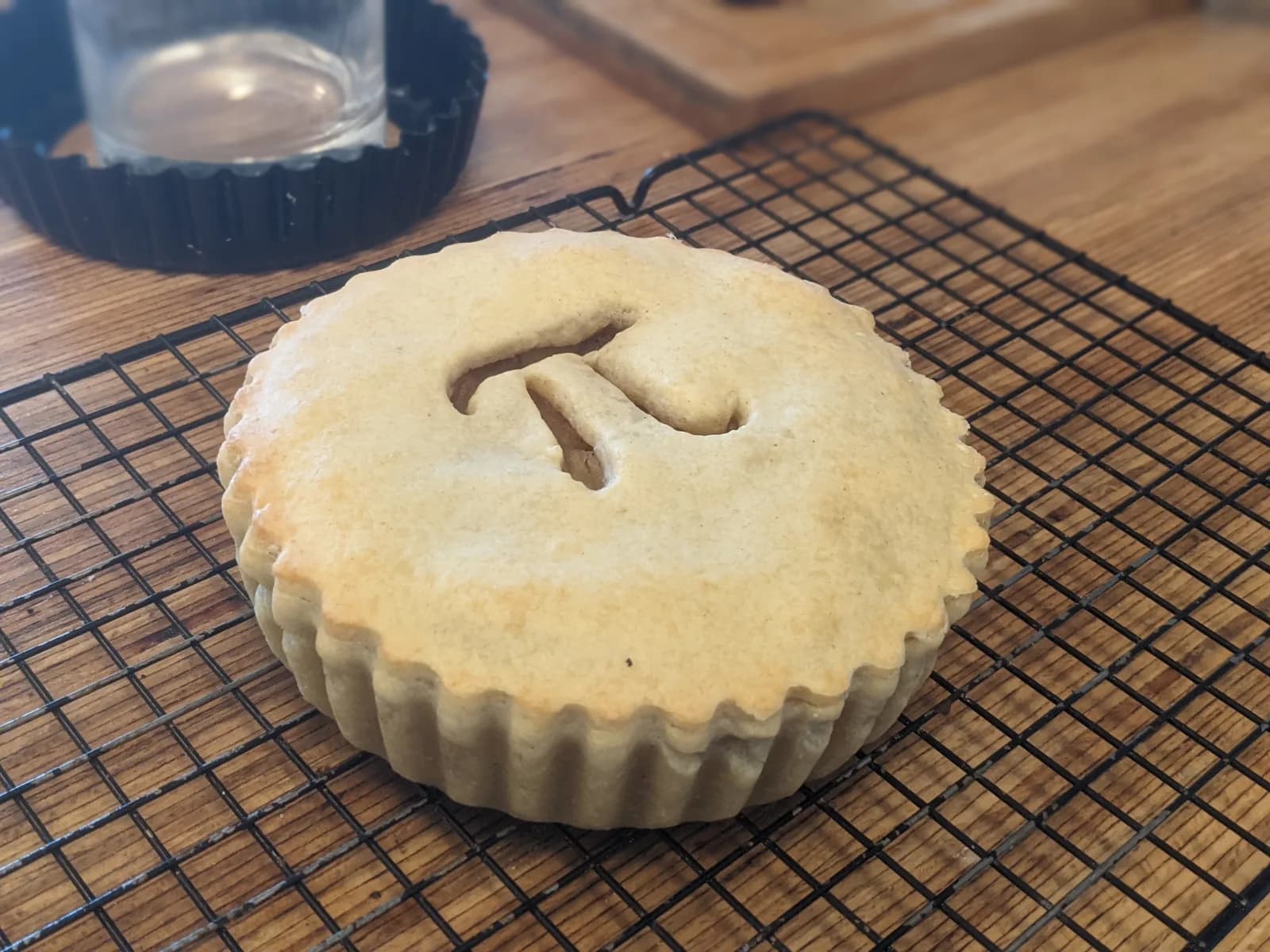
Pi is the most famous number in school maths and one of the most misunderstood: it is not 3.14, it is not 22/7, and it has no last digit. This guide explains what pi is in plain words, how to use it for the circumference and area of a circle, how many digits anyone really needs, why it can never be written as a fraction and how people have chased its digits for more than three and a half thousand years. At the end, a living textbook chapter and a free calculator let you try the numbers yourself.
Key ideas
- Pi is circumference ÷ diameter, about 3.14159 for every circle, which gives C = πd and A = πr².
- Pi is irrational (Lambert, 1761) and transcendental (Lindemann, 1882): its digits never end or repeat, and squaring the circle is impossible.
- 3.14 is off by about 0.05 % and 22/7 by about 0.04 %; NASA’s Jet Propulsion Laboratory uses 15 decimals for interplanetary navigation.
- Archimedes trapped pi between 3 10/71 and 3 1/7 with 96-sided polygons; computers have since produced more than 100 trillion digits.
What is pi, and why does every circle give the same number?
Pi, written π after the Greek letter, is the ratio of a circle’s circumference to its diameter. Measure around the edge of a round table, then straight across it through the centre, and divide the first length by the second. A coin, a plate and a bicycle tyre all give about 3.14, because that ratio is the same for every circle there is.
That one fact gives the two formulas everybody needs. The circumference is C = π × d, or 2πr with the radius, and the area is A = πr². For a circle of radius 3, C = 2π × 3 ≈ 18.85 and A = π × 3² ≈ 28.27 square units. A table 1.2 m across has an edge of 1.2 × π ≈ 3.77 m.
Area grows with the square of the radius, which produces a pizza surprise: one pizza 30 cm across covers π × 15² ≈ 707 cm², while two pizzas 20 cm across cover only 2 × π × 10² ≈ 628 cm². The name comes from the Greek letter π. The Welsh mathematician William Jones was the first to use it for this ratio, in 1706, and Leonhard Euler adopted it in 1737, after which it became standard.
How many digits of pi do you really need?
The value begins 3.14159265358979323846, and the digits go on without end. In school, 3.14 is enough: it is off by about 0.05 %. The fraction 22/7 = 3.142857… is a little high, off by about 0.04 %. A better fraction, 355/113 = 3.1415929…, is correct to six decimals and was found by the Chinese mathematician Zu Chongzhi in the fifth century.
Real engineering needs far fewer digits than people think. NASA’s Jet Propulsion Laboratory uses 3.141592653589793, fifteen decimals, for its highest-accuracy interplanetary navigation. Its engineers point out that with those fifteen decimals, the circumference of a circle 48 billion kilometres across, whose radius is roughly the distance of Voyager 1, would be wrong by less than about one centimetre.
A small test shows how little 3.14 costs. A bicycle wheel 0.7 m across turns ten times: with π you travel 10 × 0.7 × 3.14159 ≈ 21.99 m, and with 3.14 you get 21.98 m. When a calculation has many steps, press the π key on a calculator instead of typing a rounded value, so that rounding errors do not pile up.
Is pi a fraction? Why its digits never end
No. In 1761 the Swiss mathematician Johann Lambert proved that π is irrational, which means that no fraction of whole numbers equals it. A decimal that never ends and never settles into a repeating pattern is exactly what an irrational number looks like. So 22/7 and 355/113 are only close to pi; Archimedes himself knew that π is not 22/7.
In 1882 Ferdinand von Lindemann went further and proved that π is transcendental: it is not the solution of any polynomial equation with whole-number coefficients. This settled a puzzle that was already ancient, squaring the circle, which asks for a square of exactly the same area as a given circle, drawn with only a compass and a straightedge. Because π is transcendental, it cannot be done.
Never ending does not make pi vague: it is one exact number, pinned down by every circle. Whether its digits are “normal”, meaning that every digit and every block of digits turns up equally often, is still an open question. You can never write pi out in full, but you can always compute one more digit.
How people found pi: from 3.125 to trillions of digits
The earliest values came from measuring. The Egyptian Rhind Papyrus, from about 1650 BC, treats the area of a circle in a way that implies π ≈ 3.16, and values such as 25/8 = 3.125 and √10 ≈ 3.162 are traced to very early Egyptian and Mesopotamian sources.
The first calculation that proved something was Archimedes’ around 250 BC. He drew regular polygons just inside and just outside a circle and doubled their sides from 6 up to 96. For a circle of diameter 1, the 96-sided polygons have perimeters of about 3.1410 inside and 3.1427 outside, which traps π between 3 10/71 and 3 1/7, that is, 3.14085 < π < 3.14286.
Then came better formulas and more stamina. In 1706 John Machin used a clever formula to reach 100 digits by hand. In 1873 William Shanks published 707 places after years of work, though only the first 527 were correct. The ENIAC computer produced 2,037 digits in 1949, in about 70 hours, and in 2022 a team led by Emma Haruka Iwao used Google Cloud to pass 100 trillion digits. Nobody needs them for engineering; they are used to test computers and software, and for the challenge.
See pi happen in the VJOURNAL SMART BOOK
The “Pi and the circle” chapter of the VJOURNAL SMART BOOK maths textbook on VITON13 SCHOOL puts a living drawing beside each paragraph. A wheel of diameter 1 rolls out a line of length π: three widths and a little more. Archimedes’ polygons close in on the circle as you slide the number of sides from 3 to 96, and a circle cut into thin wedges lays itself out as a rectangle whose area is πr². Under the picture, a sandbox lets you change the radius and compare the result with the worked examples above.
To check your own arithmetic, open the free scientific calculator: it has a π key and shows the answer as you type. Try 2π × 3 and π × 3², and compare them with 18.85 and 28.27.
In everyday language
Picture a round flower bed. Walk once around it, then measure the straight path across its middle. The walk around is always a little more than three of those paths. That “a little more than three” is pi.
Try it yourself
Take a round object such as a mug or a plate, wrap a string around it, measure the string, measure the width of the object across the middle, and divide the first number by the second.
Expected result
A number close to 3.14; a few per cent either way is normal, because string and rulers are not exact.
Check your answer: A round pond is 8 m across. How long is its edge, and what is its area? Use π ≈ 3.14159.
The edge is C = π × 8 ≈ 25.13 m. The radius is 4 m, so the area is A = π × 4² = 16π ≈ 50.27 m².
Questions
Is pi exactly 22/7?
No. 22/7 ≈ 3.142857 is a little above π ≈ 3.141593, by about 0.04 %. Archimedes showed that 22/7 is only an upper bound for pi, and since 1761 we know that no fraction equals pi exactly.
How many digits of pi are known?
More than 100 trillion decimal digits have been computed; a team using Google Cloud passed that mark in 2022. Practical work needs very few: NASA’s Jet Propulsion Laboratory uses 15 decimals.
Why is it called pi?
Pi is the Greek letter π. The Welsh mathematician William Jones used it for the ratio of circumference to diameter in 1706, and Leonhard Euler adopted the symbol in 1737, after which it became standard.
When is Pi Day?
On 14 March, which is 3/14 in the US date format. Some people also mark Pi Approximation Day on 22 July, because 22/7 ≈ 3.142857.
What is pi used for besides circles?
It appears in formulas for circles, spheres and cylinders, in trigonometry, in waves and all over physics. The period of a pendulum, T = 2π√(L/g), contains pi although it describes a swing rather than a circle.
Next time you meet a circle, divide its circumference by its diameter and watch about 3.14 appear. Then open the pi chapter of the textbook and drag the sandbox sliders to see why.
Sources and further reading
- MacTutor, University of St Andrews: A history of pi ↗Sources checked:
- NASA Jet Propulsion Laboratory: How many decimals of pi do we really need? ↗Sources checked:
- Wolfram MathWorld: Pi ↗Sources checked:
- Wikipedia: Pi ↗Sources checked: