
Multiplication tricks: how to learn the times tables fast
The most useful multiplication tricks are patterns that always hold: a × b = b × a halves the chart, ×5 is half of ×10, ×9 is ×10 minus the number, and ×4 and ×8 are doubling twice and three times. With them and the squares, only ten of the 55 facts in a 10 × 10 chart need learning by heart.
Learning the times tables is mostly a matter of seeing how the chart is built. Once you know which facts come for free, 100 cells shrink to a handful of stubborn ones. Below are the patterns that always hold, an order to learn them in and a way to practise for a few minutes a day, with a free multiplication chart and trainer at the end.
Key ideas
- Order does not matter: 7 × 8 = 8 × 7, so a 10 × 10 chart holds 55 different facts, not 100, and a 12 × 12 chart holds 78.
- ×2, ×5, ×9, ×10 and ×11 have patterns you can work out on the spot; ×4 and ×8 are repeated doubling.
- Learned in a sensible order, the 10 × 10 chart leaves only three facts without a trick: 3 × 6 = 18, 3 × 7 = 21 and 6 × 7 = 42.
- Short practice spread over several days beats one long session: this is the spacing effect, and it suits the times tables well.
Why are there only half as many multiplication facts to learn?
Because a × b always equals b × a, every fact has a twin. This is the commutative property of multiplication: three rows of seven dots, turned a quarter turn, become seven rows of three dots, so 3 × 7 and 7 × 3 are both 21. On a multiplication chart the twins mirror each other across the diagonal that runs down from the top-left corner.
Counting each pair once, a 10 × 10 chart has 55 different facts instead of 100, and a 12 × 12 chart has 78 instead of 144. The cells on the diagonal have no twin. They are the square numbers 1, 4, 9, 16, 25, 36, 49, 64, 81 and 100, where a number is multiplied by itself.
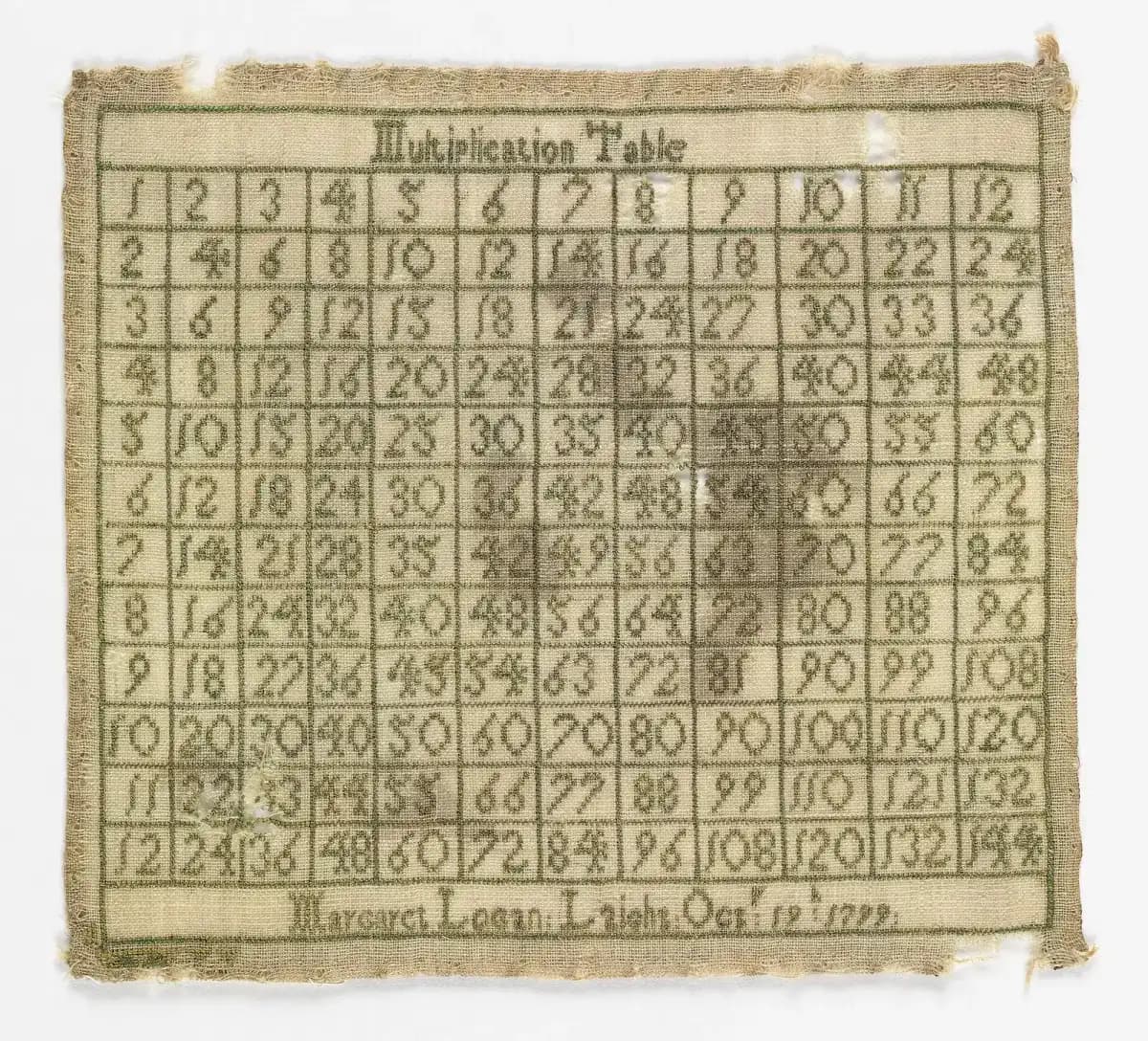
The tables themselves are old. The oldest known multiplication tables were used by the Babylonians about 4,000 years ago and worked in base 60; the oldest known base-10 tables are Chinese bamboo strips from about 305 BC. In 1799 Margaret Logan Laight embroidered a 12 × 12 table in green silk, the sampler in this guide's photo.
What are the best multiplication tricks for each times table?
×2 is doubling: 2 × 8 = 8 + 8 = 16, and every answer is even. ×10 puts a zero at the end of a whole number: 10 × 7 = 70. ×5 is half of ×10: 5 × 8 = 80 ÷ 2 = 40 and 5 × 7 = 70 ÷ 2 = 35, so an answer ends in 0 when the other number is even and in 5 when it is odd.
×9 has two tricks. From 9 × 1 to 9 × 10 the tens digit is one less than the number you multiply by, and the two digits add up to 9: in 9 × 7 = 63, 6 is one less than 7 and 6 + 3 = 9. The finger version: hold up ten fingers, fold down the seventh from the left, and read the six fingers before the fold as tens and the three after it as ones, 63. When in doubt, use 9 × n = 10 × n − n: 9 × 7 = 70 − 7 = 63.
×4 is doubling twice and ×8 is doubling three times: 7 → 14 → 28 → 56, so 8 × 7 = 56. ×11 repeats a single digit: 11 × 6 = 66. For ×3, the digits of every multiple of 3 add up to a multiple of 3, as in 3 × 8 = 24 and 2 + 4 = 6, which makes a quick check. For ×6, an even number gives an answer that ends in the same digit: 6 × 4 = 24, 6 × 8 = 48.
Squares deserve a place of their own. Once you know 7 × 7 = 49, the facts on either side follow, because (n − 1) × (n + 1) is always n² − 1: 6 × 8 = 49 − 1 = 48 and 7 × 9 = 64 − 1 = 63. ×7 has no neat pattern, so split it into 5 + 2: 7 × 6 = 5 × 6 + 2 × 6 = 30 + 12 = 42.
In what order should you learn the times tables?
Start with the facts that come for free and leave the hard ones for last. First learn ×1, ×10 and ×2, then ×5 and ×9 with their patterns. In a 10 × 10 chart these five columns already cover 40 of the 55 different facts.
Next come the squares 3 × 3 = 9, 4 × 4 = 16, 6 × 6 = 36, 7 × 7 = 49 and 8 × 8 = 64, which leaves ten facts. Doubling twice gives four of them: 3 × 4, 4 × 6, 4 × 7 and 4 × 8. Doubling three times gives three more: 3 × 8, 6 × 8 and 7 × 8. Only three facts remain to learn by heart: 3 × 6 = 18, 3 × 7 = 21 and 6 × 7 = 42.
A 12 × 12 chart adds ×11 and ×12. For 11 × 1 to 11 × 9 the digit repeats; beyond that, split 11 into 10 + 1, so 11 × 12 = 120 + 12 = 132. Split 12 into 10 + 2 in the same way: 12 × 7 = 70 + 14 = 84.
How do you practise the times tables every day?
A few minutes on most days works better than one long session. Material studied in several separate sessions is remembered better than the same amount crammed at once; this is the spacing effect, first identified by Hermann Ebbinghaus. For the times tables, that means a short round daily rather than an hour once a week.
Practise by recalling, not by reading the chart. Say or type the answer before you look, then check it. Mix the facts instead of reciting a column in order, because in a recited column each answer gives away the next one. Spend most of the time on the facts you got wrong or answered slowly, and return to the easy ones only now and then.
The free multiplication chart at VITON13 SCHOOL is built for this. In the Chart view, choose 10 × 10, 12 × 12 or 20 × 20, tap a cell to see the fact and its twin, highlight squares, multiples or even and odd numbers, and print a clean A4 chart. In the Column view, pick a number from 1 to 20 to see its whole table with tips, and hide the answers to test yourself. In the Trainer, Practice asks each fact once and brings a wrong one back until it is right, the 60-second sprint counts right answers, and a heat map at the end shows which facts were missed or slow.
In everyday language
Learning the times tables is like learning a city: you don't memorise every street, you learn a few main roads and how the rest connect to them. ×2, ×5, ×9 and ×10 are the main roads; the twins and the doubling tricks take you almost everywhere else.
Try it yourself
Open the multiplication chart, go to the Trainer, choose 6, 7 and 8, and do one Practice round.
Expected result
Your score and accuracy, the time per right answer and a heat map of the facts you got right first time, answered slowly or missed.
Check your answer: Without a chart, work out 8 × 7 by doubling and 9 × 6 with the ×9 pattern.
8 × 7 = 56: double 7 three times, 7 → 14 → 28 → 56. 9 × 6 = 54: the tens digit is one less than 6, so 5, and the digits add up to 9, so the ones digit is 4. Check with 60 − 6 = 54.
Questions
Is it better to learn the times tables in order or mixed up?
Learn each new number on its own first, with its pattern, then practise the facts in a mixed order. A recited column gives each answer away, while mixed questions make you recall every fact separately.
Why does the 9 times table trick work?
Because 9 × n = 10 × n − n. Taking n away from n tens lowers the tens digit by one and leaves 10 − n in the ones place, so the digits add up to (n − 1) + (10 − n) = 9. It holds from 9 × 1 to 9 × 10.
Open the free VITON13 SCHOOL multiplication chart today, learn one number with its tip and do a short Trainer round; repeat it tomorrow and let the heat map tell you which facts to practise next.
Sources and further reading
- Multiplication table — Wikipedia ↗Sources checked:
- Spacing effect — Wikipedia ↗Sources checked:
- Divisibility rule — Wikipedia ↗Sources checked: